Choosing a Parasol for a Windy Garden: A Buying Guide
The best-looking parasol may not be the best choice for an exposed garden. When choosing a parasol for a windy garden, start by assessing the position where you plan to use it. Then compare the canopy, support and design. A sheltered patio and an open terrace place different demands on a parasol, so appearance alone is not a reliable guide.
It’s understandable to worry about a canopy shifting or being damaged, particularly when comparing a centre-pole design with a cantilever model or planning shade over a dining set. No parasol should be treated as storm-proof. Check the product’s construction, support requirements and care instructions before buying.
This guide explains how to assess exposure, compare designs and choose a practical position for shade. It also covers which product details to verify and how to use a parasol thoughtfully as conditions change, so you can plan it around your outdoor furniture.
Key Takeaways
- When choosing a parasol for a windy garden, assess the exposure of its intended position before settling on a design or canopy size.
- Compare centre-pole and cantilever options by the shade, positioning and support each requires. Neither is universally safer.
- Before buying, check the parasol’s construction, whether its base or fixing is included, and whether that support is compatible with the model.
- Follow the manufacturer’s setup, care and wind guidance to decide when to close or store the canopy as conditions change.
- Plan how the parasol will work alongside your garden dining set, but check the specific instructions before assuming it is suitable.
Choosing a parasol for a windy garden starts with understanding your exposure
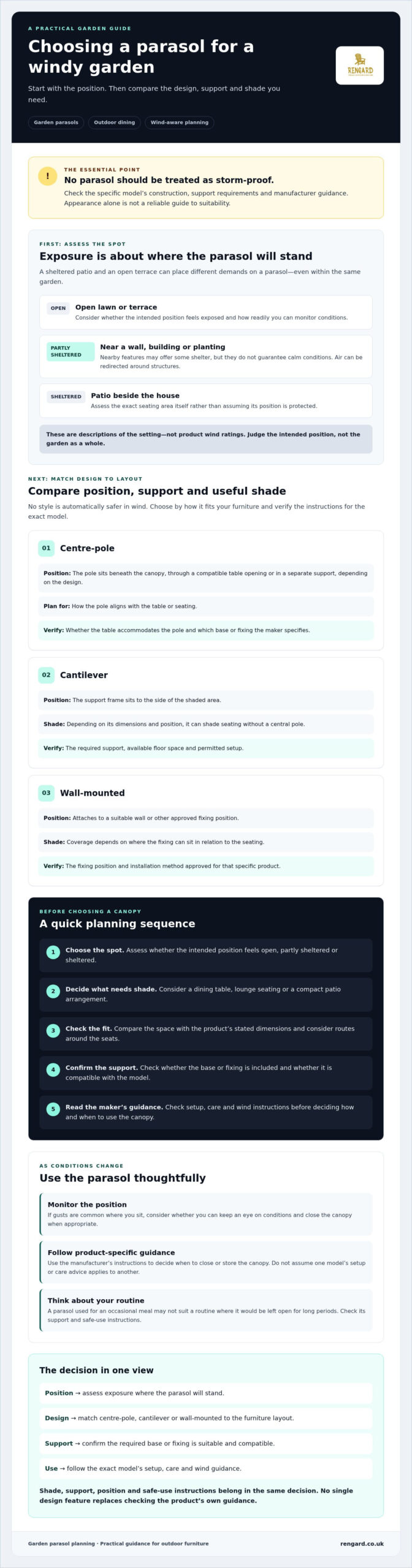
Wind exposure depends on where the parasol will stand, not simply on whether the garden is in the UK. A dining area beside a building may feel quite different from an open lawn, even in the same garden. When choosing a parasol for a windy garden, assess the intended position before comparing appearance, canopy size or style.
Wind exposure describes the conditions around the spot where you plan to use the parasol. It is not a rating of the product. Open, sheltered and partly sheltered positions each raise questions about support, placement and how often you may need to close the canopy. Don’t describe any parasol as windproof unless that claim is supported by verified manufacturer information.
How to assess wind exposure where the parasol will stand
During everyday garden use, notice whether the intended spot feels exposed or sheltered, and whether conditions change around it. Nearby walls, buildings and planting may offer some shelter, but their presence does not guarantee calm conditions. Air can be redirected around structures, so assess the position itself rather than assuming a boundary or hedge will protect the canopy.
Separate the place where you want shade from the garden’s most exposed areas. An open lawn may catch more wind than a seating area near the house, but the right position depends on your layout and the parasol’s instructions. Consider the basic design of a parasol, then think through how its canopy and support would work in your chosen spot.
Match parasol use to the garden’s everyday needs
Decide what you want to shade: a dining table, lounge seating or a compact patio arrangement. This helps you identify where the parasol needs to sit and how much useful shade you need. Sketching the layout or checking the space against the product’s stated dimensions can help you compare designs without letting coverage alone dictate your choice.
Consider your routine as well as the setting. If gusts are common where you plan to sit, ask whether you can monitor conditions and close the canopy when appropriate. A parasol used for an occasional meal may not suit a routine where it would be left open for long periods. Check the specific product’s support and safe-use instructions before deciding whether the position works.
Wind-aware selection: Weigh exposure, support, position and safe-use instructions together. No single feature replaces checking the parasol’s own guidance.
Compare parasol designs by position, support and the shade you need
Once you have identified the intended position, compare parasols by how they fit the furniture and what support they require. A clear span over seats may be convenient, but the pole or fixing still needs a suitable place and must be used as directed. Design alone does not establish wind performance. Check the maker’s guidance for the exact model before deciding whether it suits your garden.
Centre-pole or cantilever parasol: what changes in practice?
A centre-pole parasol places its pole beneath the canopy, often through a compatible table opening or on a separate base. A cantilever design supports the canopy from a frame set to one side, which can leave the area beneath it clear. Compare how each arrangement fits your furniture, available floor space and routes around the seats. Neither design is automatically safer in wind, so verify its support requirements and use instructions.
| Design | Position and support | Shade coverage | What to verify |
|---|---|---|---|
| Centre-pole | Pole sits beneath the canopy, through a table or in a separate support, according to the design. | Consider how the pole aligns with the table or seating. | Check whether the table can accommodate the pole and which base or fixing the maker specifies. |
| Cantilever | Support frame sits to the side of the shaded area. | Can shade seating without a central pole, depending on its dimensions and positioning. | Confirm the required support, available floor space and permitted setup. |
| Wall-mounted | Attaches to a suitable wall or other approved fixing position. | Coverage depends on where the fixing can be placed in relation to the seating. | Check that the fixing position and installation method are approved for that specific product. |
Use this comparison to shortlist options, not to infer a wind rating. For product-specific information, check the details on the linked Garden Parasols page and confirm what is currently listed.
Choose canopy coverage around furniture, not appearance alone
Measure the table or seating area you want shaded, including the space people occupy when seated. For an outdoor dining table, allow for chairs being pulled out and consider where the sun falls when you use the garden. A canopy that looks generous in a photograph may not cover the full arrangement in practice.
Compare your measurements with the product’s stated canopy dimensions and positioning guidance. When choosing a parasol for a windy garden, balance useful coverage with the exact support and placement requirements rather than choosing a larger canopy on appearance alone.
What to check before buying a parasol for a windy garden
A careful product check helps separate useful specifications from broad marketing language. When choosing a parasol for a windy garden, focus on the exact model you are considering: its support requirements, materials and operating guidance. General advice can help you compare options, but it cannot replace the manufacturer’s instructions for that parasol.
Check the parasol, base and fixing as one system
Before buying, confirm what support the manufacturer specifies for the exact parasol and whether it is included. If it is not, check which base or fixing is compatible and whether it can be used in your intended position. A base that looks substantial is not automatically suitable for a particular model.
Check the available space as well. A freestanding support needs room in the layout, while a table-mounted pole or fixed arrangement must match the product’s stated setup. Don’t assume a fixing can be attached to a wall, paving or another surface unless the manufacturer’s guidance confirms the method and suitability.
Don’t rely on a base-weight recommendation or wind threshold unless the manufacturer provides verified guidance for that model. If the details are unclear in the listing, seek the manufacturer’s instructions rather than relying on assumptions or generic rules of thumb.
Read material and care details without assuming wind resistance
Check the individual product listing for the stated materials of the frame, canopy and other components. Material names can help you compare construction, but they do not establish a wind rating or safe operating limit. Look for specific guidance on use in wind, as well as instructions for opening, closing and securing the canopy.
Care and storage matter for practical ownership, particularly in changeable UK weather. Before you buy, find out how the manufacturer says to clean and store the parasol, and whether it should be closed or stored in particular conditions. Don’t infer safe use from a material description or appearance.
- Exact model: Check the product’s own specifications and instructions.
- Support: Confirm the required base or fixing, whether it is included and whether it suits the planned position.
- Wind guidance: Look for manufacturer advice and don’t apply an unverified threshold.
- Materials and care: Verify the listed components and follow the maker’s operating and storage directions.
Check the product details on the Garden Parasols page, and confirm any specifications you need before deciding. Contact Rengard to ask what product-specific information is available.
Position and use your garden parasol thoughtfully when conditions change
A considered position and the correct support help you use a parasol as intended, but they cannot make it safe in every condition. Wind can change during the day, so treat use as an ongoing decision rather than a one-off setup. This is an important part of choosing a parasol for a windy garden: select a position that works for your space, then follow the specific maker’s instructions as conditions shift.
Set up the parasol in a position that suits its support
Before opening the canopy, check that the base or fixing is the one specified for the parasol, correctly positioned and secure as directed. Keep the canopy clear of walls, branches and other obstacles, and leave a clear route around dining or lounge seating. A position that obstructs access can make the space less practical, even if it provides shade.
Open, adjust and secure the parasol exactly as the manufacturer instructs. Don’t improvise a fixing or assume that a support arrangement is suitable because it appears stable. If the setup does not match the product guidance, pause and check before use.
Know when to close, secure or store the parasol
Use the manufacturer’s guidance to judge when conditions are unsuitable. If the wind exceeds the product’s stated limits, or the canopy moves or feels difficult to control, close it and follow the instructions for securing or storing it. Don’t rely on an invented wind-speed rule: guidance can differ between products.
An open parasol left unattended can move and create avoidable risks of damage. Close it when you leave the garden, and follow its care instructions for storage, including when it is not in use for an extended period. Correct support and a sheltered position do not remove the need to respond to changing weather.
- Choose the position: Select a spot that suits the shade you need and the product’s support arrangement.
- Set up as instructed: Check that the support is specified, correctly fitted and secure.
- Monitor conditions: Pay attention to changes in the weather and how the canopy behaves.
- Close or store as directed: Act whenever conditions exceed the instructions or feel unsuitable, and don’t leave the canopy open unattended.
When planning your outdoor furniture, consider the layout of your seating and dining areas alongside the parasol position. If you are reviewing the linked parasol options, contact Rengard to ask what product-specific information is available, then check each model’s support and safe-use instructions before deciding.
Choose a parasol that fits your garden and confirm the details with Rengard
A confident choice comes from matching the parasol to the place and the way you will use it, not from relying on a single feature. Start with the exposure at your intended position, decide which furniture needs shade, then compare designs and check each model’s support requirements and safe-use instructions. If you cannot follow the product guidance as part of your usual routine, reconsider whether leaving a parasol open there is practical.
Use this final checklist before choosing
- Position: Can the parasol provide the shade you need without blocking a path or taking up essential space?
- Design: Does the support arrangement work with your furniture and chosen position?
- Support: Have you confirmed the exact base or fixing requirements, whether the support is included and whether it is compatible?
- Instructions: Do you understand how to open, adjust, secure and care for the specific parasol?
- Routine: Do you have a plan to close or store it when conditions call for it, and to avoid leaving it open unattended?
These checks bring the decision back to the garden itself. A position may offer excellent shade but prove awkward if the required support does not fit, access is restricted or you cannot respond when the weather changes. No checklist can guarantee that a parasol will remain in place in wind. Use the maker’s product-specific guidance to judge whether your planned position and routine are appropriate.
When to ask for product-specific guidance
Before buying, seek clear information about the exact model under consideration. Ask which materials are specified, what base or fixing it requires, whether that support is compatible with your proposed position, and what the operating and storage instructions say. Don’t assume details for one model apply to another, or that material descriptions establish wind performance.
Rengard’s information does not confirm particular parasol specifications or wind performance, so verify those details for the individual product rather than relying on a general claim. If you are choosing a parasol for a windy garden, make your final decision using the manufacturer’s instructions and a realistic plan for changing conditions.
Contact Rengard to discuss your outdoor furniture plans and ask what product-specific information is available before you decide.
Make a considered choice for your garden
Choosing a parasol for a windy garden starts with the conditions at the spot where you will use it. Match the design and shade coverage to your furniture and available space, then check the exact model’s support requirements and manufacturer instructions. A sheltered position or suitable base does not remove the need to close or store the canopy when conditions call for it.
Before buying, confirm the parasol’s construction, base or fixing compatibility, and guidance for operation and care. These product-specific details are more useful than assumptions about materials or wind performance.
Rengard specialises in premium garden furniture for modern British outdoor living. If you are also planning your seating or dining area, explore its garden furniture options and consider how they fit the space around your parasol. Confirm any parasol specifications before deciding. For help with your outdoor furniture plans, contact Rengard.
Frequently Asked Questions
Can a parasol be used in a windy garden?
Yes, a parasol may be used in a windy garden when its instructions allow it and the position and support suit the specific model. No parasol should be assumed to be windproof. Check the manufacturer’s guidance for use in wind, and be prepared to close the canopy when conditions change or feel unsuitable. If the product’s limits or support requirements aren’t clear, seek confirmation before using it.
How do I stop a garden parasol moving in the wind?
Use only the base or fixing specified for your parasol, and set it up exactly as the manufacturer instructs. Check that the support is compatible and secure before opening the canopy. A heavy-looking base isn’t necessarily suitable, and no generic base-weight recommendation can replace product guidance. If the parasol moves or becomes difficult to control, close it rather than trying to hold it steady in gusts.
Is a cantilever parasol suitable for a windy garden?
It depends on the particular model, its support requirements and where you plan to position it. A cantilever parasol places its supporting frame to the side of the shaded area, which can suit some furniture layouts, but this alone doesn’t establish how it performs in wind. Check the manufacturer’s wind guidance and specified support. Don’t assume a cantilever design is safer or more suitable than a centre-pole parasol.
What base do I need for a parasol in a windy garden?
Choose the base specified by the manufacturer for the exact parasol, and confirm whether it’s included or needs to be purchased separately. Requirements can vary by model and support arrangement, so a general weight figure may not be appropriate. Check that the base is compatible and that your chosen position can accommodate it safely. If details are missing, ask the manufacturer before buying or using the parasol.
Should I close a garden parasol when it gets windy?
Yes, close the parasol if conditions exceed the manufacturer’s instructions or seem unsuitable for safe use. Follow the model’s specific guidance rather than relying on a universal wind-speed rule. If the canopy shifts, strains or becomes difficult to control, close it as soon as it’s safe to do so. Correct positioning and support don’t make a parasol suitable for every change in the weather.
Which parasol shape is best for a windy garden?
No shape can be named as best for every windy garden. Start by checking wind guidance for the particular model, then consider how its canopy fits the intended position and what support it requires. Canopy shape or appearance alone doesn’t confirm wind performance. Compare the stated dimensions with your table or seating area, and make sure the required base or fixing works with your chosen layout.
Can I leave a parasol open outside all day?
Only if the manufacturer’s instructions permit use in the prevailing conditions, and you can monitor the weather. Leaving an open parasol unattended can increase the risk of movement or damage if conditions change. Close it when you leave the garden or whenever the guidance calls for it, and follow the maker’s directions for securing or storing it. Don’t assume a sheltered position removes the need for care.