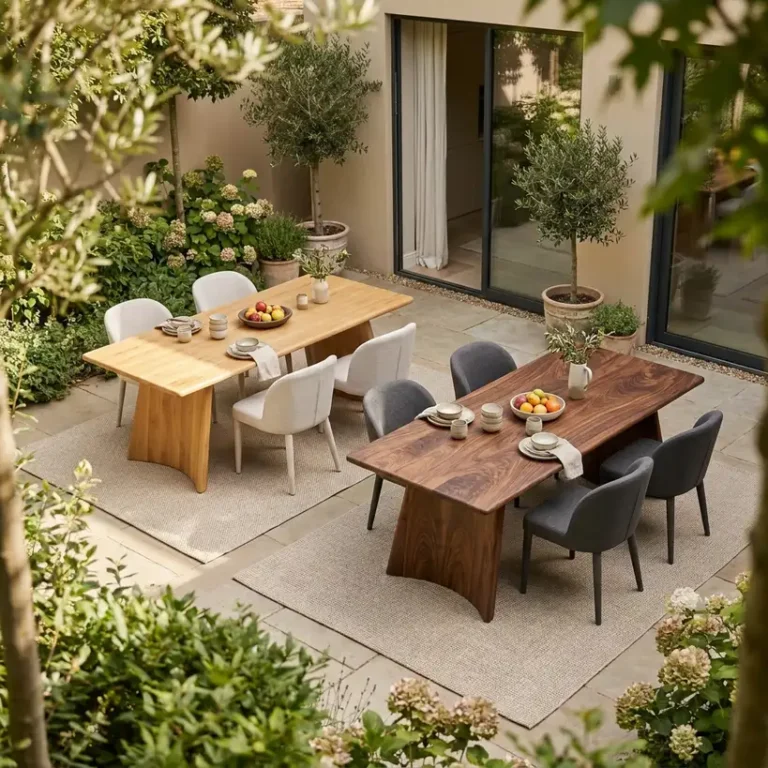
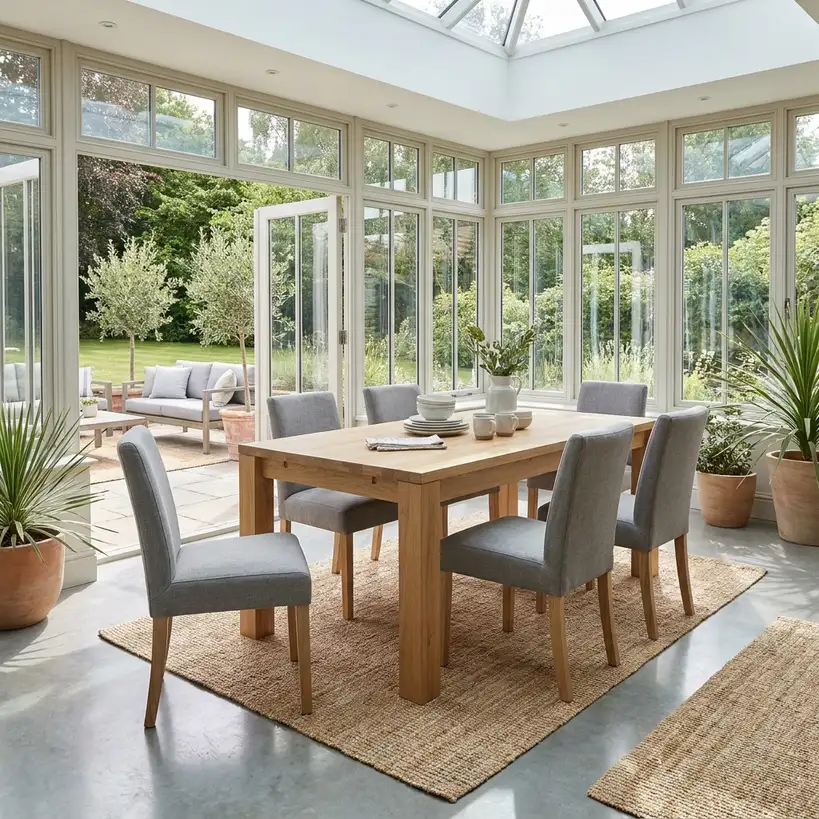
Dining Table Sizes Explained: A Complete UK Buying Guide
Picking the right dining table sizes UK homes can comfortably use seems simple enough until you actually start measuring. A table can look just right online, but if it’s too long, too wide, or just too tight for the room, it quickly becomes awkward to use every day. Chairs end up scraping the walls, which gets annoying fast. Walkways shrink. Serving dishes feel boxed in. And a table said to seat six might only manage that in theory, not in real comfort.
That’s why a dependable dining table size guide UK buyers can rely on should start with real-life use, not just product labels. The best dining table size UK homes need usually comes down to a few things working together: the table dimensions, how comfortably people can sit, the room layout, and how the space is used day to day. Whether it’s a kitchen-diner in Manchester, an open-plan home in Cheshire, a period dining room in Shropshire, or a compact family area in Birmingham or North Wales, the same point holds because each often has its own layout challenges.
This guide explains the practical dining table dimensions UK shoppers should know before buying. It covers standard widths and heights, dining table seating capacity UK guidelines, room clearance rules, and shape-by-shape advice, along with an easy planning method for answering the question, ‘what size dining table do I need?’ It also looks at how modern dining tables UK buyers like fit into busy homes, especially rooms that also serve as work areas, homework spots, and places for dinner guests or family get-togethers. In most cases, what helps most is clear, useful information, and that may be exactly what this guide offers.
The core measurements that matter most for dining table sizes UK buyers
When people search for dining table sizes UK guidance, they’re usually hoping for one simple answer. But from the outset, there are really four measurements to look at: length, width, height, and the space around the table, the one people often miss.
When planning dining table seating capacity UK, a good rule is to allow about 60cm of width per person. In most cases, that gives each diner enough space to eat without bumping elbows, usually the first problem people notice. Amanda Huber, Creative Director at The Dining Chair Company, explains this clearly in The English Home.
The general rule is to allow around 60cm of table width per person, this allows each diner to eat comfortably and enough elbow room to not feel cramped.
Across the table, around 90cm is generally a very practical width. 85cm is often used as the minimum for everyday dining, while still leaving enough space for serving dishes (The English Home). Standard dining table height is usually about 76cm (Martelo & Mo), and that tends to work well with most dining chairs.
One measurement is forgotten surprisingly often: circulation space. It may not be the first thing buyers think about, but it usually makes a real difference in daily use. A common guideline is to leave at least 90cm clearance between the table edge and the wall or nearby furniture (Nicholas John Interiors). That leaves enough room for people to sit down, stand up, pull chairs out, and walk through the room without it feeling cramped.
How to work out what size dining table you need in UK homes
Step 1: Measure the room for dining table sizes UK planning
Measure the dining area from end to end and side to side, in centimetres. Don’t leave out skirting boards, radiators, door swings, or fixed features such as islands and sideboards, include them all.
Step 2: Protect the clearance zone for dining table sizes UK layouts
Subtract about 90cm from each side where people need to move, since that is the walking area. In practice, this usually means taking roughly 180cm off the room’s length and width to estimate a safe maximum table footprint.
Step 3: Match the table to real seating needs
Think about daily life first, not Christmas dinner. If you usually seat two to four people, a big eight-seater can make the room feel heavy and crowded.
Step 4: Check chair space, not just tabletop space
Dining table measurements that UK buyers often compare can easily miss chair width. Chairs with arms, thick upholstery, curved backs, or extra bulk usually need more room around the table.
Step 5: Test with masking tape before buying dining table sizes UK homes can use
Tape out the table’s planned size on the floor, then walk around it, pull out a chair, and open the doors.
Standard dining table sizes UK buyers use by seating capacity
Rectangular dining table sizes UK buyers choose most often
- 4 seats: around 120, 140cm long
- 6 seats: usually about 180, 200cm long
- 8 seats: around 240, 260cm long
Round dining tables
- 120cm round: seats 4 comfortably
- 120cm round: seats 4 to 6, depending on chair size
- 150cm round: seats 6 with a more generous layout
Oval dining tables
- 110cm x 190cm: 6 to 8 people
- 120cm x 220cm: 8 people
- 120cm x 250cm: 8 to 10 people
Room layout rules that make dining table sizes UK homes feel comfortable
A dining table might look right on paper and still feel off when it’s actually in the room. More often than not, that’s down to the layout, not the tabletop itself.
Choosing the best dining table sizes UK rooms and routines need
Rectangular tables
For longer rooms, these are often the easiest choice.
Round tables
A round table often makes conversation easier because everyone faces inward.
Oval tables
Oval tables work well in softer interiors.
Square tables
A square table often suits four people in a compact room.
Modern dining table sizes UK homes use now
A dining table often ends up doing more than just mealtimes. In many UK homes, it doubles as a desk, somewhere for homework, a surface for crafts, and the place people tend to gather when hosting.
When extendable dining table sizes UK buyers need make more sense than a fixed one
Sometimes, the answer to “what size dining table do I need” isn’t one fixed size.
Common dining table sizes UK mistakes that lead to buyer regret
Buying for maximum seats, not normal life
An eight-seater can seem sensible. But if it takes over the living room every day, it usually cuts comfort instead of adding it.
Ignoring chair bulk
A slim, armless chair and a padded carver chair take up very different amounts of space.
Focusing only on room size
Room measurements matter. But walkway routes often matter just as much.
Choosing a table that’s too narrow
A narrow top can make meals feel cramped and frustrating.
The depth of the table should ideally be around 90cm wide (or 85cm minimum) so that there is plenty of space for plates, serving dishes and decor that you might wish to dress down the middle.
Skipping the floor test
Masking tape on the floor is simple and very useful.
Quick benchmarks for faster dining table sizes UK buying decisions
- Per person: allow about 60cm width
- Table depth: aim for 90cm, with 85cm minimum
- Table height: around 76cm
- Clearance around table: about 90cm
- Rectangular 4-seater: about 120, 140cm long
- Rectangular 6-seater: about 180, 200cm long
- Rectangular 8-seater: about 240, 260cm long
- Round 4-seater: around 120cm diameter
Dining table sizes UK frequently asked questions
What size dining table seats 6 comfortably?
If you’re looking at a rectangular six-seater, 180cm x 90cm is usually a good place to start.
How much space should I leave around a dining table?
Leave at least 90cm from the edge of the table to any wall or nearby furniture.
Is a round or rectangular dining table better for a small UK room?
A lot comes down to the shape of the room.
What is the standard height for a dining table in the UK?
Most dining tables are about 76cm high.
Are extendable tables a good choice for modern homes?
That’s especially true when you need fewer seats day to day than you do when guests come over.
Where can I compare modern dining tables UK buyers like for style and practicality?
Check the size, seat width, depth, and the clearance you need before you look only at the finish.
The right dining table sizes UK buyers choose start with the room
Most UK homes don’t need the dining table with the biggest seat count or the nicest photo. What usually works best is a table that fits the room properly, suits daily life, and still feels comfortable when every chair is being used.