Best Armchairs for Bay Windows in British Homes
Bay windows can be one of the best features in a British home. They bring in light, give a room more shape, and create a natural place to pause, which is often why people take to them so quickly. Even so, they are not always easy to furnish well. A bay is rarely a simple rectangle. It might be shallow, angled, tall, or placed awkwardly near a radiator. Because of that, choosing the right armchairs for bay windows usually needs more thought than just picking a chair that looks good online.
For many homeowners, the goal is not simply to fill the space. They want it to feel both useful and attractive. That could mean a reading corner, a calm place for morning coffee, a quiet seat by the window that makes the most of the daylight, or simply somewhere easy to sink into at the end of the day. A modest comfort, really. In period homes across Shropshire, Staffordshire, Cheshire, Manchester, North Wales and Birmingham, bay windows often work well with a softer, more thoughtful approach, especially when the room already has some character. The same often applies in newer homes too, where a bay can stop a room from feeling flat or too boxy.
This guide looks at what actually works in everyday use. It covers shape, scale, comfort, circulation, light, fabric feel, and the styling choices that matter in daily life. In most cases, the helpful details are practical ones. Readers will find guidance on choosing bay window armchairs UK buyers can live with every day, ways to avoid common mistakes, and ideas for bay window seating ideas UK homes can adapt to different layouts. And for anyone looking for a reading nook armchair UK shoppers would enjoy using daily, or an accent chair for bay window areas that feels balanced rather than forced, this guide is here to help with exactly that.
Why armchairs for bay windows need a different kind of approach
A bay window is more than just another corner of the room. It is a shaped area with its own limits, and those usually become obvious quite quickly. Many bays have shallow depth, angled walls, and strong daylight. That is why bulky seating often feels too heavy here and can end up blocking the window area the room is supposed to make the most of.
In this setting, scale usually matters even more than it does elsewhere in the living room. That is especially true in bay windows, where the layout is often less forgiving. Designer Steph Hill put it simply:
The scale of the armchairs is always important in our schemes
That point becomes even more relevant in a bay. A chair that looks perfectly fine against a flat wall can seem oversized once it is placed between angled glazing and skirting lines. Instead of sitting neatly in the space, it may look cramped between the window panels and the lower wall trim, which is often where the eye goes first. In this kind of layout, compact armchairs UK buyers often overlook are usually the more effective choice.
There is also a practical reason to be selective. The UK furniture market is large and active, with household spending on furniture reaching £20.15 billion in 2025 and spending on furniture, carpets and floor coverings reaching £25.5 billion in 2025 according to FIRA’s statistical digest drawing on ONS data (FIRA). Imports of seats and seat components were more than £3.2 billion in 2025. That gives a fairly clear sense of just how many seating options exist across the wider market (FIRA).
Why proportions matter
The difficulty, though, is not a shortage of choice. What tends to be harder is narrowing that choice to chairs that suit natural light, room flow, and the awkward geometry that bay window furniture in UK homes often creates. That is where many people get stuck. It is not easy.
Start with the shape before choosing armchairs for bay windows
Many people start with colour or fabric, which makes sense, but it’s usually more useful to begin with the actual shape of the bay. Stand back first and look at the floor area, the line of the glazing, the sill height, and the places where people tend to walk past. That often gives a clearer, more realistic idea of what will actually fit.
Common setups usually fall into a few groups:
Shallow bay armchairs for bay windows
A shallow bay usually works best with a compact accent chair that has a small footprint. Slim arms, a neat back, and especially raised legs help it feel lighter. Deep recliner-style seating, by contrast, will likely feel cramped here.
Angled bay layouts
This is common in period properties. In this type of bay, gently curved or rounded chairs often work well and usually look more natural. They echo the bay’s shape and help soften the joins between wall planes, so the corner feels less sharp. That detail also reflects the wider move toward softer silhouettes noted in recent trend coverage from design publications such as X Showhome and Homes & Gardens.
Wide bay layouts
A wider bay gives you more freedom, which is usually helpful in practice. You might choose one larger armchair and a side table, which often works especially well. Another option is a pair of smaller chairs, as long as movement still feels easy and the area stays comfortable to walk through. That flexibility can be a real plus in this setting.
When choosing between motion seating and static seating, a fixed model is often easier to place in a bay because the footprint is more predictable, so planning is usually simpler. That usually makes layout decisions easier. We covered that choice here: swivel vs fixed armchairs UK.
One useful rule is to leave enough visible floor around the chair. That open space helps the bay feel intentional rather than crowded, and it also lets daylight move through the room more easily. This usually matters most when your armchair for natural light space is meant to brighten the wider living area during the day.
For buyers comparing compact seating, guides such as Modern Armchairs Shropshire Fast Delivery 2026 can also help narrow down proportions and styles that work in tighter layouts.
What makes a good armchairs for bay windows choice in real UK homes
The bay window armchairs UK buyers often choose for everyday homes usually share a few key qualities. Comfort matters, of course. But just as much, the chair needs to work with space limits without making the room feel tight or overcrowded, which can happen more easily than many people think.
One good place to begin is the footprint. A smaller footprint does not mean the chair has to feel too small or awkward. It simply means the proportions are controlled so the piece fits the bay properly. A narrower seat, slightly lower arms, and visible legs often suit the space better than a deep, bulky design. In many rooms, that helps the chair sit neatly inside the bay instead of sticking too far into the main route through the room.
Comfort for daily use
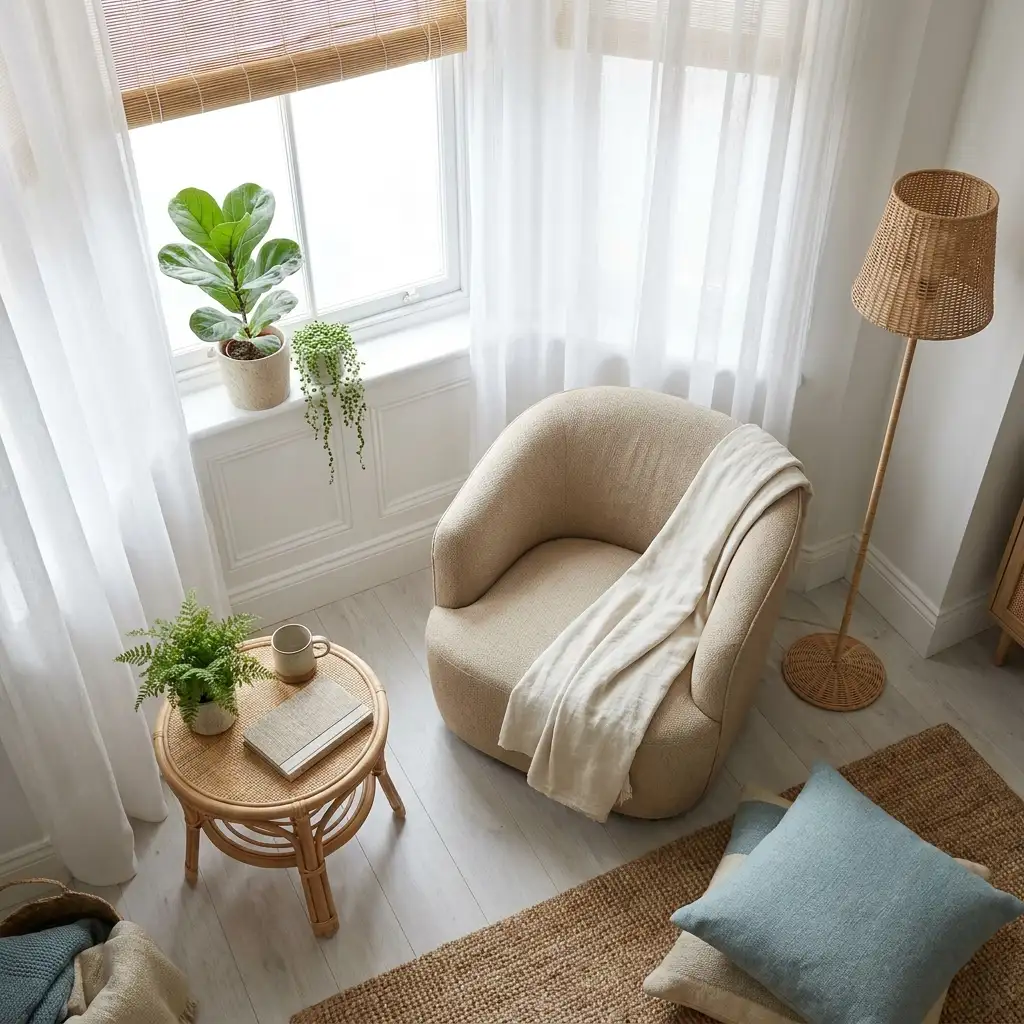
The back shape also makes a clear difference. In bay areas, a softly curved back usually feels more natural than a square, formal outline. It tends to create a calmer window spot and often works especially well in soft-modern or contemporary interiors. That is probably because curved lines reflect the shape of the bay more naturally, while also looking a little less stiff.
Comfort for real daily use deserves close attention too. If the aim is an armchair reading corner UK setup, softness alone is rarely enough. Good back and shoulder support matter, along with enough room for a throw or cushion. Betsy Proxmire explains this clearly when discussing reading nooks:
In addition to a cushion seat, it\’s helpful to have several accent pillows that can be used to prop up and support your back.
That point matters here because bay seating is often used for longer, quieter periods than the main sofa. It is where people read, take phone calls, drink tea, or simply pause for a while.
A before-and-after example often appears in older terraces. Before, the bay holds a random chair that is simply too deep, and the room starts to feel heavy at the front. After, a compact curved chair, paired with a small side table and floor lamp, turns the same spot into a reading nook armchair UK homeowners are much more likely to use.
If you’re looking at broader styles before narrowing things down, we covered this in an overview of upholstered armchairs UK. Buyers comparing textures and finishes may also find the Armchair Fabric Guide UK: Bouclé, Linen or Velvet? useful when choosing upholstery for brighter bay areas.
How to use natural light with armchairs for bay windows without creating glare or fading problems
Natural light is a big reason many people want a chair in a bay in the first place. It can lift the mood, make a room feel more open, and give a quiet corner a little character, which is often the goal. That added sense of comfort is a real benefit. Artem Kropovinsky puts it well:
Natural light plays a pivotal role in reading corner design. Large windows or even skylights can transform a nook into a space of serenity and reflection.
That is the advantage. On the practical side, direct sunlight can cause glare on pages or screens, especially at certain times of day. It can also heat dark fabrics and slowly fade some finishes. So an armchair in a naturally bright space should usually fit with the light rather than fight it.
Place the chair slightly off-centre
The chair does not always need to sit right in the middle of the bay. A slight angle often helps as well. Placing it a little off-centre can improve comfort and usually makes the setup feel more relaxed.
Layer daytime and evening lighting for armchairs for bay windows
Daylight helps in the morning and afternoon, and that is usually enough during those hours. At night, though, the bay still needs soft light. Architectural Digest points to natural light and also recommends a warm lamp for later use (Architectural Digest), which often works well here.
Lighting placement can also influence how large the seating area feels. For wider inspiration around layered lighting, this guide to Lighting Trends for Modern Homes explores softer evening setups that work well beside windows.
Choose forgiving fabrics and colours
Mid-tone neutrals, earthy greens, warm taupes, and textured weaves often handle light more gently than very bright whites or deeply saturated dark shades, which can be harder to manage. They’re a practical choice and usually easier to live with.
Add a side table with a purpose
A drink, book, glasses, or lamp needs somewhere to land, and it will probably work best right beside the seat instead of across the room. Without a table, the setup can easily look unfinished.
According to House Beautiful UK, reading nooks often feel most successful when they seem welcoming instead of staged, and that usually comes from layered, practical pieces rather than leaving a single chair on its own (House Beautiful UK). A simple detail, but often a key one here.
Styles that work best for armchairs for bay windows
[Content unchanged for remaining sections except headings below]