Oak Dining Tables UK vs Walnut: Which Is Best?
Picking between oak and walnut can look straightforward at first. They’re both premium woods, they can both last for years, and both usually look far better than fast, disposable furniture. But put them next to each other and the decision often gets harder, especially for people comparing oak dining tables UK buyers regularly choose for modern homes. One table may look light, calm, and easy to work into a room, which can be a real plus in everyday spaces. The other has a deeper, bolder look with a quieter kind of luxury.
That is why so many buyers searching for oak dining tables UK, walnut dining tables UK, and a clear oak vs walnut dining table guide end up comparing two genuinely strong options. If you’re furnishing a modern dining room, making a long-term furniture investment, or trying to match a soft-modern interior, the wood you choose changes more than just the colour. It sets the mood of the room. It can also change how well a table hides everyday wear like light scratches and marks, how often it may need touch-ups, and how easily it fits with other furniture, from pale wood chairs to darker cabinets.
This guide explains it in a practical way for UK homes. It’s designed to stay simple and useful. It looks at appearance and feel, strength, day-to-day use, design fit, and maintenance, as well as long-term value, which is usually what matters most with a purchase like this. It also looks at what the wider furniture market shows about material choice, craftsmanship, and sustainability. So if you’re deciding between a solid oak dining table UK shoppers trust and a walnut wood dining table UK buyers often see as more refined, this article will help you make that choice with confidence.
Why Oak and Walnut Matter in the Oak Dining Tables UK Market
A dining table tends to be one of the most used pieces in the house. People eat at it, work there, chat, host, open parcels, help with homework, and gather around it at weekends, so one surface ends up doing quite a lot. Because so much everyday life plays out there, the material does matter.
That’s especially true in the UK, where wood still remains central to furniture buying. In 2025, wood made up 54.40% of UK furniture-market value, according to Mordor Intelligence (Mordor Intelligence). Living-room and dining-room furniture also accounted for 31.78% of UK home furniture market revenue in 2025. That’s a substantial share, and it shows how important these pieces still are in ordinary homes, especially in dining areas and living spaces that get constant use (Mordor Intelligence).
It’s a big market, and buyers are thinking more carefully about what they bring home. FIRA reported £25.5 billion in UK consumer expenditure on furniture, carpets and floor coverings in 2025, while household spending on furniture and furnishings reached £20.15 billion in the same period (FIRA, FIRA). People are still willing to spend seriously on the home, but they often want better value and less waste at the same time, which is understandable.
For buyers in Shropshire, Staffordshire, Cheshire, Manchester, North Wales, and Birmingham, that often means comparing timeless woods instead of chasing short-lived trends. Oak often appeals because it’s practical and easy to style in many homes. Walnut tends to stand out for its drama, deeper tone, and richness. Each has its own strengths, and the right choice often comes down to how the table will be used and the overall look the home needs.
The Real Material Difference in Oak Dining Tables UK: Colour, Grain, Density, and Hardness
When people look at premium wood dining tables UK retailers sell, the colour tends to stand out first. That makes sense. Even so, it’s only the beginning, and often not the most important difference once the table is examined more closely.
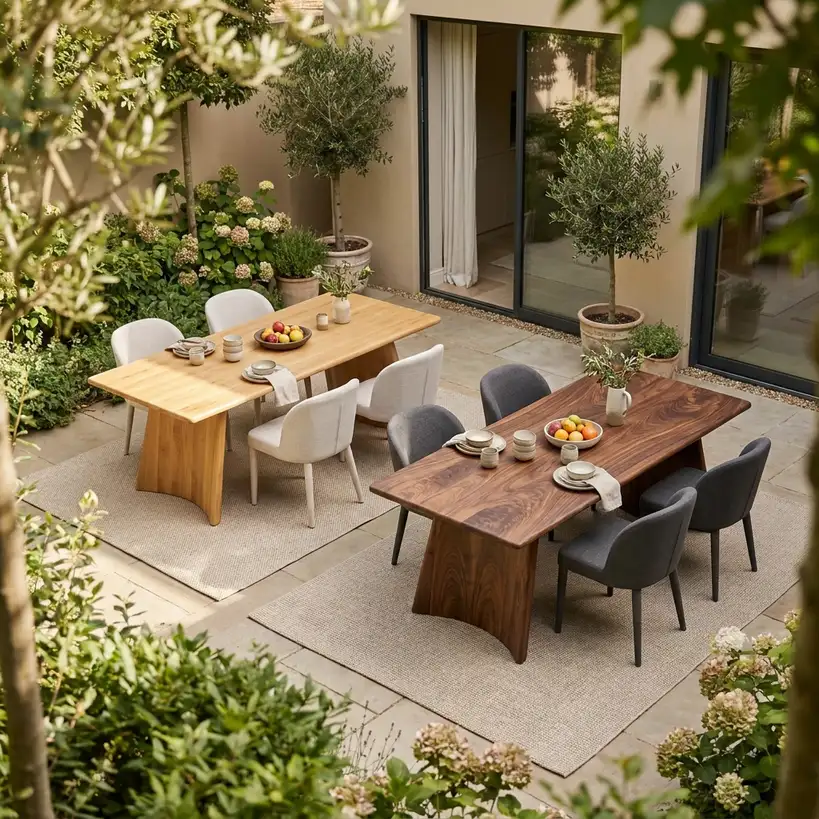
Oak tends to begin with a lighter overall tone. With different finishes, it can come across as honey, beige, sandy, or softly golden. You can usually see the grain more clearly, and that gives it texture and an easy, natural feel. That probably helps explain why oak fits so easily into soft-modern, Scandinavian, Japandi, and contemporary country interiors. It usually feels at home in those rooms without dominating the space.
Walnut is darker, usually somewhere from medium brown to deep chocolate, and it can have grey, purple, or smoky undertones. Its grain often appears smoother, more fluid, and sometimes more striking. In a dining room, walnut can come across as more architectural, in a good way, since it usually makes a stronger visual statement. In a lot of rooms, that makes the table the centrepiece rather than something that fades into the background.
There are practical differences in the wood itself as well. A peer-reviewed study in BioResources listed common oak at 0.753 g/cm³ air-dry density and common walnut at 0.702 g/cm³ (BioResources). In simple directional terms, that supports the usual view that oak is denser. Reference values also give European oak at 1,290 lbf Janka hardness and American black walnut at 1,010 lbf (ArchiDecors).
Put simply, oak is usually harder and may handle dents a bit better in busy homes. Still, hardness is only part of the story. With a table that’s used every day, build quality, joinery, thickness, and finish often matter just as much.
How Oak Dining Tables UK and Walnut Change the Feel of a Room
This is often the point where the choice becomes personal. The same dining table shape can come across very differently in oak than in walnut, and that’s what makes the choice interesting.
Oak can brighten a room because it reflects more light. That can take the edge off heavy chairs, dark flooring, and even smaller layouts. In many UK homes, especially when natural light is limited through autumn and winter, that shift can matter more than people expect. An oak table will often make the room feel open and calm instead of crowded. It’s subtle, but in most spaces you can see the difference.
Walnut changes the atmosphere in a different way. It adds depth and creates stronger contrast around the room. It can anchor a pale space and make it feel more settled. In modern dining rooms with plaster tones, black accents, brushed brass, smoked glass, or textured fabrics, walnut often feels more refined, maybe a little moodier too. It has more presence.
According to interior designer Diana Wagenbach, dining table trends are moving toward softer, more tactile forms:
Furniture, and especially dining table trends, are leaning sculptural and tactile, with curves, soft edges, and artisanal detailing.
That direction works well with both woods, although each one creates a different atmosphere. A curved oak table feels gentle and organic, while a curved walnut table has a more sculptural, luxurious feel. Recent trend coverage also points to warm woods, natural grain, and crafted detail as key design directions (Opulent & Co.).
So the useful question is simple: should the table brighten the room, or give the space more visual weight? Oak brightens a room. Walnut gives it a more anchored feel, which is probably the clearest way to describe the difference.
Which Wood Works Better for Everyday Family Life?
If a dining table gets used every day, practicality usually counts for more than showroom looks, especially in family homes.
For everyday family life, oak often has the edge. It’s usually harder than walnut, so it can be a better fit in homes with children, regular guests, or simply a lot of daily activity. In everyday use, a well-made oak table can cope with dinner plates, homework laptops, school bags set down on top, and the usual knocks that come with family life. That doesn’t mean it won’t get damaged, but it does tend to feel solid and dependable over the years.
Walnut is durable as well, so it’s not a fragile wood. Even so, the darker, smoother look can make marks show up differently, depending on the finish. Dust also tends to show more easily on deep, dark tops, especially in bright rooms. In strong daylight, scratches in the finish can stand out earlier than they would on a lighter oak surface.
Still, day-to-day durability isn’t just about the wood species. The build details matter just as much, and you usually notice that more as time goes on.
A well-made table should have:
- Stable, properly dried timber
- Strong joinery at the legs and frame
- A finish suited to dining use
- Enough top thickness to feel substantial
- A design that supports weight evenly
So a high-quality walnut piece can easily outlast a poorly made oak one. If someone is comparing a solid oak dining table UK option with a walnut wood dining table UK design, the label is only part of the picture. A useful approach is to look closely at how the table has been made, since that’s often the deciding factor.
And if shape still matters in the decision, a guide on round and rectangular dining table layouts can help match the table to daily use rather than style alone.
It can also help to compare layouts in guides such as Modern Dining Tables for Small Spaces UK, especially when floor space is limited.
Oak vs Walnut in Modern British Interior Styles
The best dining table wood comparison UK buyers can make isn’t only about the timber itself. More often, what matters is how the room comes together, since that’s usually the first thing people notice.
Oak fits into more settings without much effort. It’s often the dependable choice. It often suits:
- Soft whites, warm neutrals, and pale stone
- Limewash tones, boucle, linen, rope, and other textured fabrics
- Black details used lightly, such as on lighting or chair legs
- Scandinavian, Japandi, soft-modern, and relaxed contemporary schemes
That’s why oak is a strong option for homeowners who want the dining room to evolve over time. If the wall colour changes later, the chairs are replaced, or the lighting is updated, oak will usually still sit comfortably in the room without clashing with the new scheme.
Walnut has more presence in design-led interiors. It’s often the more expressive option. Walnut is especially effective with:
- Rich creams, taupe, mocha, and clay tones
- Bronze, brass, smoked glass, and dark metal accents
- Mid-century influences, boutique-hotel styling, sculptural lighting, and curved upholstered chairs
- Luxury apartments or open-plan rooms where darker furniture needs to contrast with lighter surfaces
For many buyers, it ends up being a head-versus-heart choice. Oak is usually the easier all-round option, while walnut often gets the stronger emotional reaction once it’s seen in a finished room.
In places like Manchester and Birmingham, where period features are often mixed with newer finishes, walnut can add extra polish to a modern renovation. In Shropshire, Cheshire, Staffordshire, and North Wales, oak often feels more at home in interiors that combine contemporary furniture with warmth and texture.
If the wood is being paired with a softer chair silhouette, this guide to comfortable dining chairs for modern table pairing can help create a more balanced dining set.
Buyers comparing seating and layout ideas may also find Match Dining Chairs With Table UK for Modern Homes useful when narrowing down finishes.
Long-Term Value, Sustainability, and the Case for Solid Wood
A dining table shouldn’t feel temporary. That’s a big part of why solid wood still appeals to people, and the reason is usually pretty simple.
Sustainability carries more weight now than it once did. In the British Furniture Confederation’s 2024 survey, 93% of respondents said sustainability practices were important. The same report found 70% were considering recycling, remanufacturing, or circular-economy initiatives in product development, and 81% planned to invest in sustainability and circularity over the next five years (British Furniture Confederation).
For buyers, the takeaway is fairly practical: one well-made wood table can often make more sense over time than buying lower-grade furniture again and again. So it’s not only a sensible purchase, but often a more sustainable one as well.
Oak and walnut are especially well suited to that kind of long use because they can often be:
- Refinished instead of replaced
- Kept in use for many years
- Repaired after light damage
- Paired with new chairs as your home changes
Still, some wood tables are far more sustainable than others. Veneers, mixed materials, imported low-grade cores, and weak construction can all change how long a table really holds up. So if you’re comparing luxury dining tables UK shoppers may keep in their dining room for ten years or more, solid timber usually still offers strong value, especially over the long run.
If you want a closer look at material quality, construction, and the details that set solid wood apart from lookalikes, oak dining tables vs veneer is a useful next read.
For people focused specifically on extending formats and flexible layouts, extending dining tables UK for Modern Homes is another practical comparison guide.
How to Choose Based on Your Room, Not Just the Sample Swatch
A small wood sample can throw you off, and it does that a lot. Something that looks just right in your hand can feel too light or too dark once it’s a full dining table in your room, especially in your own lighting.
If you’re not sure where to begin, a simple buying framework is often a good place to start.
Choose oak dining tables UK buyers love if you want:
- A lighter feel in the room, which often helps in smaller spaces
- A table with a relaxed, flexible look
- A better fit for soft-modern interiors or Scandi-inspired spaces
- A practical family table that works with many styles
- An easier option if chairs might change later, since it will likely suit more shapes and colors
Choose walnut if you want:
- A stronger visual statement
- More contrast in a pale room
- A richer, more premium look
- A dining table that feels sculptural or design-led
- A better fit with mid-century, luxe, or darker modern schemes
Then test the wood in real room conditions, because this step matters and is honestly easy to miss. You’ll get a better read on the finish if you look at it in daylight, then check it again in the evening. Try comparing it with your flooring and putting samples beside your dining chairs. It also helps to think about what usually lives on the table day to day, and whether the room already leans dark or light.
That’s why the best modern dining tables UK buyers choose are usually selected with the whole room in mind, not just as a piece on its own. It usually leaves the room feeling more balanced once everything’s in place.
Anyone considering shape and timber combinations can also compare options in the Solid Oak Round Dining Table UK Buying Guide.
Common Buying Mistakes When Comparing Oak and Walnut
Most buying mistakes happen when shoppers focus only on appearance, and that’s very common.
A common mistake is assuming darker wood must be better quality. Walnut can look more luxurious and sometimes seem pricier, but that richer look doesn’t tell you how well it’s made. Some oak tables are made to a much higher standard than some walnut ones. That’s easy to miss when the judgment begins and ends with colour alone.
Another mistake is using hardness as the only sign of durability. Oak is usually harder, yes, but that alone doesn’t promise it will perform well over time. Bad finishing, weak joints, or timber that isn’t stable can still lead to problems whatever species you pick. Material alone isn’t the whole story. In many cases, how well it’s built matters just as much and, in daily use, often more.
It’s also easy to overlook how the table is looked after. If a household wipes the table soon after meals, uses mats, and keeps radiators from blowing dry heat straight onto the wood, both oak and walnut can age beautifully. Without that kind of care, either one can start to show wear over time. You often notice the gap more as the years pass, especially with daily use.
People also tend to underestimate scale. A large walnut table can feel too heavy in a small room. In a very large open-plan space, pale oak may not look as convincing unless the design has enough presence for the room.
A thoughtful retailer or design-led furniture source such as RENGARD can help buyers compare materials through room style, finish, and everyday use instead of surface-level trend chasing. Seen that way, it often comes down to whether someone chooses a table they simply like or one they still love years later.
Final Pointers Before You Buy
When people compare contemporary wood dining furniture UK options, the right choice usually comes down to how they live day to day and the look they want their home to have.
Oak is often a better match for homes that want a calm, bright, adaptable look, especially in kitchens, open-plan dining spaces, or lighter rooms. It’s practical in a way that makes everyday use feel easy, and that often matters more in real homes than people expect. Walnut, on the other hand, usually works better for buyers who want a table with a richer, moodier, more premium feel as soon as someone walks into the dining room.
Both woods still fit comfortably within today’s design direction. Current trend coverage points to warm woods, visible grain, tactile finishes, and crafted forms rather than cold, glossy uniformity (Yahoo Shopping). That’s part of why oak and walnut still feel current, while also giving both of them lasting appeal.
If the choice feels unclear, keep it simple. Oak usually makes sense when ease and versatility matter most. Walnut is often the clearer pick for buyers who want more depth and drama. After that, construction, finish, and proportion are the details that turn good wood into a great dining table.
Frequently Asked Questions
Is oak or walnut better for a family dining table?
Oak is often the safer practical choice because it’s harder and slightly more dent-resistant in busy homes. It holds up well and is a better fit for homes with children, frequent meals, and heavier daily use.
Do walnut dining tables look more expensive than oak?
In a lot of rooms, yes. Walnut is darker and shows more depth, so it tends to feel richer and more styled. Oak can still look premium, though it comes across as lighter, calmer, and more understated.
Which wood fits soft-modern interiors better?
Oak tends to suit soft-modern interiors a bit more easily. The lighter color goes nicely with warm neutrals, curved shapes, textured fabrics, and airy rooms, so the whole space feels simple and balanced. Walnut can work too, but it gives the room a bolder, more dramatic feel.
Are solid oak dining tables a good long-term investment in the UK?
Yes, if it’s actually well made. A solid oak dining table UK buyers pick for the long term can be hard-wearing and keep the look simple. It holds up over time and also leaves open the option of refinishing the surface later. RENGARD is a UK furniture brand with a design-led approach, where buyers can find durable materials and a modern, built-to-last way of furnishing.
Do walnut tables make small dining rooms feel darker?
They can feel that way, especially in rooms that don’t get much natural light or have dark floors. That said, walnut isn’t a bad choice for a small room. It usually looks best with lighter chairs, pale walls, and reflective surfaces. The whole space feels more balanced that way.
Where can I compare premium wood dining tables in the UK?
Start by looking at the timber, the finish, the shape, and the joinery, rather than going on colour alone. People shopping for premium wood dining tables UK usually begin with modern retailers, particularly design-led brands such as RENGARD. From there, they tend to narrow it down by the room’s style, how the table will be used day to day, and whether they prefer the lighter ease of oak or the richer feel of walnut.
The Bottom Line for UK Buyers
If you want the short answer to the oak vs walnut dining table question, it’s usually this: oak is often the more practical, easy-to-live-with option, while walnut is more often the luxurious, design-led one.
Which one works best really comes down to the home. Oak usually works better in brighter rooms, is easier to match with other pieces, and stands up well to everyday use, especially if the table will be used often. Walnut, on the other hand, tends to suit people who want a deeper colour, more contrast, and a statement piece that gives the dining area a more refined, high-contrast feel. In most homes, that’s the real difference.
Keep these key takeaways in mind:
- Oak is generally harder and often better suited to heavy daily use
- Walnut usually creates a richer, more premium visual effect
- Both can work well in modern British interiors, particularly with warm wood trends
- Construction quality matters just as much as the wood species
- Solid wood supports long-term value, is easier to repair, and may help reduce replacement waste
Before buying, it helps to step back and look at the whole room. Think about the light, wall colour, flooring, chairs, and how the space is actually used, because that often has more impact on the better choice than people expect. It’s also worth looking past first impressions. That’s usually how homeowners across the UK choose between oak dining tables UK, walnut dining tables UK, and other luxury dining tables UK. A table might look beautiful on day one, but it should still suit everyday life years later after regular meals, guests, and daily use.