Curved Dining Chairs UK: Style, Comfort & Everyday Practicality
Curved dining chairs UK buyers are choosing are everywhere in British homes at the moment, and it’s not only because they’re in fashion. They make a room feel gentler and more welcoming, and they’re often simply nicer to sit on every day. For many homeowners, that kind of practicality matters just as much as looks. A chair can look lovely, but if it’s uncomfortable after twenty minutes or feels too bulky next to the table or close to a wall, it tends to lose its appeal pretty fast.
That goes a long way towards explaining why curved dining chairs in the UK are getting so much attention. They fit the softer, more easy-going look many interiors are shifting towards, often for practical reasons. They also reflect how dining rooms are actually used now. In many homes, the dining area is no longer just for Sunday lunch or entertaining. It’s where people work, help with homework, drink coffee, and often stay around the table long after dinner. Put simply, it’s part of daily life.
This guide looks at curved dining chairs from a practical point of view. It covers why the shape works so well, how modern curved dining chairs compare with straighter styles, when upholstered curved dining chairs are worth choosing, and what to consider if contemporary dining chairs are needed for a soft-modern or luxury setting. Useful details, especially when the aim is to balance comfort with style.
It also looks at room size, materials, maintenance, styling ideas, and how to make rounded dining chairs work with oak, ceramic, or marble tables, since that combination can be harder to judge than many expect. So whether furnishing a home in Shropshire, Staffordshire, Cheshire, Manchester, North Wales, Birmingham, or elsewhere in the UK, this guide is intended to help with more confidence and a clearer sense of what usually works best.
Why curved dining chairs UK homes love feel so right in modern British homes
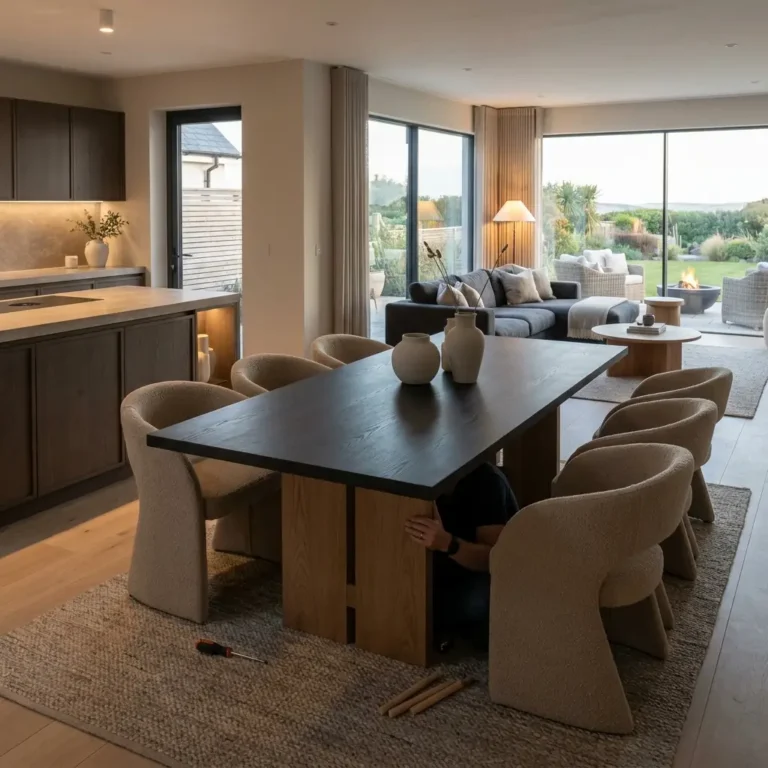
Curves can alter the feel of a room quite fast. They break up harder lines, take some of the visual weight away from the dining table, and make the setup feel less formal, which tends to work well in everyday homes. It’s a small tweak, but people usually spot it straight away. That goes some way to explaining why curved back dining chairs work so well in homes aiming for a soft-modern look.
The wider furniture market also shows this category has become more significant. UK household spending on furniture and furnishings reached £20.15 billion in 2025, up 3.2% year on year, according to FIRA using ONS data (FIRA). FIRA also says upholstered wooden seating was the largest single category of domestic seating, with sales of £784 million in 2024 (FIRA Statistics Digest). That doesn’t prove demand for curved dining chairs UK shoppers want on its own. But it does suggest strong demand across the UK market for comfortable upholstered seating, especially for people who want softness as well as support.
Bringing softness and flow to the dining space, these silhouettes help to create interiors that feel calmer and more nurturing, offering a welcome contrast to the clean, linear forms that have dominated in recent years.
That softer feel matters in real homes. In open-plan spaces, curved chairs can make the dining area feel less severe beside a kitchen island or a long run of cabinetry. In smaller dining rooms, rounded dining chairs in the UK often seem easier on the eye, likely because they add fewer hard edges. It’s a subtle change, but it often helps. They can also fit more naturally into older homes with bay windows, alcoves, or uneven walls, where straight, boxy furniture can feel a bit too stiff.
What makes curved dining chairs UK buyers choose comfortable, not just stylish
Some curved chairs look good but aren’t that comfortable to use every day. The best ones usually get the shape, support, seat depth, and practical upholstery right, and that really does matter. It’s often the small details that decide it. If you’re comparing modern curved dining chairs, start with four key factors.
1. Back support
A gentle wraparound back often feels more supportive than a flat panel and, in this case, more comfortable too. Because it follows the body more closely, you’ll often feel more settled at the table. So it makes sense that buyers choose curved back dining chairs for regular use, not only for special occasions, but for everyday meals too.
2. Seat padding
A thin padded seat can still be comfortable if the foam is dense and the shape stays even; that usually matters more than people expect. Really soft padding can feel plush at first, but it often stops giving the same support over time. If you’ll use it every day, firmer padding is usually the better pick than sink-in softness.
3. Arm style and clearance
Some statement dining chairs in the UK come with low arms, which can add comfort without making the chair too wide, and that is usually useful. Others use a tub style, so they may need more space. Does the chair slide fully under the table, so the arms don’t bump?
4. Upholstery and touch
Soft-touch fabrics really do make a difference. Furniture in Fashion highlights how UK dining trends are putting more emphasis on easy-clean upholstery, generous padding, and supportive backs (Furniture in Fashion). That lines up with the wider shift toward dining spaces built for comfort, and most people notice that pretty quickly.
For a wider view of how soft silhouettes work across the home, this guide to soft modern seating in the UK is useful beyond the dining room. It gives helpful context and is usually easy to put into practice.
Everyday comfort matters more than trends
For many couples furnishing a new room, the sweet spot is simple: a curved back, medium seat padding, and fabric that feels warm instead of formal. Most of the time, that mix feels comfortable for everyday meals. Simple and effective.
Comfort and shape in everyday use
Many curved dining chairs UK homeowners buy now are chosen with daily routines in mind rather than occasional entertaining. That often changes what people prioritise. A chair that supports the back through a long dinner, a work session, or an evening conversation usually feels more worthwhile than one chosen only for appearance.
This is also why softer silhouettes keep appearing across British interiors. Rounded backs and supportive seats tend to feel easier to live with over time. In many cases, comfort becomes part of the room’s overall atmosphere, not just a functional detail.
Upholstered or non-upholstered: which works better for everyday life?
For a lot of buyers, this is the big decision. Upholstered curved dining chairs are often more comfortable and softer in feel, while non-upholstered ones are usually easier to maintain and can keep a room feeling lighter, which really suits some spaces. What works best comes down to how the home is actually used day to day.
If the dining table gets used every day for meals, work, and family time, upholstered curved dining chairs can make the room feel more comfortable and easier to use. People tend to sit in them for longer, and they often feel warmer than timber, plastic, or metal chairs. That usually matters more in homes where the dining area is in constant use, rather than saved for more formal, occasional use.
There is market evidence behind this shift toward comfort. FIRA reports £1.05 billion in UK imports of upholstered seats with wooden frames in the latest reported period, and £3.24 billion in seating imports overall (FIRA Autumn 2025 Digest). In most cases, that suggests upholstered seating makes up a large share of what the UK buys.
Comparing room feel and practicality
Before: a dining room with six straight-backed chairs can look tidy, but it can also come across as a bit stiff. For quick meals, that may be absolutely fine. Later, when people linger over dinner, work, or conversation, the room can start to feel less welcoming.
After: swap them for contemporary dining chairs in the UK with rounded backs and textured fabric, and the room often feels calmer and more at ease. The softer look changes the feel of the room, but there’s a practical side to it as well. It’s easier for people to lean back, which tends to make longer meals or conversations more comfortable. The room then starts to work for conversation as much as eating.
Still, non-upholstered chairs are a better fit in some homes. If there are very young children, if the aim is the lightest possible look, if visible wood grain works best beside an oak table, or if easy wipe-clean care matters most, timber chairs may be the better option and often the simpler one as well. Mixing the two can work well too, with upholstered end chairs and simpler side chairs.
We covered this here: Best Dining Chairs for Everyday Use.
For buyers comparing materials more closely, Wooden Dining Chairs UK That Never Go Out of Style is also useful when weighing up natural timber against upholstered options.
How curved dining chairs UK homeowners buy work with different dining tables
Curved chairs can work in a lot of settings, though some combinations do tend to look more natural than others. What matters most is balance, the chair should suit the table instead of clashing with it, and it shouldn’t look out of place, which people usually spot right away.
Oak tables
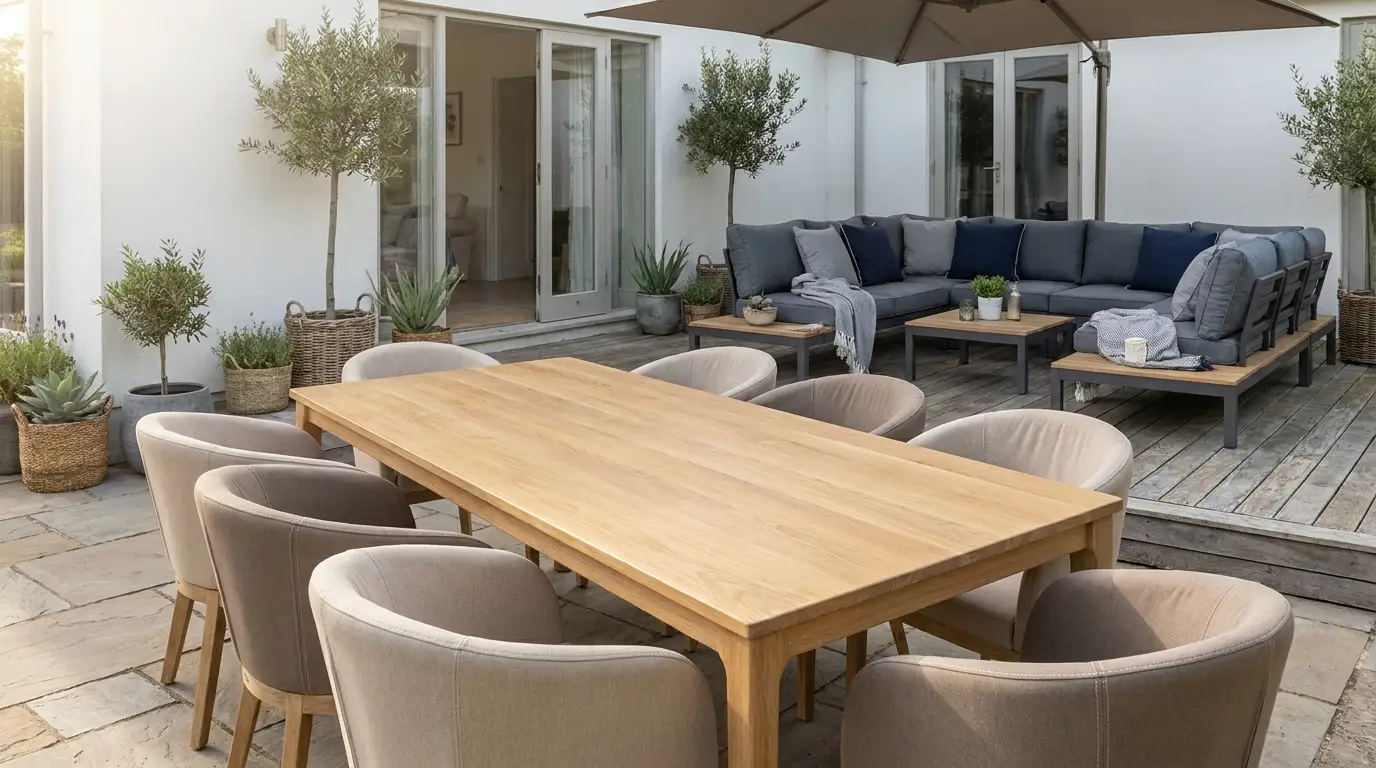
Oak adds warmth and a clear grain, which usually helps. Curved chairs soften that solid feel, so the room doesn’t seem too heavy.
In homes across Shropshire, Staffordshire, and Cheshire, buyers usually want something that feels settled but still current, and this mix tends to work really well. Textured neutrals, warm greys, olive, oatmeal, and soft brown usually do the job, so the whole palette stays relaxed.
Ceramic tables
Ceramic tables can have a sleek, structured look. However, rounded dining chairs in the UK often take the edge off that harder surface, so the whole setup tends to feel easier to live with. A softly curved upholstered chair can make it seem less harsh, too.
Marble tables
Marble already makes a statement, so the chair usually shouldn’t compete with it too much. That’s why luxury dining chairs in the UK tend to work well in this kind of space. Go for smooth curves, refined fabric, and a simpler frame. It can still look high-end without feeling too styled.
Round and oval tables
This is probably the easiest pairing. Curved shapes match the table form and often make movement around the room feel more natural, which can be especially helpful in smaller dining areas. Amanda Huber says, “Circular dining tables feel more inviting and social, creating a more intimate setting that naturally encourages conversation and connection” (House Beautiful UK). That feels like a good fit here. The same idea also often works well with chairs that have rounded shapes.
How to Match Dining Chairs to Your Table covers the basics, so there’s no need to repeat them here.
Buyers looking for more detailed pairing ideas can also read Match Dining Chairs With Table UK for Modern Homes alongside this guide.
Choosing curved dining chairs UK homes can use every day
A chair needs to work in the room both when someone’s sitting in it and when no one is. That’s the bit people often miss. In many UK homes, especially terraces, semis, and flats, having enough space to move around matters just as much as how the chair looks. If a chair looks great but gets in the way between the table and the doorway, it’s probably not the right one.
Measuring space properly
A good way to check is to look at the chair from a few angles: the width from the front, the depth from the side, how far the back curves out, and how much space the arms take up. Some designer dining chairs in the UK seem compact from the front but flare out more at the back. Others have arms that add several useful-looking but space-hungry centimetres, which can easily catch buyers out. That is often where people get the size wrong.
A few practical rules help:
- In smaller dining rooms, open-leg designs and lighter fabrics usually make the chair feel less heavy.
- In open-plan rooms, slightly fuller chairs can do more to define the dining area.
- If the table is close to a wall or sideboard, it’s often better to avoid deep tub shapes that need more pull-out space behind them.
- If people are often moving around the table, smooth fabrics and sturdy frames usually hold up better to frequent sliding.
Balancing style with movement
This is also where contemporary dining chairs in the UK differ from purely decorative options. The best ones for everyday use have a sculptural look without awkward proportions. It sounds simple, but it makes a difference day to day. They can still stand out while tucking under the table, leaving usable space around the edge, and moving easily when people sit down or get up.
British Furniture Confederation data shows the scale of the home furniture sector, with £9.6 billion in furniture manufacturing turnover in 2023, around 9,000 companies, and 94,000 people employed (British Furniture Confederation). That leaves buyers with a lot of choice, probably more than they really need. It also means checking dimensions carefully matters even more.
A useful test is to picture the room on its busiest day, not in its neatest photo. If the chair still works when guests are over, shopping bags are on the floor, and someone needs to squeeze past behind, it’ll usually work the rest of the time too. In most homes, that’s usually the clearest test: real life first.
Thinking about movement and flow
Curved dining chairs UK households use every day often work best when circulation around the table still feels easy. That can matter more than people expect. Even a well-designed chair can become frustrating if it blocks walkways or needs too much clearance behind it.
This is particularly important in multifunctional homes where dining areas overlap with kitchens, living spaces, or work zones. In those situations, softer shapes can improve visual flow without making the room feel crowded.
Materials and maintenance for curved dining chairs UK families use daily
Style might be what catches someone’s eye at first, but how much upkeep it needs often has more to do with how happy they are with it later on. That’s particularly true for upholstered curved dining chairs. A pale, textured fabric may look perfect online, but the real question is how it copes with pasta sauce, denim transfer, pet hair, and daily use, because that’s what tends to test it.
Practical finishes for everyday use
In family homes, the finish really does matter.
- Tightly woven fabrics are often easier to vacuum and are usually less likely to snag.
- Performance fabrics or stain-resistant finishes can make spills easier to deal with, especially around mealtimes.
- Mid-tone colours often do a better job of hiding everyday marks than very light shades, and they can also be easier to live with than very dark ones.
- Wooden or metal legs with a durable finish usually hold up better with regular cleaning.
Juliette’s Interiors points to comfort-led dining trends such as plush fabrics, leather-look finishes, and padded seating, while also noting that dining rooms are now used in a more relaxed, multifunctional way (Juliette’s Interiors). In that kind of room, easy care and durability usually matter more than people expect at first.
Looking at build quality
If you’re comparing brands, this is a good time to look more closely at how the chair is built. It helps to ask what the frame is made from, how the upholstery is fixed in place, and whether replacement dining chairs will still look right beside existing pieces. Small details like that usually make a noticeable difference. Retailers focused on durable, design-led furniture, such as RENGARD, can also help explain how material choices affect long-term use, especially when the aim is to balance softness for comfort with enough sturdiness for everyday life.
In most homes, the best chair usually isn’t the most delicate one. It’s the one that still looks good after everyday life has happened around it, and that’s often what people notice first.
For anyone considering textured upholstery, Bouclé Dining Chairs UK: Comfort, Texture & Contemporary Style explores how tactile fabrics fit into modern British interiors.
Soft-modern, designer, or luxury: deciding on the right look
People often use these terms as if they mean the same thing, though they don’t exactly. In the UK, soft modern dining chairs usually lean on gentle shapes, calm colours, and subtle texture, without anything feeling too loud. In most rooms, they feel calm, balanced, and easy to live with. Meanwhile, designer dining chairs often take the shape further, with a more sculptural profile or a less expected mix of materials. Luxury dining chairs in the UK can have those same qualities, but with richer finishes and more refined upholstery.
Matching the chair to the room
If a room already has strong features, such as a marble top, dark wall colour, or a large pendant light, a softer curved chair will often balance it out. In a simple, neutral room, statement dining chairs in the UK can bring in personality without making the space feel crowded. It’s usually a small change, but it can shift the mood in a noticeable way.
Domkapa’s trend coverage points to a move toward rounded furniture, curved backs, and softer corners in dining design (Domkapa). That lines up with the soft-modern direction seen across many British interiors, especially in newer schemes.
A simple way to narrow the options
- Pick soft modern if a calm look with easy elegance feels right.
- Choose designer when you want the chair itself to act as a visual feature.
- If richer materials matter more, go for luxury with a more tailored finish.
- You can also start with the shape you like most, then narrow the choice through upholstery and detail.
Curved chairs can work comfortably in all of these categories. It’s a versatile shape, so the final look usually comes down more to upholstery, scale, and detailing. If you’re unsure, that’s often the best place to focus first.
Where curved dining chairs UK styles work best across the home
These chairs don’t only suit large dining rooms. They often work best in awkward spots or in rooms that have to do more than one job, which is the case in a lot of homes.
Open-plan and compact spaces
In compact dining corners, rounded backs can make the space feel easier to move around, with fewer sharp angles cutting across the eye line. In open-plan kitchen-diners, curved shapes can make the dining area feel warmer next to straight kitchen units, and that contrast is often what people notice. The overall effect is softer. In period homes across Manchester and Birmingham, as well as North Wales, they can also soften traditional architecture without making it feel old-fashioned or too formal.
Flexible everyday living
They are also useful where the dining area has to handle several roles. If the table is used for remote work, children’s projects, long relaxed dinners, or everyday overflow, comfort becomes part of how well the space works. A chair that supports the back and still feels good over a longer sit will usually justify its place more easily.
Mixed seating is another strong option. Juliette’s Interiors and Furniture in Fashion both note the move away from rigid matching sets towards more individual combinations (Juliette’s Interiors) (Furniture in Fashion). This makes it easier to use two statement end chairs with simpler side chairs. Fabric can also be mixed with timber without the room feeling unfinished, giving a bit more flexibility.
Many curved dining chairs UK retailers now offer are designed specifically for these flexible layouts. That makes them easier to integrate into homes where the dining space is expected to work hard every day rather than sit unused between special occasions.
Common mistakes buyers make with curved dining chairs UK designs
A lot of buying mistakes start when all the attention goes to the shape. It’s easy for a nice curve to pull your eye away from the details that usually matter more once the chair is actually in the room. In everyday use, the practical details are often what matter most.
Sizing and layout errors
Common problems include:
- Chairs that are too wide for the space between the table legs.
- Very pale upholstery, chosen without much thought about maintenance.
- Not checking whether the chair actually fits under the table.
- Oversized statement chairs in a narrow dining room, even if that sounds obvious.
- Matching every piece too closely, so the room feels flat instead of layered.
Comfort issues people overlook
Another mistake is thinking all curved chairs give the same kind of support. That’s not always the case. Some chairs look better than they feel in everyday use. If possible, check how the back supports your shoulder blades. It’s also worth noticing whether the seat edge presses into your legs. Good contemporary dining chairs in the UK should usually feel stable and easy to sit in, not just look striking. When the proportions are off, comfort problems usually show up pretty quickly.
If you’re shopping online, a checklist helps. Measure the table height and make a note of the clearance around it. It also helps to choose a fabric that makes sense for daily life. Then decide whether the chair should blend in or stand out, because either option can work. A retailer like RENGARD can be a useful reference point when comparing modern home furniture with a Scandinavian or industrial edge, especially for buyers looking for design that feels stylish but still practical for daily living.
For buyers focused mainly on comfort, comfortable dining chairs UK: Modern Table Pairing adds more detail on supportive seating and table combinations.
Frequently Asked Questions
Are curved dining chairs more comfortable than straight-backed chairs?
Often, yes. A curved back tends to follow your body a bit better, so it can feel more supportive through longer meals. That said, comfort also comes down to seat depth, padding, and build quality. For a lot of people, curved-back dining chairs are simply more comfortable to sit in.
Do curved dining chairs work in small dining rooms?
They can, if the size is right. In a small room, rounded dining chairs can make things feel a bit softer and less cramped because they cut down on hard lines. Go for compact designs with slim legs, but when space is tight, skip bulky tub chairs.
Are upholstered curved dining chairs practical for family homes?
They can work really well if you pick the right fabric. Fabrics with easy-clean finishes, tight weaves, and medium tones usually stand up to daily use better than delicate ones. If the dining room gets heavy use, choose durability first and softness second.
What tables look best with curved dining chairs?
Round, oval, oak, ceramic, and marble tables all work well here. To keep the look calm and modern, match the chair’s softness with a table that feels right in both look and weight. Curved chairs tend to look best with tables that have clean, straight lines or solid tops.
Where can I find curved dining chairs that suit soft-modern British interiors?
Look for retailers that specialize in contemporary furniture, use durable materials, and have a distinct design style. If Scandinavian or industrial influences are what you like, RENGARD is one option that still brings warmth, texture, and practical everyday appeal to the dining space.
How do I know if a curved chair is too large for my table?
Check the width first, then consider how much elbow room each person will need. See whether the chair slides under the table and whether there’s enough room to pull it out without a struggle. If you’re not sure, slightly slimmer modern curved dining chairs are usually the safer choice.
Making the right choice for your curved dining chairs UK home
The best curved dining chairs in the UK tend to get a few key things right at the same time. They make a room look softer, make the table more comfortable to sit at, and suit how people actually live at home. That goes a long way to explaining why they suit contemporary spaces so well across Shropshire, Staffordshire, Cheshire, Manchester, North Wales, Birmingham, and beyond. In open-plan layouts, where straight lines can feel a bit stiff, they bring in a stronger sense of movement. In sharper, harder-edged interiors, they can add warmth and make everyday dining feel less formal.
Final points worth remembering
Keep these points in mind:
- Pick shape and size together, rather than treating them as separate choices.
- In most homes, comfort and support matter more than visual impact because they’re the first things people notice.
- Think about upholstery, cleaning, and how the chairs will be used day to day.
- Match curved shapes with strong table materials so the room still feels balanced.
- Be careful with statement pieces, so the space still feels easy to live in.
Whether someone prefers soft modern dining chairs in the UK, designer dining chairs in the UK, or a more luxurious upholstered style, the smartest choice is usually the one that suits both the room and the routine. Curved chairs don’t feel like a passing trend. If they’re chosen well, with real daily use in mind, they can make a dining space feel more comfortable and easier to use every day.
In many cases, curved dining chairs UK buyers return to are the ones that balance comfort, proportion, and durability without trying too hard to make a statement. That combination tends to age better visually and practically, especially in homes where the dining area is part of everyday family life rather than a formal room used only occasionally.