dining table shape guide UK for Modern Homes
A dining table isn’t just something that sits in the middle of the room. It changes how people move around, chat, host, work, and unwind. In plenty of British homes, the dining area has to handle more than one job. It might be in an open-plan kitchen, tucked into a bay window area, share space with a breakfast spot, or double as an everyday workspace, as it often does. Meals are only one part of how it gets used. That is why the best dining table shape UK buyers choose is usually not based on looks alone, and why a dining table shape guide UK homeowners can rely on needs to focus on real daily use.
This guide examines one main decision: shape. Maybe you’re weighing up a round vs rectangular dining table UK shoppers often compare online, or wondering if an oval dining table UK style gives you a softer option in between; either way, this is a good place to start. It covers when a square dining table UK layout tends to work best, what to consider when people need to move around chairs and walkways, and how to pick a shape that suits how the room is actually used. The aim is to keep it practical, not complicated, and often more useful than relying on photos alone.
Why Shape Matters in Modern UK Homes
There’s not much hard UK data showing which table shape people choose most often. What does exist, though, is strong practical advice from design experts, along with market context that shows how large the category is. In 2024, kitchen, dining and living furniture brought in £3.8 billion in revenue, making up 24.2% of the UK furniture retail market (Business Gateway). So it’s a significant buying decision, whether you’re furnishing a main eating area or updating a room that has to serve more than one purpose.
In this dining table buying guide UK readers can use, the focus is on how room shape, traffic flow, seating style, and modern interior trends affect the smartest choice. It also explains how to choose a shape that fits real daily life. In the original view presented here, that’s what usually helps a table work well over time: it suits the room, the routine, and the way the space is actually used.
Start with the Room: A Dining Table Shape Guide UK Homeowners Can Use
A lot of people start with style boards, saved images, or a material they really love. That makes sense. But one of the most useful things in any dining table shape guide UK homeowners can follow is simpler: start with the shape of the room.
Certain table shapes just work better within certain room shapes.
It sounds obvious, maybe even a bit basic. But it usually stops people making a lot of buying mistakes. A table can look beautiful on a product page but feel completely wrong once it’s in the dining area. In modern British homes, especially in places like Manchester, Birmingham, Cheshire, Staffordshire, Shropshire and North Wales, dining spaces are often compact, awkwardly shaped or part of open-plan layouts. The right table shape can ease that tension. The wrong one can make uneven proportions stand out even more.
Matching Table Shape to Room Layout
Kris Manalo of Ideal Home gives practical advice that fits what many designers recommend. Square and round tables usually suit square rooms, while rectangular and oval tables tend to work better in longer rooms (Ideal Home). Bethany Adams makes a similar point in Homes & Gardens. She recommends rectangular or oval tables for long rooms, and round tables for square ones (Homes & Gardens).
That’s really the starting point for dining room planning UK homes often need, and it’s probably the part people skip most:
- Start by looking at the room outline
- You’ll also want to note where doors open and how much space they need to swing
- One useful step is noticing radiators, islands, and windows
- How do people actually move through the space?
Measuring Before You Choose a Size
If exact measurements are the next issue, this dining table size guide explains dimensions in more detail. Shape should come first, then size helps confirm whether that choice will actually work in a real home. Buyers comparing timber finishes can also look at Oak Dining Tables UK vs Walnut: Which Is Best? for more material-specific guidance.
Round Tables in a Dining Table Shape Guide UK Buyers Often Need
A round table is often the easiest shape for people to gather around. With everyone facing the middle, nobody ends up at the head or foot of the table. That even shape tends to make the room feel more relaxed, which works well for couples, smaller households, and homes going for a softer modern look. It can also make it easier for conversation to move around the table.
In tighter spaces, which plenty of UK homeowners are dealing with, round tables can make movement easier because there aren’t any sharp corners to dodge. That tends to matter most in kitchens and open-plan family rooms, where people keep walking past the table during the day. Rounded edges can also feel a bit gentler in homes with young children, which is a small but useful point. In many layouts, that softer shape just makes day-to-day movement easier.
Clearance and Seating Around Round Tables
Even so, planning still matters. Large round tables can take up more floor space than people first expect. They may seem compact at first, but once chairs are in place, you need enough room all the way around. Rayon gives a useful benchmark: allow a minimum of 70 cm clearance in front of a dining table for seating and pull-out space. If someone needs to walk behind seated diners, 75 cm is the minimum. 90 cm usually feels more comfortable (Rayon). This is especially relevant in busy family spaces.
Typical round table capacities can also help guide the choice:
- 100 cm diameter: seats 4
- 120 cm diameter: seats 4 to 6
- 150 cm diameter: seats 8
- 170 cm diameter: seats 8 to 10
These figures come from Tom Faulkner’s planning guide (Tom Faulkner).
In modern interiors, round tables often look particularly good with pedestal bases. They keep the overall look light and can help with legroom too. For a more detailed shape comparison focused on this choice, see: round and rectangular dining tables. You can also compare styles in this Solid Oak Round Dining Table UK Buying Guide, especially if natural timber finishes are part of the plan.
Rectangular Tables in a Dining Table Shape Guide UK Homes Use
If your dining area is longer than it is wide, a rectangular table is usually the most efficient option. That’s why the round vs rectangular dining table UK choice so often comes back to the room’s shape. In most homes, that’s usually the first thing to check, because it tends to affect everything else about how the space works.
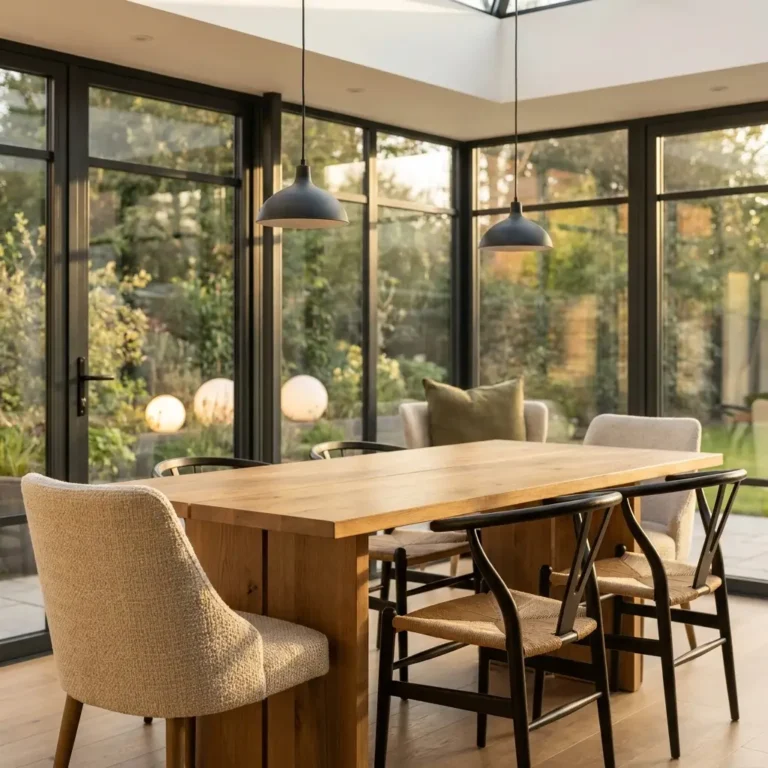
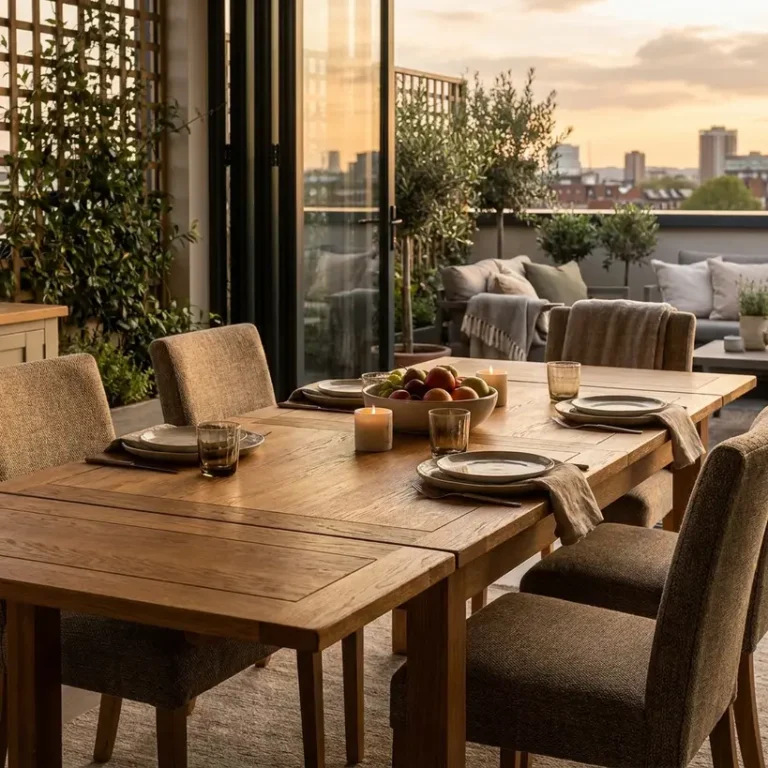
Rectangular tables work well in many British homes, especially galley-style kitchen-diners, open-plan rooms with one clear long axis, and family spaces where extra seating can make a real difference. They’re easy to place near a wall or along the room’s longer side, and that’s a big part of why they’ve stayed such a practical classic. They also tend to work naturally with rugs underneath and ceiling lights above, and they’re usually easier to scale up for six, eight, or more people, which is often what settles it.
As a general guide, square and circular tabletops are ideal for square rooms but can look awkward in rectangular spaces. For a rectangular room, choose rectangular or oval shaped tables.
That guidance is useful because rectangular tables generally follow the room’s natural direction instead of working against it. In practice, that often makes the whole space feel easier to move through and simpler to use day to day. The fit is usually more obvious.
Seating Capacity and Entertaining
They can also be especially useful for entertaining. Designers often mention a planning guideline of around 60 cm per person of table edge for comfortable dining, attributed by The English Home to Amanda Huber of The Dining Chair Company (The English Home). That figure gives a more practical sense of how many people can sit comfortably without elbows constantly bumping, something guests will often notice right away.
A rectangular table is often best when you need:
- Clear seating capacity
- Space for serving dishes in the middle
- A table that works beside a banquette or bench
- Better use of a narrow dining zone
The main compromise is its stronger visual presence. Straight lines and corners can feel sharper, particularly in smaller rooms. In contemporary dining tables UK buyers often choose today, many rectangular designs include rounded corners, slimmer tops, or sculptural bases, so the overall effect feels softer and usually less stiff.
Oval Tables in a Dining Table Shape Guide UK for Soft-Modern Homes
An oval dining table is one of those options UK buyers often skip over, but it can be a smart middle ground. You get a lot of the same seating logic as a rectangular table, with some of the easier circulation of a round one. In day-to-day use, that mix often works especially well. In many soft-modern interiors, this shape ends up fixing several problems at the same time, which is likely why it keeps showing up.
Why Oval Shapes Feel Softer
Oval tables usually suit rectangular rooms well, but they don’t feel as rigid as standard rectangular tops. Those rounded ends really do help, and the shape as a whole looks softer. In open-plan homes, that can make a dining area feel looser and less visually heavy. That also helps explain why curves and gentler silhouettes continue to appear across current interiors coverage, often alongside other softer design cues.
Recent editorial trend reports point to rounded forms, warm woods, mixed materials, and sculptural bases as key style directions in dining furniture (Furniture in Fashion, FW Home Stores). They’re trend signals, not hard market proof, so that’s how they should be read. Even so, they matter because they line up closely with what many homeowners now want: contemporary dining tables UK homes can use every day, whether for family meals, working at the table, or hosting guests, not simply looking at them.
Oval Table Sizes and Seating Examples
Oval shapes can also handle seating well. Tom Faulkner’s guide gives useful examples:
- 110 x 190 cm: seats 6 to 8
- 120 x 220 cm: seats 8
- 120 x 250 cm: seats 8 to 10
- 140 x 300 cm: seats 10 to 12
So an oval table can give you good seating capacity without the sharp corners of a rectangle.
A simple before-and-after example shows it well. In a long kitchen-diner, a rectangular table can make the room feel cramped because people catch their hips on the corners near the island. Switch to an oval table at a similar length and it’s often easier to move through the space. You still keep strong seating capacity, but the room feels softer. It’s a small change, but in homes aiming for calm, contemporary design, it can shift how the whole room feels by making movement easier and cutting some of the visual heaviness around the dining area.
Dining table shape guide UK layouts often overlook
One detail people regularly miss is how oval tables affect visual flow from adjoining spaces. In open-plan homes, especially where the dining area is visible from the living room, rounded ends can make the transition between zones feel smoother. That visual softness is subtle, but it often changes how welcoming the whole room feels.
Square Tables in a Dining Table Shape Guide UK Buyers Often Overlook
A square dining table UK buyers choose is rarely the option that fits the most seats. Usually, it comes down to balance. In the right room, a square table can look calm and centred, as if it naturally belongs there, and that may be why it’s often overlooked at first. It works particularly well in square dining rooms, compact kitchen corners, and homes with two to four regular diners.
What it does best is symmetry, and in this case that can really matter. With a square table, all sides are equal, sightlines stay clear, and the footprint is tidy. In a square room, that often feels more natural than pushing a narrow rectangle up against one wall. It also works well in contemporary interiors with a minimalist style, since the shape feels clean and simple to style, and that’s likely part of why it appeals.
Square tables also work well for intimate dining. When everyone is sitting about the same distance apart, conversation usually feels easier and more balanced. Meals can feel more connected than they do around a long rectangle, where people are spread farther apart from one end to the other. That’s especially helpful in homes where the dining table is part of daily life, not only something that comes into focus when guests come over.
Where Square Tables Struggle
There are limits, though. In longer rooms, square tables can leave awkward extra space at the ends or around the sides. Once they get too large, they often feel less social, since diners sitting across the diagonal are farther apart. So they usually work best for smaller households or in layouts that are clearly square, and that’s arguably the first thing to check.
Useful ways to make a square table work well include:
- Keep chair scale light so the room doesn’t feel boxed in
- Use a round pendant above to soften the geometry
- Choose rounded table edges if the room is compact
- A pedestal or central base can improve knee space
If you’re furnishing a tighter footprint, this guide to modern dining tables for small spaces UK can help you think through compact layouts and avoid repeating the same shape mistakes.
How to Plan Clearance, Traffic, and Everyday Use in a Dining Table Shape Guide UK Homes Need
Once you have a likely shape in mind, test it against daily life; that’s often the step people miss. Many dining table buying guide UK articles are too general here. A table is more than a seat count, because people move around it every day and often knock into it.
One useful place to start is with these questions:
Do people walk through this room often?
If so, don’t put bulky corners where people usually walk, that’s often the tightest spot. In busy areas, round or oval shapes usually work well, especially because they make movement easier.
Is the table used every day or only for guests?
For meals, work, homework, or casual use each day, easy movement often matters more than fitting in the most people. That’s often what daily life looks like.
Will chairs stay pushed in most of the time?
In a compact room, the table’s shape and base design often matter more than you might expect. It’s a small thing, but it can make the space feel easier, or harder, to use. A pedestal base can also give you more room to work with than four corner legs, which can get in the way.
Is the room open-plan?
In open-plan kitchen-diners, the table shape can help split the room into clear areas. A rectangular table often gives the space more structure, especially between the kitchen and dining area. A round or oval table, though, can soften the feel of the room, which often helps in busier spaces.
Test the Layout Before Buying
A useful planning checklist for dining room planning UK households can use is:
- Mark the table outline on the floor with masking tape
- Add chair depth, not just the tabletop size
- Walk the route from the door through the kitchen and out toward the garden
- Test whether drawers, doors, and appliances still open properly
- Sit where each diner would normally sit
You’ll usually see the answer quite quickly. And the best dining table shape UK choice is often the one that makes the room simpler to use every day, not just the one that takes up more space.
Dining table shape guide UK buyers can test at home
A taped floor outline is surprisingly useful because it shows how chairs actually move in real life. It also reveals details that measurements alone often miss, such as awkward door swings or narrow walkways around kitchen islands.
Choosing Shape by Home Style in a Dining Table Shape Guide UK Readers Need
Shape is practical, but it also affects how a room looks and feels. In soft-modern British interiors, curves show up more often because they can soften visual tension, especially in tighter spaces where hard lines tend to stand out more. It’s a small shift, but it can change the atmosphere quite a lot. Warm woods, matte finishes, rope details, and mixed materials usually work best when the table shape carries the same overall feel.
For example:
- Round tables suit Scandinavian and relaxed contemporary rooms
- Oval tables fit soft-modern spaces, especially with curved chairs and other gentle lines
- Rectangular tables suit industrial, architectural, or more structured layouts
- Square tables work well in minimal, symmetrical dining nooks
Brand fit matters as well. A retailer like RENGARD makes sense for buyers who want modern furniture, durable materials, and a calm design style. In most cases, that suits homes that mix natural textures with contemporary styling, especially wood, woven details, and softer finishes.
How Materials Change the Look of Each Shape
Material choice also changes how a shape comes across in a room. A thick dark top on a rectangular table can feel heavy, especially in smaller dining areas. In that same setting, a lighter oak oval or a natural teak-inspired finish can feel warmer and more open. Glass and stone-effect tops can make visual bulk seem lighter, while timber adds softness and depth. So the finish matters just as much as the silhouette, since it affects how open, grounded, or visually dense the table appears.
For buyers comparing extension mechanisms alongside shape, extending dining tables UK for Modern Homes can help narrow down practical options.
Common Mistakes When Comparing Table Shapes in a Dining Table Shape Guide UK Readers Follow
Most table-shape mistakes aren’t dramatic at first. They often begin as small planning mistakes, then turn into everyday annoyances. That’s part of why they’re easy to overlook, so they often keep happening.
Here are some of the ones that come up most often:
- Choosing only by seat count
- Ignoring chair pull-out space
- Buying a round table that’s too large for the room
- Forcing a square table into a narrow room
- Picking a rectangular table with chunky corner legs, which can block knees
- Forgetting how the table looks from the living area in open-plan homes
Trend Choices vs Daily Practicality
Another common mistake is taking trend-led content too literally. Curved shapes are popular, yes, but advice driven by trends isn’t the same as ergonomic fact. UK furniture spending also suggests the sector is still large and active, with £21.5 billion spent on furniture and furnishings in 2024 according to FIRA, though that was £3.2 billion lower than 2022 (FIRA). That matters because it shows buyers are still choosing carefully, often for sensible reasons. Most people want furniture that lasts and works in day-to-day life, not just pieces that look good in photos.
If an oval table appeals but the room is close to square, it’s worth pausing and trying it out first. Prefer a rectangle in a kitchen-diner that also serves as a busy walkway? A quick mock-up will often show problems early. Good dining table layout ideas UK homes need are rarely one-size-fits-all; you usually get a better result by checking how the shape works in the actual space.
Small layout checks that prevent larger mistakes
Sometimes the issue is not the table itself but the surrounding furniture. Sideboards, pendant lights, benches, and nearby seating can all affect whether a shape feels comfortable or crowded once everything is in place.
A Simple Shortcut in a Dining Table Shape Guide UK Homes Can Follow
If you want a quick rule of thumb, start here:
- Choose round for square rooms, easier conversation, softer flow, and gentler edges
- Choose rectangular for long rooms, larger households, and more efficient seating
- Choose oval for long rooms that would benefit from a softer, more contemporary feel
- Choose square for square rooms, smaller households, and balanced layouts
From there, refine the choice based on lifestyle. Do you host often? Need child-friendly edges, as many homes do? Prefer a sculptural statement piece? Or want easier movement between the kitchen island and the patio doors? In real homes, those everyday details tend to count more than strict design rules. A table shape usually works better when it suits how the room is actually used, not just how it looks in a photo.
Why Daily Use Matters More Than Trends
The UK furniture market is still significant, with furniture manufacturers recording £10.8 billion in sales in 2024 and kitchen furniture alone reaching £2.34 billion in 2024 (FIRA Statistics Digest, FIRA Statistics Digest Spring). That scale shows how much these decisions matter in real homes, not just in showrooms. Buyers aren’t simply filling space either; they’re often investing in how a room supports meals, movement, and everyday seating.
If you’re comparing modern dining room table UK options online, a curated store focused on durable contemporary furniture, such as modern home and garden furniture retailer, can make it easier to look at shape, material, and style side by side. That can save time and make the final choice feel clearer. Buyers looking at coordinated seating can also compare Best Dining Table Sets for Modern UK Homes for ideas that balance proportion and layout.
Frequently Asked Questions About a Dining Table Shape Guide UK Buyers Use
Which dining table shape is best for a small British dining room?
Round tables are usually the best fit in small rooms, since without sharp corners they’re easier to move around. Simple and practical. In a long room rather than a square one, though, a narrow rectangular table can still be a better choice.
Is a round vs rectangular dining table UK decision mainly about style?
No. Style matters, but layout matters more. In most homes, the right choice depends on the room’s shape and the walking space available. It also comes down to how many people actually use the table each day.
Are oval dining tables practical for family homes?
Yes. An oval dining table seats people well, and it’s easier to walk around than a rectangle with sharp corners. It’s particularly handy in open-plan kitchen-diners, where the softer shape helps.
When does a square dining table make sense?
A square dining table is best for a square room or a small dining nook used by two to four people on a regular basis. In a narrow room, though, it can leave awkward empty space, so it isn’t as practical.
How much space should I leave around a dining table?
Plan on at least around 70 cm so there’s room for seating and chairs to move. Behind chairs, 75 cm is workable if the walkway is tight, but 90 cm is more comfortable. Try it in the actual room, since radiators, doors, or islands can affect what’s practical.
Where can I compare modern dining room table UK styles without losing sight of layout needs?
Start with the shape first, then compare finishes, base options, and materials. RENGARD is a UK furniture retailer where buyers look at contemporary styles. Keep a soft-modern, practical home layout in mind throughout the process.
Put the Right Shape to Work with This Dining Table Shape Guide UK
A table in the right shape can make a dining room feel calmer, seem bigger, and work better from day to day. The wrong one can leave even a lovely room feeling awkward, and that happens more often than many people think. That’s the real point of this dining table shape guide UK readers can use right away.
Here are the main points:
- Match table shape to room shape first
- Check circulation before you buy
- Think about daily use, not only guest numbers
- Round and oval shapes can soften busy spaces, especially in open-plan layouts
- Rectangular shapes usually make the best use of a long room
- Square shapes work well when symmetry matters and the setting feels more intimate
Still unsure? Try taping the table footprint on the floor and living with it for a day or two. Walk around it. Pull out chairs. Picture how the room copes with breakfast, homework, dinner, or guests dropping by, even if it’s only in your head. It’s a small test, but it can tell you more than another hour of scrolling.
The table should fit the interior and also work for the way the household lives each day. Usually, that means enough space to move around easily, pull chairs out fully, and use the room without squeezing past furniture. In many modern British homes, the best dining table shape UK choice is the one that lets beauty, flow, and everyday function work together over time.