Wood Furniture Care Tips for Everyday Family Homes
If you want your wood furniture to handle family breakfasts, school projects, weeknight dinners, toy traffic, and the occasional spilled squash, this guide is for you. By the end, you’ll know how to clean, protect, and look after wooden pieces in a busy UK home without turning furniture care into a full-time job, which, honestly, nobody wants.
Wood furniture earns its place in a family home because it feels warm, wears well, and suits soft-modern British interiors so easily. Real life in the UK does bring a few familiar problems, though: central heating in winter, damp patches in summer, condensation near windows, heat from radiators, and constant use in the dining room, kitchen-diner, and living room. That is quite a lot for any surface to deal with. Even so, the wood furniture care UK households usually need day to day is often pretty simple. In most homes, problems usually start with inconsistency, harsh cleaning products, or spills left sitting too long, which is easy enough to let happen.
This tutorial walks you through a practical routine for modern wood furniture care UK families can actually stick to. It covers what to use, what to avoid, how to protect surfaces from children, guests, and everyday mess, how to manage humidity, and how to spot early warning signs before light wear turns into real damage. Nothing too complicated. So if the goal is choosing pieces for real life rather than a “show home only” setup, these family home wood furniture tips should help you protect wood furniture from UK conditions like damp air, radiator heat, and window condensation, while keeping it looking natural and relaxed.
Before you start caring for wood furniture
Here’s what’s useful to have before starting a wood maintenance UK routine, and none of it is fancy:
- 2 to 4 soft microfibre cloths
- A dry soft duster or a clean cotton cloth
- A bowl of lukewarm water
- Mild pH-neutral soap, or just a tiny drop of well-diluted washing-up liquid
- Coasters, placemats, and heat-resistant trivets for hot dishes and mugs
- Felt pads for lamps, vases, and other decor
- A vacuum with a soft brush attachment for corners and joints
- Optional: wood oil or wax, but only if your furniture maker specifically recommends it
- Optional: a small indoor hygrometer so you can keep an eye on room humidity
One thing people often underestimate is that not every wood surface needs the same treatment. Before using any product, check the care instructions from the furniture maker. Finished oak, teak, walnut, and veneer surfaces can react in different ways, so guessing usually isn’t worth it. If anything feels unclear, it’s better to follow the maker’s guidance than try something and just hope for the best.
If you are still comparing styles and finishes before buying, Best Home Furniture Brands UK for 2026 gives a broader look at modern furniture options and materials suited to British homes.
Step 1: Identify the finish before you clean anything
The first step is working out what kind of surface you’re actually dealing with. That matters, because the right cleaning wood furniture UK method for a sealed dining table won’t work the same for an oiled sideboard. The same applies to a matte open-grain finish too, which often catches people off guard.
Look for these clues:
- Lacquered or sealed finish: usually smoother, a bit better at handling spills, and common on modern dining room furniture.
- Oiled finish: more natural-looking and matte, often shows the grain clearly, and may soak up marks more easily if it’s been neglected.
- Waxed finish: has a soft sheen and can mark with heat or water rings if it isn’t protected.
- Veneer: a real wood surface over a core material. Durable, but it shouldn’t be soaked or scrubbed too hard.
If you still have the product listing or care card, that will usually give you the clearest answer. If not, a useful way to check is to test your routine on a hidden area first, like the underside of a table edge, somewhere you’re unlikely to notice.
There’s a practical reason this matters. Modern finish trends usually lean toward matte, natural-looking wood instead of heavy gloss, and those more subtle finishes are often less forgiving when strong cleaners are used on the visible surface or around the table edge (Wood Finishes Direct). So for modern wood furniture care UK advice that actually works, it’s better to respect the finish and use a cleaner that fits it.
Why modern finishes need gentler handling
Many newer furniture collections focus on softer textures and lower-sheen finishes because they suit contemporary interiors well. However, those finishes can sometimes show fingerprints, dried spills, or abrasive cleaning marks more quickly than older gloss coatings. That does not make them impractical. It just means the cleaning routine usually needs a lighter touch and more consistency.
Tip: If the surface feels dry, that doesn’t automatically mean it needs oil. Usually, the bigger issue is the room environment rather than the wood being ‘thirsty’, despite what people often assume.
Common mistake: Using furniture polish on every wooden surface by default. Easy enough to do, but silicone-heavy products can leave residue, create patchy shine, and make later maintenance harder. In most cases, that means more cleaning later, not less.
Step 2: Set up a safe daily wood furniture cleaning routine
The best family friendly furniture care UK routine is usually the one people will actually stick with. For most tables, sideboards, coffee tables, and wooden chairs, daily or near-daily care is pretty simple: dusting, plus the occasional light wipe when needed. Not a deep clean.
Here’s what that looks like:
- Use a dry microfibre cloth to pick up dust, crumbs, and fine grit.
- If there are sticky fingerprints or light marks, dampen a second cloth with lukewarm water and a tiny amount of diluted mild soap.
- Wipe gently with the grain, then dry the surface straight away with a clean cloth.
That final step matters most. When moisture sits on wood, even sealed wood, it can shorten its life surprisingly quickly in a busy home. Advice from care specialists is generally pretty consistent here: use a soft cloth, avoid soaking the surface, and dry it promptly (House of Oak; Indoor Luxury).
In UK homes, conditions often shift between dry heated air and damper patches, so gentle cleaning usually works better than getting the surface too wet, especially for everyday care. And if the aim is kids safe furniture care UK households can really stick to, it helps to keep the routine easy enough that everyone can handle it. That’s usually what makes it realistic.
Keep the routine easy enough to repeat
A lot of furniture care advice falls apart because it asks people to do too much too often. In reality, a straightforward routine that takes less than a few minutes is usually far more sustainable for busy households. A quick wipe after dinner and a weekly dust is often enough to prevent bigger maintenance issues later.
Tip: Keep one cloth in the dining room and another in the kitchen, so wipe-downs can happen straight after meals. That small setup makes the habit much easier to keep.
Common mistake: Spraying cleaner directly onto the wood. If a product is needed, spray the cloth lightly instead. Direct spray can collect around edges, joins, and veneer seams, and that can lead to problems.
Wood does not need ‘feeding’ and the only effective way to stop drying out is to maintain a suitable, stable environment (relative humidity of 40-60%).
Step 3: Protect wood furniture in the dining room from everyday wear
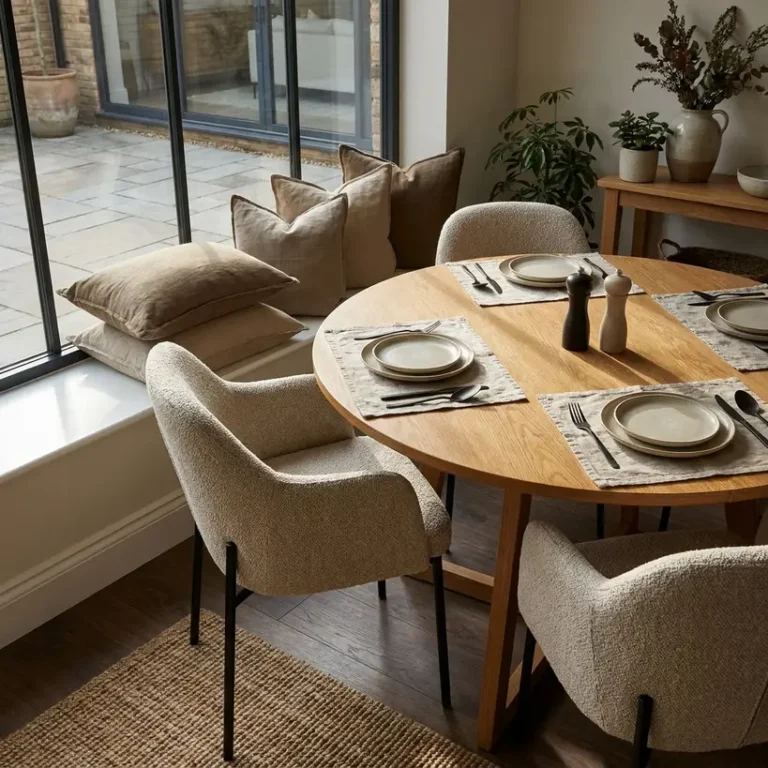
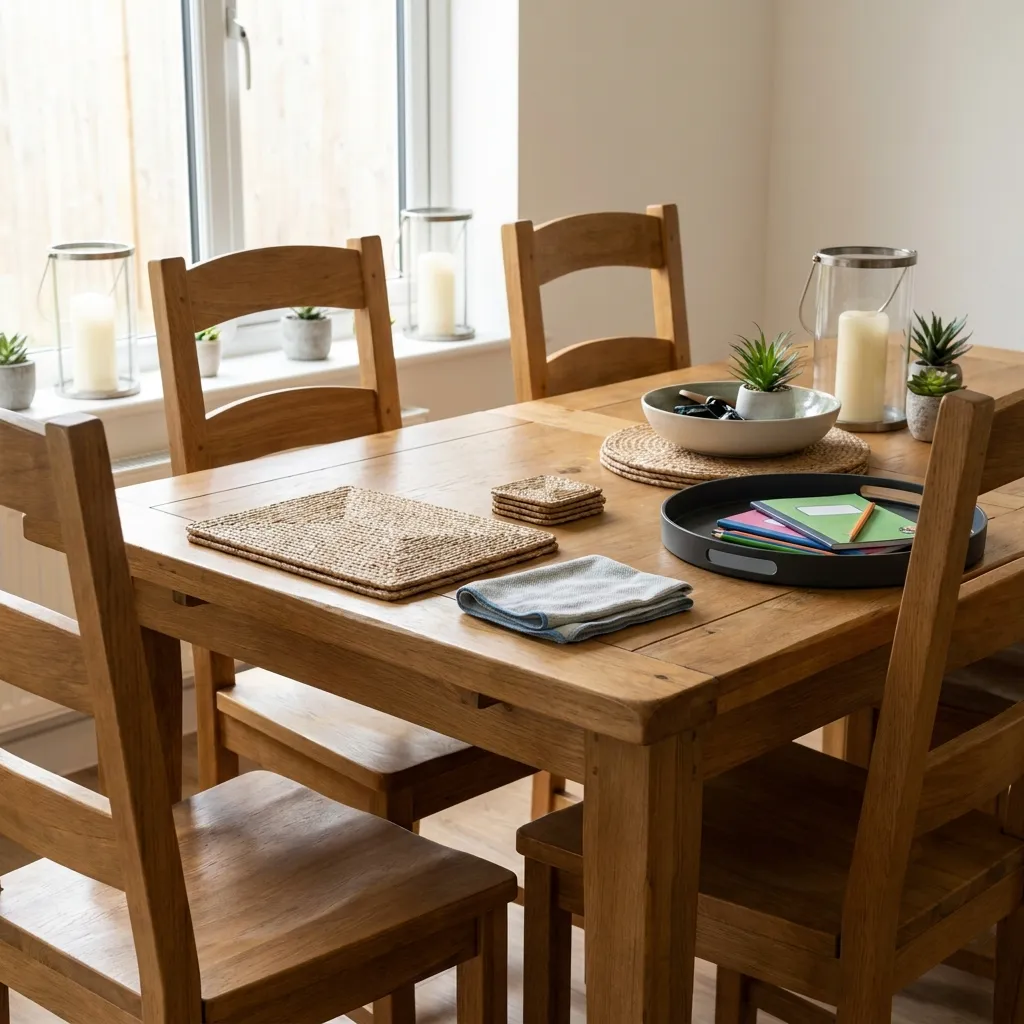
In a lot of homes, the dining room isn’t just for Sunday lunch anymore. It often turns into a homework spot, laptop spot, snack zone, craft zone, and sometimes the place where parcels get opened too, which honestly happens pretty often. That’s why protect wood furniture UK advice needs to be practical, not precious.
A simple protection setup usually works best:
- Put coasters at every regular seat.
- Use placemats for everyday meals, not just formal ones.
- Keep at least one trivet or heat pad on the table all the time.
- Add felt pads under bowls, lamps, candle holders, and decorative trays.
- Use a wipeable runner if the table also doubles as a work zone.
For families with children, clear rules that are easy to repeat usually make things simpler. Drinks go on coasters. Hot dishes go on trivets. Felt-tip pens and paint stay on a craft mat, not directly on the table. It’s basic, but it’s usually much easier to stick to when everyone keeps hearing the same thing.
This is often the point where wood furniture durability UK expectations get set more realistically. Wood is durable, and that’s probably one reason people like it so much. Still, durable doesn’t mean indestructible. Barker and Stonehouse shows the risk from moisture clearly in its Furniture Health Report.
Wooden furniture is particularly susceptible to moisture, which can cause rot, warping, or splitting, while metal pieces are at risk of rust and corrosion if they aren’t protected.
If the layout is still being planned, it helps to make care decisions at the same time as buying decisions. A family dining setup with easy-clean surfaces and practical seating is usually easier to look after day to day. Related sizing and pairing ideas can also be looked at in Choose Dining Table UK Styles for Modern Homes.
For households still deciding on furniture combinations, Best Dining Table Sets for Modern UK Homes can also help with layouts that balance style and durability.
Small protective habits matter more than expensive products
People sometimes assume furniture care comes down to buying specialist cleaners or premium treatments. In most homes, the bigger difference usually comes from simple protective habits repeated consistently. A coaster used every day tends to matter more than a cupboard full of products that rarely get used properly.
Tip: Keep a shallow basket nearby with spare coasters, mats, and a cloth so protection feels automatic instead of turning into a last-minute scramble. Keeping it close usually matters more than people expect, because if those things are in another room, they probably won’t get grabbed in time.
Common mistake: Using tablecloths all the time and assuming that means the table is protected underneath. Moisture can still get trapped, and that may leave marks, so the surface can still end up damaged even when the top looks covered.
Step 4: Control humidity and temperature like it’s part of wood furniture care
This is the part a lot of people miss, even though it’s still one of the biggest parts of wood furniture care UK homes usually need to get right. Wood reacts to the air around it. When humidity goes up, it can swell. When the air gets too dry, it can shrink. Over time, that movement can loosen joints, create small gaps, or put stress on the finish, which is frustrating, honestly.
Authoritative UK conservation guidance recommends keeping furniture in 40 to 60% relative humidity, and the risk of mould, fungal attack, and woodboring insects rises above 70% RH (Institute of Conservation). Specialist guidance for solid wood also suggests a steady room target of around 50 to 55% RH and 20 to 22°C for the best results (Marc Wood Furniture). In real life, that usually means keeping furniture in a room that stays fairly steady, not pushed right next to a radiator, fireplace, or a sunny window that gets strong afternoon light.
Here’s the practical version:
- A small hygrometer in the dining room or main living area will give you a useful reading on conditions.
- Keep large wooden pieces away from radiators, fireplaces, and strong direct sun.
- Where possible, aim for roughly 15 to 20 cm of space from walls or heat sources.
- Regular ventilation helps, especially after cooking or drying clothes indoors.
- In very dry winter conditions, it may help to use a humidifier.
- In rooms that stay damp, better ventilation or a dehumidifier is often the better fix.