How to Make a Small Living Room Look Bigger
TLDR; Short on space? Make your small living room do more.
Keep walkways clear, avoid blocking windows, and use fewer, well-sized pieces. Choose slim-armed sofas, raised legs, open-frame tables, and hidden or multifunctional storage to cut visual weight and add function. A larger rug, lighter curtains, open sightlines, layered lighting, and one clear focal point help the room feel brighter and bigger. Use calm tonal colours and edit hard for a clean, practical modern look in real UK homes.
A compact lounge can still feel calm, stylish, and easy to use day to day, and in many UK homes that matters more than ever. If you’re wondering how to make a small living room look bigger, the answer often starts with layout, light, and careful furniture choices rather than major renovation work. In 2024, the average usable floor space of dwellings in England was 96 m², 25, while privately rented homes averaged 76 m² and social-rented homes averaged 66 m² (English Housing Survey). Flats can be even smaller, as many people already know, with a median floor space of 43 m² in England and Wales according to ONS feasibility research (ONS).
So in the UK, styling a small living room isn’t only about how it looks. It also has to help with flow, comfort, storage, and making better use of every inch without the room feeling boxed in. That’s usually the main balance to get right. Lots of people want to make their home work better without moving or adding an extension, and they need ideas that are practical and attractive for real homes in Shropshire, Staffordshire, Cheshire, Manchester, North Wales, and Birmingham, not showroom spaces.
This guide covers the styling approaches interior designers use to make a compact room feel bigger. It shows how to make a small living room look bigger using layout, furniture shape, colour, lighting, storage, and a few visual tricks. Often, the changes are quite simple. The aim is to help create a modern small living room design that feels open, relaxed, and easy to enjoy every day, so it’s more comfortable to use.
How to make a small living room look bigger with flow first
One of the most common mistakes with a small lounge in the UK is buying the furniture first, then trying to make it fit afterwards. Designers tend to start the other way, with how people actually need to move through the room. If it’s easy to walk through the space, the room usually feels better even before any styling goes in, and that’s something people often miss.
In England, 3% of households were classed as overcrowded in 2024, 25, which goes some way to explaining why smart planning matters so much in smaller homes (English Housing Survey). And even if a home isn’t officially overcrowded, a bad layout can make the room feel far smaller than it is.
A compact living room layout in the UK usually works best when you stick to a few simple rules:
- Make sure there’s one clear route from the door to the main seating area, so you don’t have to squeeze past furniture to get through.
- Don’t block windows with tall pieces or anything too bulky.
- Let the biggest item, usually the sofa, ground the room rather than dominate it.
- Leave some visible floor edges around the room where possible, especially near the walls and corners.
- Use fewer pieces, chosen with more care.
A lot of homeowners assume everything needs to go against the wall to make the room feel bigger. That can help sometimes, but it won’t always give you the best layout. Moving a sofa slightly forward can leave a little breathing space behind it. That also makes the layout feel more deliberate. Designers often do this because it improves visual balance and helps stop the room from looking flat.
If the room is especially awkward, that is covered in this guide on small and narrow living room layout ideas for British homes. You can also explore Small Living Room Ideas UK for Stylish Compact Homes for more inspiration focused on practical layouts.
Choose furniture that looks lighter than it is to make a small living room look bigger
When you’re trying to make a UK living room feel bigger, the furniture’s shape matters nearly as much as its size. Two pieces might use the same amount of floor space, but the bulkier one will usually feel much heavier in the room. In a smaller space, that’s often what makes the layout feel more boxed in than it really is.
Sofas that are too bulky will leave little room for other furniture and movement in a small room, making it feel more cramped,
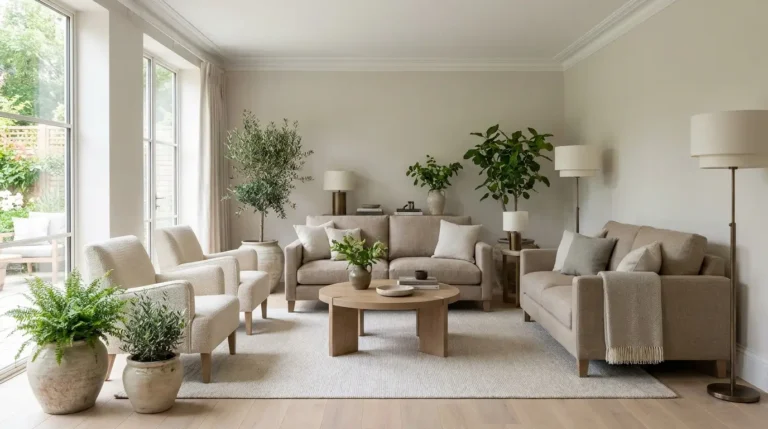
That is why designers often choose sofas with narrow arms, neat backs, and raised legs. These are simple details, but they change how the room feels. When space is visible under the sofa and around the sides, the eye can move through the room more easily. According to Lena Gierasinska’s expert guidance in Ideal Home, slimmer shapes, shallower seats, and visible legs help keep circulation clear in compact lounges (Ideal Home). That is especially useful in smaller UK living rooms, where even small visual gaps can make a noticeable difference.
Linear furniture designs with a minimal profile are ideal for smaller rooms,
This remains one of the most practical small room decorating ideas in the UK because it works with almost any style. Soft-modern homes often work especially well with pieces such as:
- sofas on slim legs
- armchairs with open sides
- side tables with fine frames
- benches or stools that tuck away
- media units with a lighter look
A sofa with raised legs will often feel easier in a room than one that sits flat on the floor. An open-frame chair, meanwhile, can add extra seating without blocking the view across the space. In a UK living room, visual space often comes from letting the eye travel freely from one side of the room to the other. For more furniture guidance, Modern Living Room Furniture UK: Complete Buying Guide looks at sizing and proportions in more detail.
Use open sightlines to create visual space and make a small living room look bigger
Designers often talk about visual weight, meaning how heavy or light something looks rather than what it actually weighs. In a small living room, cutting that visual weight can make the room feel calmer and, often, less cramped. In other words, it just feels less crowded.
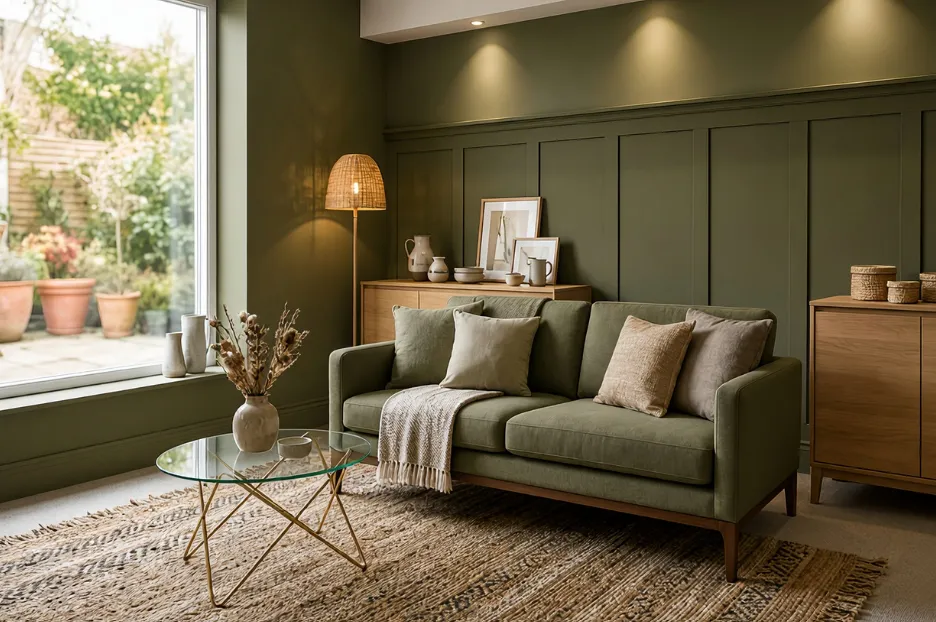
The coffee table is an easy example. A solid, boxy piece can block the eye right in the middle of the room. A glass top, a wire frame, or a table with slim legs, by comparison, usually makes it easier for your eye to travel across the floor. That gives the room a bit more breathing space, which sounds minor but often makes a noticeable difference.
The open lines of a wire metal coffee table gives the illusion of more space as the surrounding scene is visible through it.
It’s a practical way to make a small living room look bigger without changing the room itself. You’re not adding any extra square footage. Instead, the aim is to take out the things that break up the eye line, especially through the centre of the room and in the gaps between larger furniture.
The same idea can work in other parts of the room:
- Choose shelving with a few open sections instead of one fully solid unit.
- If floor space is tight, a wall-mounted media unit can help keep more of the floor in view.
- Go for nesting tables instead of one oversized side table.
- Put a mirror where it reflects light, rather than where it draws attention to clutter.
- Keep window dressings light so they frame the window instead of covering it.
In many UK lounges, especially in terraces, flats, and newer compact homes, one room often has to do several jobs. Once a space starts to look visually busy, it can feel smaller very quickly. That’s why designers often edit quite firmly, usually by keeping the pieces used regularly and removing anything that breaks the line of sight.
If you also need ideas for nearby spaces, how to furnish a small UK home without losing space looks at the home more broadly. Meanwhile, Living Room Ideas for New Build Homes includes more advice for compact modern layouts.
Build a palette that lifts the room without making it bland
Colour often gets oversimplified in small living room styling in the UK. A lot of people assume plain white walls will do the job on their own. Designers, though, tend to handle it with a bit more care. They usually begin with light and mid-tone colours, then bring in contrast, texture, and warmth so the space doesn’t end up feeling flat.
The goal isn’t to make the room feel empty. It should feel open and calm. More grounded, and more comfortable to spend time in.
For a modern small living room design, softer neutrals tend to work well:
- warm white
- light stone
- soft beige
- pale taupe
- muted greige
- gentle sage or clay accents
According to Studio Nine Interiors, small living room trends are moving toward a soft-modern look and layered minimalism, with warmer neutrals and softer textures taking the place of colder, sharper schemes (Studio Nine Interiors). In many UK homes, that tends to suit the space because it feels relaxed, current, and easier to live with day to day.
Designers also tend to work with subtle tonal shifts. Instead of setting the wall colour, sofa colour, and rug colour apart with strong contrast, they keep the shades fairly close. That tends to blur the edges a little and stops the room from feeling too chopped up. It can also make the whole layout feel calmer.
A few simple ways to do that:
- Keep curtains close to the wall colour.
- Choose a rug that blends gently with the floor instead of pulling too much focus.
- Keep large furniture within one calm colour family.
- Bring in depth through texture, such as boucle, linen-look weaves, wool, and timber.
If darker tones appeal, they usually work best in smaller amounts. A charcoal lamp base, walnut side table, or olive cushion can ground the room without making it feel smaller. So the best small living room ideas in the UK don’t avoid character. They just use it with care, usually where it will have the most effect.
How to make a small living room look bigger with layered lighting
Bad lighting can quickly make a compact lounge feel flat. In many smaller rooms, there’s too much dependence on one central ceiling fitting, usually in the middle, and the corners end up dim. That kind of contrast can make the space feel more closed in.
To give a room more depth, interior designers often layer the lighting. In practice, that means using different types of light rather than relying only on the overhead fitting. It’s a simple approach, but it usually works well.
Ambient light
This is the main general light. It’ll usually be a ceiling fitting, a flush mount, or a discreet pendant light, those tend to work well. If the room is small, don’t go for anything oversized or visually heavy; it can make the space feel cramped.
Task light
This supports specific activities, usually reading as the main use. By the sofa, a slim floor lamp often works well. A table lamp on a console can work too.
Accent light
Accent lighting gives the room a bit of mood and more depth. Wall lights, shelf lighting, or a small lamp on a side table can make the room feel softer in the evening, and that can really change things. It’s only a small touch, but it can work really well.
If more of the room is lit, it often feels bigger because you can see more of it in one glance. That can be especially useful in British homes, where natural light can change a lot through the day, sometimes more quickly than you’d expect.
For a compact living room layout in the UK, this setup usually does the job:
- one main ceiling light
- a floor lamp or reading lamp
- a smaller accent lamp
- warm, light-toned shades
Often, that’s enough to make the room feel more complete. Just avoid overly bright blue-white bulbs. In an open-plan lounge, lighting can also help define the seating area around the sofa and coffee table without adding extra furniture. That can make the space feel clearer and more settled.
Best Home Lighting Ideas UK: Curated Designs for Every Space is a useful next read.
Use multifunctional pieces that earn their place
In a small lounge, every piece needs to earn its keep. That doesn’t mean the room should feel stiff or overplanned; in most cases, it’s better if it doesn’t. The aim is to cut wasted space and skip furniture that only does one job.
Recent small-space design coverage often points to multifunctional pieces such as storage ottomans, nesting tables, and furniture that can be tucked away neatly when not in use (Studio Nine Interiors). That’s especially useful for couples, renters, and homeowners who want a layout that can stay flexible without adding more clutter. In a lot of homes, pieces like these make it simpler to shift how the room works from one day to the next.
The most useful living room space saving ideas in the UK usually include:
- a storage ottoman instead of a standard coffee table
- nesting tables rather than two fixed side tables
- a slim console behind a sofa for lamps and baskets
- stools that can also be used for guest seating
- a media unit with closed storage to hide visual mess
What tends to work best is restraint. Designers don’t usually pack a room with clever products just because they can, even if that’s often the temptation. Instead, they tend to pick a few multifunctional pieces that fix the biggest problems in a clear, practical way.
If blankets, remotes, and cables are the main problem, hidden storage is often the best place to start. If the room also needs to handle guests, seating that can be moved around easily may make more sense. And if the lounge also has to work as a place to work, a compact side table may be more useful than bringing in a large desk.
Good small lounge design in the UK usually comes down to choosing fewer pieces that do more, rather than adding extra items that may not earn their place. If you’re comparing layouts for sectionals and modular seating, Modular Sofa Sets UK: Layout Tips for Small Rooms is worth reading.
Style around a focal point instead of scattering attention
A small room usually feels bigger when there’s one clear centre. If there isn’t, your eye jumps from one thing to the next, and the room can start to look cluttered fast, especially when the space is tight. Designers usually build the layout around a focal point, and it’s one of the easiest ways to make a room feel calmer and more settled.
That focal point might be:
- a fireplace
- a window
- a media wall
- a piece of art
- a sofa with a rug grouping
Once you’ve got that in place, the rest of the room can work around it. The sofa can face the focal point or help frame it. The rug anchors the main seating area, usually at the centre of the seating zone, while lighting and accessories can strengthen that same area instead of trying to draw attention to the whole room at once. It’s simple, but it works.
This matters because a lot of small rooms end up trying to do too much. You might have a TV in one corner, a reading chair along another wall, oversized shelving across one side, and decorative objects spread across shelves and tables. The room starts to feel visually noisy, and that usually shows up quite quickly.
A better option is to set up one clear conversation area. If entertaining matters most, when people are sitting together and talking, a layout that lets seats turn toward each other often works better than one aimed only at the TV. If lounging is the priority, keep the setup comfortable and simple, with one strong centre.
This is especially helpful in new build homes, where rooms can feel like blank boxes and a little unfinished. A more focused arrangement adds structure. Most of the time, it makes the room feel intentional and lived in rather than temporary. More settled.
Avoid the styling habits that quietly shrink the room
Many people look for small living room ideas in the UK, but the real issue often isn’t just the room’s size. A few styling habits can quietly make the space feel smaller and less open, especially around the walls, without it being obvious at first.
The most common ones are:
Too many small accessories
Small items spread across shelves, tables, or windowsills can make a room look busy, and often they do. In most cases, fewer pieces, often larger ones, work better. Less clutter, I think.
Rugs that are too small
When a small rug just sits in the middle of the room, the space can feel disconnected, almost like nothing quite belongs together. Most of the time, a larger rug works better, especially if it goes under at least the front legs of the sofa or chairs, and in many cases, it can make the room feel wider.
Heavy curtains
If dark, heavy curtains take up too much wall space, the room can end up feeling smaller and a little closed in. Lighter fabric or tidier folds, though, usually keep the area around the window brighter.
Oversized arms and deep seats
A sofa can sit neatly along the wall and still feel wrong in the room; that happens often. Deep seats matter too, and arm thickness can matter as much as the overall width.
Clutter in open view
Visible cords, stacked papers, extra throws, and crowded shelves all reduce visual space.
In a small lounge design in the UK, that’s where careful editing often helps. A bit of negative space can work well as a design tool, and it’s very useful here. It makes the room read more clearly and usually helps it feel calmer. Knowing how to make a small living room look bigger often comes down to removing visual noise rather than adding more décor.
Frequently Asked Questions
What colours make a small living room look bigger?
Light and mid-tone shades usually work best since they bounce more light around and make edges look softer. Warm whites, soft beige, pale greige, and muted stone tones tend to feel more welcoming than stark, bright white. What matters most is keeping the palette calm and connected, rather than using lots of sharp contrast.
What sofa style is best for a small lounge?
Pick a sofa with slim arms, a neat back, and legs that are raised off the floor. That way, more of the floor stays in view, and it’s often easier to get around the room. A compact two-seater or a well-sized chaise usually works better than an oversized sofa, especially if it takes up the whole wall.
How can I make my living room look larger without decorating the whole room again?
Begin with the biggest fixes: take out one bulky piece, improve the lighting, swap a solid coffee table for an open one, and cut down on visible clutter. Even a few small tweaks can help. Try changing the curtains, adding a larger rug, or moving the sofa slightly forward so the room feels more open.
Are mirrors always a good idea in small living rooms?
Mirrors do help, but only if you put them in the right spot. It should bounce back light, a window, or a part of the room you actually want to draw attention to. But if it shows clutter, tangled TV cords, or a crowded shelf, the room can end up feeling busier instead of bigger.
Where can I find furniture that suits small living room styling in the UK?
It’s worth checking retailers that carry contemporary furniture in good sizes, with slimmer profiles, raised legs, and practical storage. Stick to simple details. If you’re in the UK and comparing stylish indoor furniture that’s also comfortable and lighter in visual feel, RENGARD is one option.
Should I buy all my small lounge furniture as a matching set?
Usually no. In a compact room, matching sets can end up looking a bit heavy and too samey, especially when every piece carries the same visual weight. It usually works better to start with one main anchor piece, then bring in lighter complementary items around it. The whole room feels more balanced that way. If comparing options, RENGARD is a useful reference for mixing modern pieces instead of relying on one bulky full set.
The designer mindset to use in your own home when making a small living room look bigger
A small living room usually feels bigger when you approach it with a designer’s mindset. It helps to ask not only, “does this fit?” but also, “does this leave enough room to move through the space easily?” In many UK homes, the room size is fixed, and that often won’t change. But the sense of space can change a lot, and that usually comes down to the choices you make.
A few principles are worth keeping in mind:
- Think about how people will walk through the room before you buy any furniture.
- Go for slimmer furniture with legs and open frames.
- Leave a clear view from one end of the room to the other.
- Mix different kinds of lighting to give the room more depth.
- Stick to calm, warm colours and bring in texture.
- Add storage that does more than one job where it fixes a real problem.
- Cut back on accessories so the room feels styled rather than crowded.
Taken together, these ideas can make a cramped lounge feel more comfortable, modern, and polished. Whether it is a flat in Manchester, a terrace in Birmingham, a compact home in Shropshire, or a smaller property in North Wales, the same approach still tends to work. The priority should be flow. Try to keep things visually light, and be picky about what stays in the room, because small changes often make the biggest difference.
If the room is being improved gradually, it often helps to start with the sofa, coffee table, lighting, and how those pieces work together in the space. In smaller UK living rooms, those decisions often make the biggest impact. Still, what matters most is usually how everything works together, not simply what is bought. If you want to look at contemporary furniture and décor ideas for compact homes, RENGARD is a handy place to browse inspiration alongside practical options for modern British interiors. Learning how to make a small living room look bigger is often less about dramatic change and more about making careful, consistent styling decisions over time.