Coffee Table Decor Ideas UK for Modern Homes
A coffee table that’s styled well does more than just fill a gap. It plays a big part in the feel of the room, hinting at whether the space comes across as calm, cluttered, polished, relaxed, luxurious, or just not quite finished. Good coffee table decor ideas UK homeowners actually use usually focus on balance, practicality, and texture rather than filling the surface with random accessories. It’s a small feature, but you usually notice the difference straight away. In contemporary homes, it often matters even more because the coffee table usually sits right at the centre of the room’s visual focus, between the sofa and the main seating area. It’s the point where day-to-day use meets design discipline, and you can see that immediately.
For UK homeowners, getting that balance right is often harder than expected. Many living rooms need to handle a lot at once: family downtime, entertaining, reading, drinks, remote work, daily movement through the space, and all the smaller routines that happen in the same area. So the best coffee table decor ideas UK readers can actually use aren’t just about placing attractive objects on a surface. They involve styling with purpose, editing with confidence, and choosing accessories that support a soft, modern look without making the room feel staged. In most homes, that usually means keeping only what adds function, texture, or visual structure. Nothing unnecessary.
That is especially relevant in homes across Shropshire, Staffordshire, Cheshire, Manchester, North Wales, and Birmingham, where contemporary interiors often combine clean-lined furniture with warmer textures and a more welcoming British sensibility. Many homeowners aren’t aiming for stark minimalism, and often wouldn’t want to live with it every day. At the same time, they don’t want spaces that feel cold. They want modern coffee table decor that feels refined yet liveable, with enough softness and practicality to support real routines.
This guide shows how to get that balance right. Inside are the basics of coffee table styling UK homes often respond to, effective accessory combinations, layout formulas for different table shapes, luxury coffee table styling tricks that don’t feel excessive, common mistakes to avoid, and coffee table centrepiece ideas that suit contemporary interiors. If you want a living room that feels professionally styled instead of randomly accessorised, this is a good place to start: clearer layouts, better object choices, and a table that works with how the room is actually used. Clear and practical.
Why coffee table decor ideas UK homeowners use matter in contemporary British homes
Coffee table styling isn’t just a last little touch. It changes how a living room feels and whether it comes across as tidy and comfortable. In the UK, that’s even more important because homes are often smaller than some overseas properties. So every surface you can see carries more visual weight, especially in smaller lounges. A coffee table can tie a room together. It can just as easily make the room feel smaller and more crowded than it really is.
That wider market backs this up too. UK household spending on furniture and furnishings reached £22.722 billion in 2024 (ONS). In the financial year ending 2024, average weekly UK household spending on furniture and furnishings was £10.20 (ONS). That doesn’t track coffee tables by themselves. It does show that furnishing and styling the home is still a significant category for British households, and that’s hard to ignore.
What’s changed is the kind of look people want. Recent editorial trend coverage points to a move towards warmer, more layered interiors. Mixed materials, natural textures, and softer silhouettes are replacing colder, sharper minimalism (Oak & Loom). For contemporary coffee table decor, that usually comes down to fewer objects, stronger materials, and a clearer purpose. More purpose, less clutter. It also shows a closer look at how a table actually works in the room, not just how it appears in a photograph.
A stylish coffee table needs to do a few jobs at once:
- anchor the seating area
- introduce texture
- add personality without feeling forced
- preserve enough clear space for everyday use
Get that balance right and the room often feels more expensive, better considered, and more complete. In practical terms, the seating area usually feels more visually centred, the materials sit more naturally with the rest of the room, and there’s still enough space to put down a drink or a book. For anyone exploring living room ideas for new build homes, this same balance between styling and practicality usually matters just as much.
Start with the designer rule: function first, beauty second
Good coffee table decor starts with a simple question: what do you actually use the table for? If it needs to handle drinks, remotes, candles, books, feet-up moments, and the occasional gathering, the styling has to make space for all of that. There’s no getting around that. Even beautiful setups fall apart pretty quickly when they ignore daily life, and that’s usually when the styling stops working.
The key to interior joy is balancing aesthetics with function, especially when it comes to a high-traffic item like a coffee table.
Keep that in mind with every choice. Before you add accessories, break the surface into practical zones. One area might hold a tray for drinks and candles. Another could be a stack of books. It also helps to leave part of the table open, so it stays useful day to day or when guests come over, which is probably more often than you think. That’s the difference between real luxury coffee table styling and clutter pretending to be design.
A simple framework works well in most contemporary interiors:
1. Clear the whole surface
Start fresh, seriously. That way, it’s easier to judge scale and proportion across the whole surface.
2. Choose one anchor piece
Usually, the best anchor is a tray, a sculptural bowl, or a big stack of books.
3. Add one vertical element
A vase or candleholder adds height, and that usually helps. It’s simple, effective, and you’ll notice it.
4. Include one low object
It might be a small dish, a strand of beads, a box with a lid, or some other low object.
5. Leave visible negative space
Once every inch is filled, the setup can start to feel a bit tense and cramped. A setup looks more settled when there’s open space around the table. That matters.
This usually works best in family rooms, open-plan homes, and smaller spaces, where visual clutter can build up fast. If the wider room around the table is still being refined, it probably helps to read small living room ideas for stylish compact homes, since scale and breathing room matter just as much.
The most effective coffee table decor ideas UK homes use for a soft-modern look
When people in the UK look for coffee table accessories, they usually don’t want lots of tiny decorative pieces. What they want is a balanced mix: tactile, elevated, contemporary, and not at all fussy, though that’s often the tricky part. Nothing overdone.
If you’re styling a soft modern living room, the best accessories usually fit into just a few clear categories. Most of the time, they’re simple, and easier to get right than people expect.
Books
Large-format design, fashion, travel, and photography books bring some instant structure to a room, especially in contemporary spaces where it tends to show up clearly. They make a sturdy spot for smaller objects on coffee tables or shelves, too. Simple. Linen or matte covers tend to work best since they add texture without creating harsh contrast.
Trays
A tray can make the setup look more deliberate and, honestly, a bit tidier. It gives loose pieces a spot, adds some shape, and helps everyday items look pulled together. Simple, but effective. A round tray can soften the lines on rectangular tables. On round tables, an oval or more organic tray usually feels less stiff, which helps.
Vases and vessels
Ceramic, stoneware, smoked glass, and hand-finished metal vessels bring in height and a mix of materials, so you tend to notice them right away. They have a strong presence, and they work just as well with flowers as they do on their own, so they’re a good pick for everyday styling.
Bowls and boxes
A decorative bowl is handy for keys, coasters, and matchbooks, which does help. They’re useful. Lidded boxes keep visual clutter out of sight. They’re still some of the most effective modern home accessories UK interiors often use, since they tend to balance beauty with practicality.
Candles
A candle can make a room feel softer, smell better, and have more atmosphere. If you want a more contemporary look, one larger candle or a close pair usually works better than a cluster of tiny ones.
We also love to bring wood textures into a space through a coffee table, creating a focal point for the room.
Wood texture works especially well in British interiors, where soft daylight and neutral palettes often need natural warmth. Even sleek rooms still need tactile contrast, and that is usually what is missing. If a living room feels slightly flat, materials like wood, ceramic, linen, or stone will often fix it faster than adding more colour, and often with better results.
How to style by shape: round, rectangular, square and ottoman tables
A lot of the frustration UK homeowners run into with coffee table styling starts with advice that’s too generic. You wouldn’t arrange a square table the same way as a slim rectangle, and an ottoman needs treating differently as well. Most of the time, the shape is what changes everything.
Round coffee tables
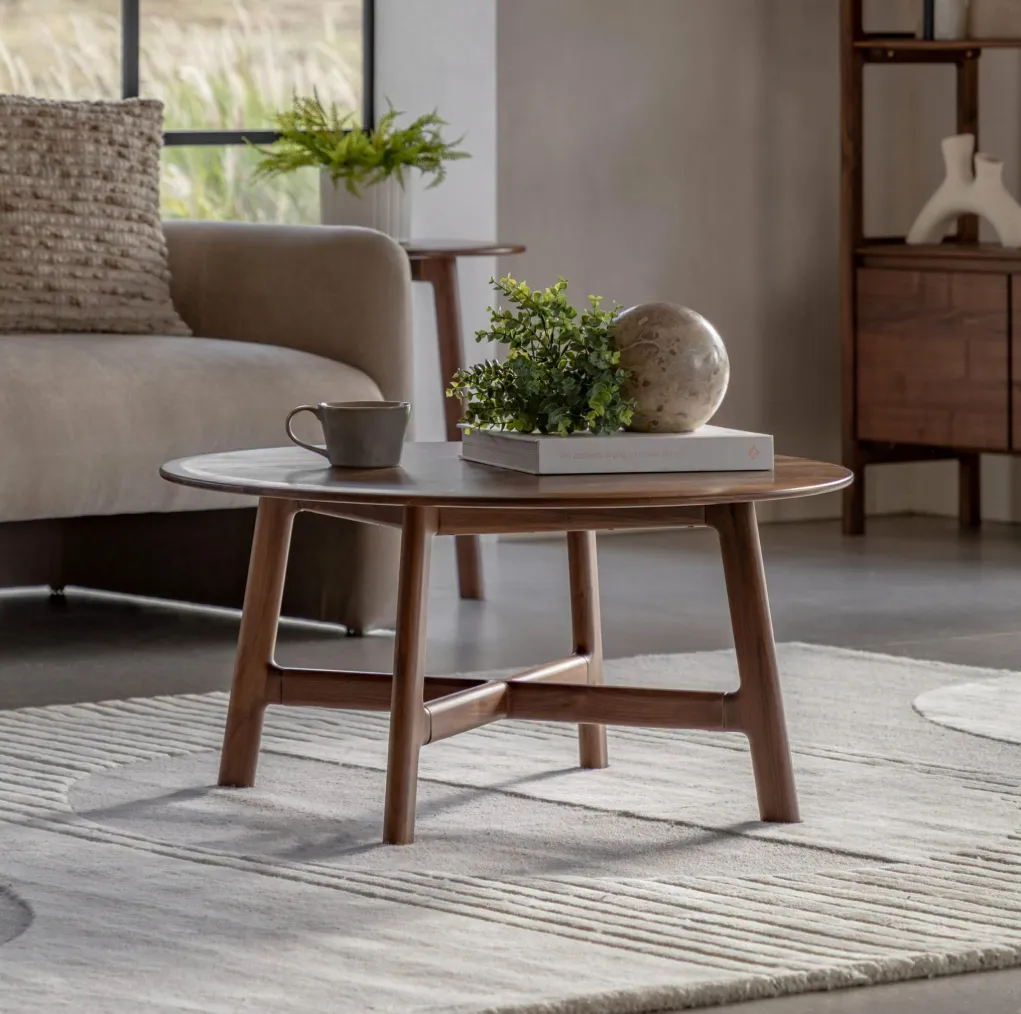
Round tables work well in contemporary rooms: they break up the hard lines of sofas and chairs and make it easier to get around them, which can matter a lot day to day. Trend coverage has also described round coffee tables as practical and stylish in modern homes (Oak & Loom). When you style one, don’t make it too symmetrical. A simple setup is a taller vase, a medium stack of books, and a low bowl or candle. Leave a bit of space around them so each one stands out clearly.
Rectangular coffee tables
These need clearer zones. Try splitting the surface into thirds by eye, since that tends to work well. Put books and a tray in one section, and a sculptural object or floral arrangement in another. It’s an easy way to make the whole thing feel balanced. That keeps long tables from looking too sparse or too crowded, which happens a lot.
Square coffee tables
Square tables tend to look best when the balance is split into four parts. It doesn’t have to be perfectly symmetrical, in fact, that’s often not the best choice, but the visual weight should still feel even. Two small clusters can look better than one pile in the center. Cleaner overall.
Ottoman coffee tables
They work well in homes that need to feel comfortable as well as look good, especially in rooms that get used every day.
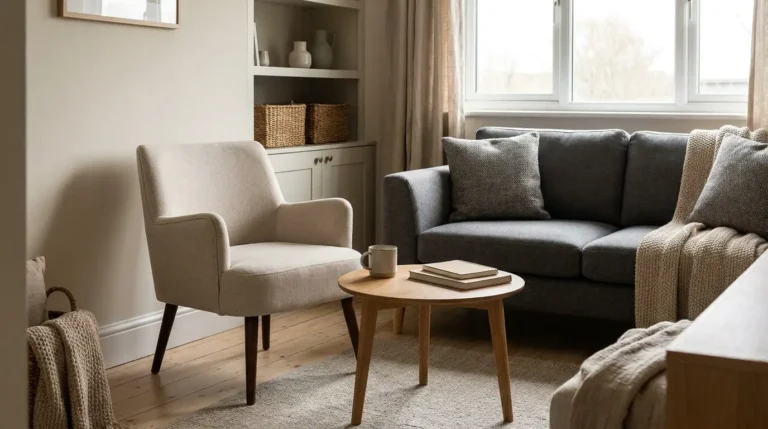
For coffee tables in smaller rooms where the sofa is quite close to the coffee table, a soft upholstery ottoman is perfect, often styled with a tray for drinks or with beautiful coffee table books.
That advice is particularly handy in apartments, townhouses, and compact UK reception rooms, where space can be tight. In this case, a tray really matters: it gives you a steady place to style things and helps protect the softness of the upholstered piece.
For a broader furniture foundation, modern living room furniture UK: complete buying guide gives more context on choosing shapes and proportions that fit contemporary layouts, which can make the decision easier. It can also help to compare layouts with small & narrow living room layout ideas for British homes when working with tighter floorplans.
Colour, texture and material combinations that look expensive
Luxury coffee table styling isn’t just about how much you spend. What makes it look polished is usually restraint: a tight palette, noticeable texture contrast, and accessories with enough presence to draw the eye. That’s often what makes a room feel expensive. Usually, it’s the materials that do the heavy lifting, not simply spending more, even though that’s what people often assume.
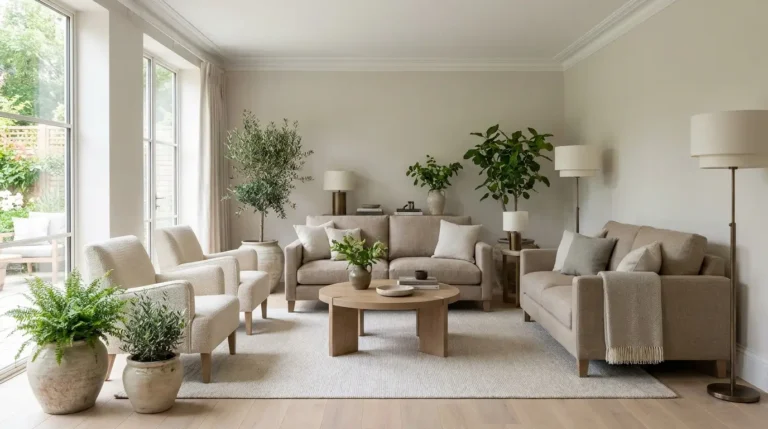
For contemporary coffee table decor, warmer neutrals usually work especially well. Trend coverage shows a move away from colder greys and toward ivory, chalky neutrals, warm whites, and greige tones in living room styling (Furniture in Fashion). These shades suit soft modern schemes because they catch light gently and sit naturally with timber, bronze, black accents, and stone. They often work best when they appear both in the main table styling palette and in the surrounding soft furnishings, where that balance helps the room feel settled. Quiet, but effective.
Texture matters just as much as colour here. Jeremiah Brent said, “Verdigris is definitely having a moment, I love how it feels neutral yet colorful all at once” (Vogue). Even if you don’t use verdigris itself, the same principle applies here: some colours behave almost like neutrals when they’re muted and closely tied to the material they come from. A green-grey glazed vase, for example, can add depth without disrupting a calm palette. That’s often why these tones feel more refined than flatter decorative colour choices.
Try these combinations for modern coffee table decor:
- Oak + travertine + linen books for warm minimalism
- Walnut + smoked glass + black metal candleholder in urban contemporary rooms
- Ivory ceramics + taupe books + brushed brass tray for understated luxury
- Stone bowl + muted green vessel + natural wood beads for soft modern living room decor
Controlled contrast tends to work better. Smooth surfaces often look better next to rougher ones, and matte finishes usually benefit from a subtle sheen nearby. Try pairing curved shapes with straighter lines to add visual depth to coffee table centrepiece ideas without making the arrangement feel busy. Most of the time, that kind of balance gives the whole setup a more considered, expensive finish.
The one-centrepiece method for a polished focal point
If your coffee table feels scattered, the easiest fix is often to stop adding lots of accessories and start with one statement piece. It’s one of the most useful coffee table decor ideas UK homeowners can try, because it makes the rest of the decisions easier, and that’s often half the battle.
And we love a ‘wow’ piece on a coffee table, after all, it’s usually at the centre of the room, like a unique basket or hand-painted ceramic vase
One strong centrepiece gives the table a clear sense of hierarchy straight away. Rather than having several objects all fighting for attention, you notice one focal point first, then the supporting pieces around it. It sounds simple, but that’s often what makes the table look more finished. In practice, that usually means:
- a sculptural ceramic vase with seasonal branches
- a large decorative bowl in stone or wood
- an artisan basket on an ottoman table
- an oversized design book topped with a single object
- a low floral arrangement in an organic vessel
This approach works especially well in open-plan homes, where the coffee table needs enough presence to stand up to nearby dining tables, kitchen islands, and media units. It also suits professionally styled spaces because it feels considered rather than busy, and that difference is usually easy to spot straight away.
Sometimes the problem isn’t the arrangement itself but what’s underneath it. If the room around the table still feels visually disconnected, the rug may be part of the issue, because a coffee table display often looks better when it sits on something stronger and more grounding. So modern rugs to elevate your home decor can probably be a useful next read.
Styling for different living room moods: minimal, warm, luxe, and lived-in
Not every contemporary living room calls for the same finish, and that’s usually pretty clear. Some homeowners want a crisp, architectural look; others go for something softer and more layered. In UK homes, coffee table styling works best when it fits the room’s mood instead of working against it.
Minimal contemporary
Keep the colors muted, and don’t crowd the surface with too many objects. Go with one tray, one stack of books, and one sculptural piece. For this look, clean, strong shapes count more than decoration. That’s what matters most.
Soft modern
Right now, this is one of the directions that tends to appeal most in UK homes. You get rounded shapes, warm neutrals, textured ceramics, and natural materials, so it ends up being a practical mix. Across broader decor coverage, there’s often a move toward earthy palettes and biophilic touches, along with comfort-first interiors where accessories bring in warmth without a major renovation, and that’s often why it works (About Wall Art). Readers exploring coffee table decor ideas UK trends often lean toward this softer style because it feels easier to live with every day.
Quiet luxury
Go with fewer pieces, but make them count: thick books, stone trays, smoked glass, polished wood, details you can actually feel. Then bring in metallic accents, but choose them with care. The whole thing should feel solid and restrained, not ornate.
Collected and personal
Even this style needs a light touch. A travel object, a small candle, a personally chosen book, maybe a hand-thrown bowl can all work, as long as nothing starts to feel too fussy. Keep the mix tight, though, so the table still looks intentional instead of overcrowded.
What matters most here is consistency. The coffee table should pick up on the room’s style, since that’s usually what gives the strongest result. If the sofa is curved and upholstered, harsh, angular metal objects can feel out of place next to it. In a sleek, monochrome room, too many rustic accessories can soften the design and make it feel less cohesive. Similar principles also appear in mirror styling ideas UK for elegant rooms, where balance and proportion matter just as much.
Common coffee table styling mistakes that make rooms feel cheaper
Even great accessories can miss the mark if the arrangement is off, and you can usually tell at a glance. Most styling issues trace back to seven common mistakes. Usually, the fix is simple.
Too many small items
Small candles and ornaments can make the room look busy. Using fewer, larger pieces usually feels more considered and makes the space look cleaner.
No variation in height
When everything sits low and flat, the arrangement can look dead, and it usually does. Just add at least one vertical form; that’s an easy fix.
Ignoring scale
On a large coffee table, one tiny candle set in the middle can look unfinished and, honestly, a bit off. Choose pieces that fit the table’s scale. Most of the time, it’s an easy fix.
Perfect symmetry in the wrong room
Symmetry can work, sure. But in relaxed contemporary spaces, it can come off a bit forced or stiff, so go for balance instead.
Styling without function
If guests have nowhere to put a glass down, the styling hasn’t worked. ONS said household-goods stores grew in the three months to January 2026, and retailers partly put that down to strong January furniture promotions and seasonal sales (ONS). Taken more broadly, that buying momentum often points to people still spending on homes they can actually use, not just image-led rooms where tables, storage, and seating are there to be used.
Overusing trends
One trend-driven piece can freshen up a room, and that can help. But if a table is covered in trend pieces, it’ll probably look dated before long, and it tends to show.
Forgetting the view from every seat
Walk around the table and look at the setup from the sofa, the side chair, the doorway, and the sightline to the television; it’s worth the minute it takes. Styling usually has to hold up from more than one angle, and you often don’t notice what’s off until someone actually moves through the room.
Try taking away one piece. It’s basic, but it works. If the arrangement looks better as soon as you do that, there was probably too much on the table.
Where to buy and what to look for in modern home accessories
If you’re choosing coffee table accessories UK buyers should actually prioritise, it’s better to think about a practical styling kit than about filling every empty bit of space. You usually don’t need dozens of pieces, since a lot of them end up sitting there unused. A smaller mix of versatile items you can switch around with the seasons usually keeps the table usable and helps it avoid looking cluttered.
A good kit often includes:
- one tray in wood, stone, leather-look, or metal
- two to four large-format books, plus
- one statement vase or vessel
- one decorative bowl or box
- one candle or candleholder set
- one optional seasonal accent, such as branches or fresh flowers
The materials matter too, especially in modern interiors. Contemporary rooms tend to show finishes more clearly than heavily traditional spaces, so lightweight plastic, shiny coatings, and overly decorative details can stand out very quickly, and usually not in a good way. In most settings, solid-feeling ceramics, real wood tones, matte glass, and natural textiles tend to look better and sit more naturally within a modern scheme.
In the wider UK furniture market, household spending on furniture and furnishings reached £20.15 billion in 2025, up 3.2% year on year (FIRA). That suggests it’s an active category, with plenty of options for shoppers. Retailers such as RENGARD can be especially useful if the aim is to coordinate modern furniture with accessories, so the overall look feels cohesive rather than pieced together from unrelated styles. Often, that’s the simplest way to keep finishes, scale, and colour direction matched, particularly when buying across more than one room. If you’re also comparing furniture proportions, best modern coffee tables UK 2026 is another useful reference.
Frequently Asked Questions
How many items should go on a coffee table?
For most modern living rooms, three to five pieces usually do the job, as long as they differ in height, shape, texture, and scale. The count itself matters less than whether the setup feels visually balanced. You also need some open empty space for everyday use.
What is the easiest way to make a coffee table look professionally styled?
Pick one anchor first, like a tray or a stack of books, and then add one taller object plus one lower accent piece. Stick to a limited palette, and don’t fill every spot. That way, the coffee table feels intentional instead of cluttered.
What colours work best for soft modern living room decor?
Warm whites, taupe, greige, stone, muted green, mocha, and soft black accents tend to look especially good here. They’re solid picks, and they add depth without making the room feel as cold as stark, grey-heavy schemes can.
How do I decorate a coffee table in a small UK living room?
Go with fewer accessories, and make them a bit larger instead of using lots of small pieces. Put them on a tray so it all stays contained. If you’re working with a compact space, a round table or ottoman is easier to move around, and it still gives you room for stylish decor. Many compact coffee table decor ideas UK homes use follow this exact approach because it keeps the room feeling open.
Where can I find coffee table accessories that suit a contemporary British interior?
Look for retailers that lean toward modern furniture and tactile, understated decor, rather than heavily themed accessories. RENGARD is worth a look. Its pieces work well in a contemporary home that feels premium but still accessible.
Should coffee table decor match the rest of the room exactly?
No. It should fit with the room, not match it exactly. Pick up a couple of details, like the wood tone or the metal finish. Then let the table bring in some contrast with its shape and texture, so the space has more layers.
Bring the whole room together with smarter styling choices
The best coffee table decor ideas for contemporary interiors don’t come from copying a showroom setup piece by piece, because that rarely feels right in a real home. What usually matters is knowing why some layouts work: controlled colour, layered texture, balanced height, practical space, and a clear focal point. Once you’ve got that clear, styling the table tends to feel easier and more natural.
In most UK homes, the approach is fairly simple. Use fewer accessories, but choose materials with more presence. Wood, ceramic, stone, glass, and linen often do most of the work. A statement piece helps, and a practical grouping element such as a tray or bowl keeps everything grounded, while negative space in the centre or around the edges keeps the surface usable day to day. That’s often what gives coffee table styling in UK homes a polished, comfortable finish without making it feel overdone or excessive. The most effective coffee table decor ideas UK homeowners return to usually rely on that same balance.
When the goal is to refresh the whole living room rather than a single surface, it usually works better to tie the table in with the furniture around it instead of leaving it as an afterthought. That tends to give a better result, especially when each piece needs to support a clear, cohesive look. Looking at contemporary furniture and accessory combinations through a curated retailer such as premium home and garden furniture retailer can help build a room that feels consistent from the rug upward, which in many cases makes the entire space look better.
Modern coffee table decor should make a living room feel calmer, warmer, and more intentional. Start with function, edit firmly, and then style with confidence. The effect is often immediate: even a small surface can change the atmosphere of the whole room when it is handled well.