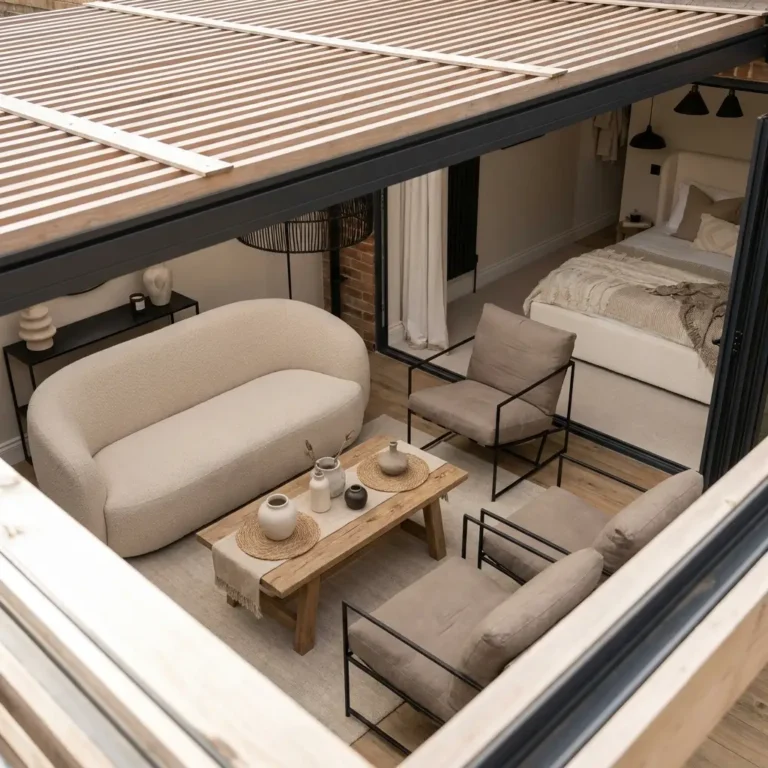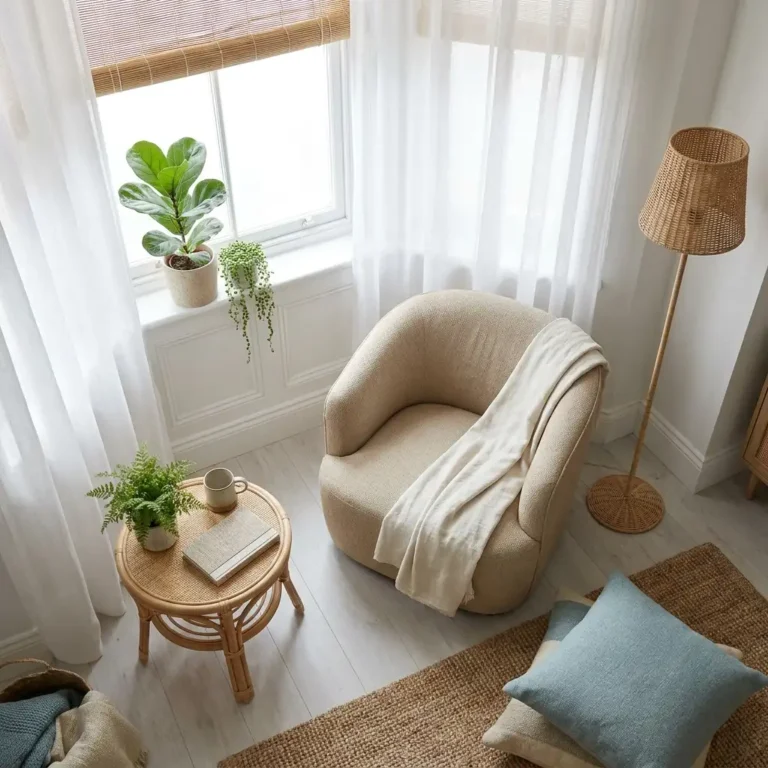
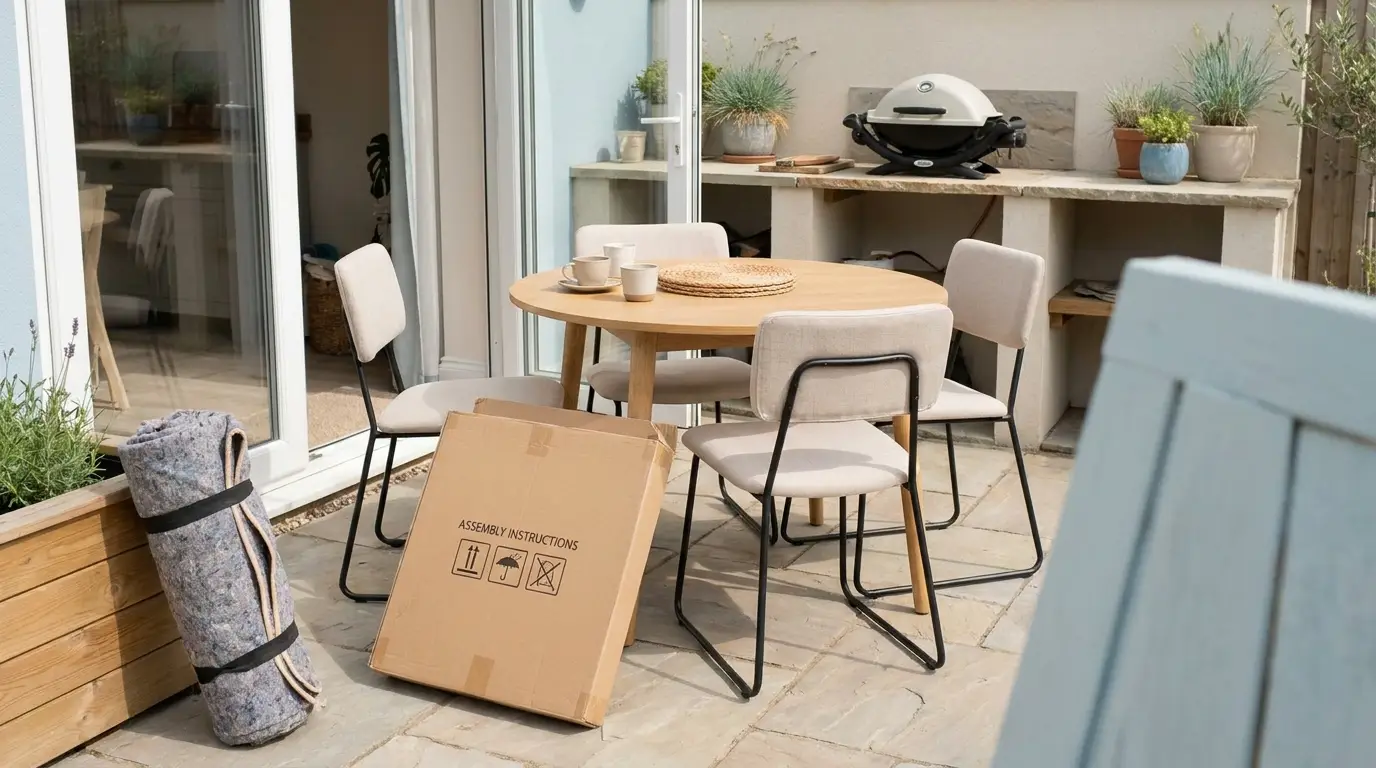
Dining Chairs for Small Dining Rooms in UK Homes
Small dining rooms ask more of every piece of furniture. A chair can’t just look good. It also needs to slide neatly under the table, stay comfortable through a full meal, and move easily when guests arrive, which is often where things become awkward. Just as much, it shouldn’t make the room feel boxed in or crowded. Getting that balance right isn’t always simple. Because of that, more buyers are looking for dining chairs for small dining rooms, compact dining chairs UK shoppers can trust, and modern styles that fit real British floorplans.
This applies across the UK, from flats in Manchester and Birmingham to narrower period homes in Shropshire, Staffordshire, Cheshire, and North Wales. According to the English Housing Survey, the average usable floor space of English homes was 96 square metres in 2024, while privately rented homes averaged 76 square metres and social-rented homes averaged 66 square metres (UK Government). In smaller homes, the need for space saving dining chairs UK homeowners can truly live with every day becomes clearer. That is often even more obvious when the dining area shares space with the kitchen or lounge.
In this guide, you will learn how to choose slim dining chairs UK buyers often prefer for compact rooms and which dimensions matter most. It also looks at materials that can help a room feel lighter, often by reflecting more light and reducing how heavy furniture looks. There is also practical coverage of dining room seating ideas UK households can use in flats, terraces, and open-plan layouts, along with common mistakes to avoid if you want small dining room furniture UK homes can use comfortably for years, which is usually the real goal.
Why compact dining chairs matter in British homes
Space-saving seating is no longer a niche concern. It reflects how many people in Britain actually live, and the numbers make that fairly clear. The Office for National Statistics reported an average UK household size of 2.35 people in 2024 (ONS). That helps explain why two-seat and four-seat dining sets are so common, especially in kitchens, flats, and open-plan living spaces, where each part of the room often needs to work a bit harder.
The pressure shows up even more clearly in the rental market. In 2024, 17% of privately rented homes and 26% of social-rented homes were under 50 square metres (UK Government). In homes of that size, bulky upholstered chairs with wide arms can take over a room surprisingly quickly, especially around the table and along main walking routes. Narrow dining chairs UK buyers often choose use the available footprint more efficiently without losing the ability to host, eat in comfort, or use the table for work, which in many homes is part of daily life. It is a practical trade-off.
It is not just about fitting more seats around a table, either. Compact dining chairs also affect how people move through the room. They usually leave clearer walkways, tuck more neatly under the table, and reduce visual clutter. That can help a dining area feel calmer and, in many cases, look larger even when the floor space stays exactly the same.
Interior advice supports that view. As designer Nicky Emlick told Ideal Home:
In smaller spaces, it’s about choosing furniture that works hard without compromising on comfort, a properly sized table and comfortable chairs can transform even a compact area into a sociable dining space.
That idea sits at the centre of the best compact dining chairs UK shoppers compare. They bring less bulk, more function, and still enough comfort for everyday use. Simple, but still important.
The chair features that save the most space in dining chairs for small dining rooms
When people look at space saving dining chairs UK stores offer, style is often the first thing they notice. That matters, of course. But in everyday use, the biggest difference usually comes from a few practical design details. They affect how much room a chair really takes up, and also how open or crowded the room feels, which is often what people notice first.
Width is a good place to start. Slim dining chairs UK buyers often choose usually have narrower seats and backs, so it is easier to fit four chairs around a modest table in a smaller dining area. Armless styles help even more because they don’t add extra width. They also slide fully under many tabletops, so they are less likely to stick out into the walkway, and that often makes daily use easier.
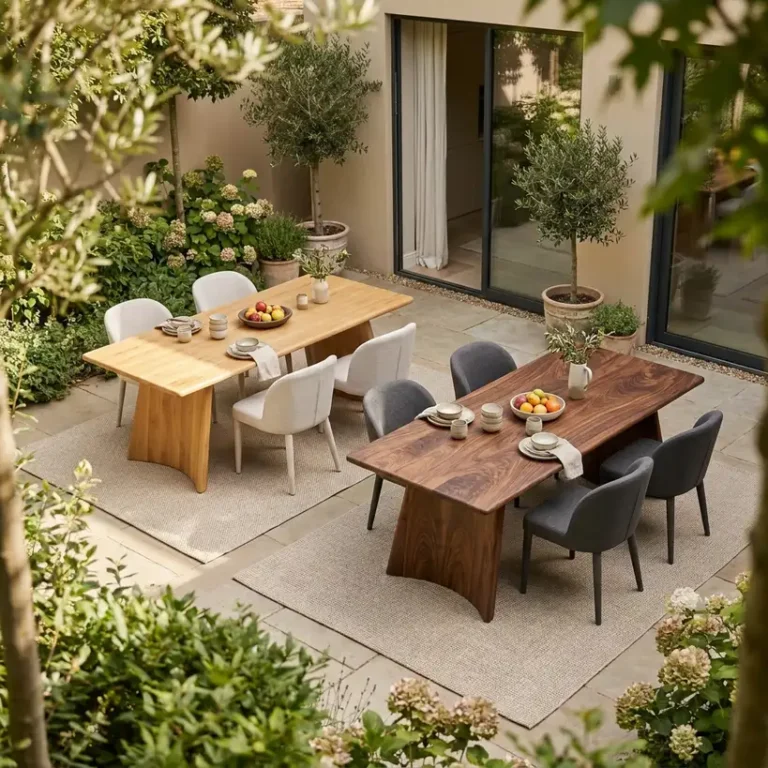
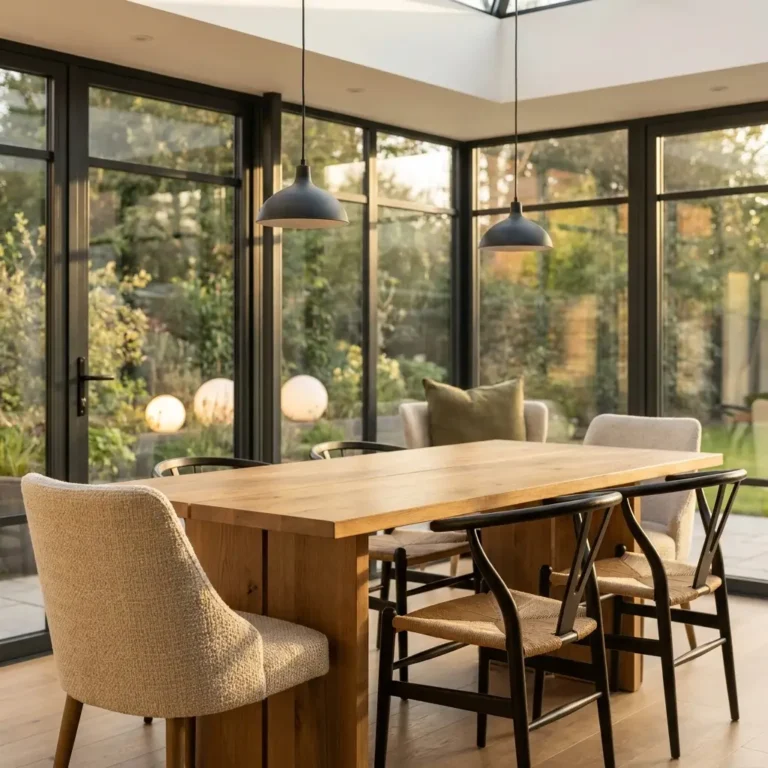
The frame matters too. Open-frame chairs, sled bases, slim legs, and similar details leave more floor visible beneath and around the chair. That extra openness can make a compact room feel calmer and less crowded. That is often one reason lightweight dining chairs UK customers like tend to use slim timber or metal frames rather than thick, fully upholstered shapes.
Back height also makes a difference. In a small room, a very tall chair back can feel visually heavy. A lower back, or one with a gentle curve, often feels softer and less imposing. It also suits the current move toward soft-modern interiors, where comfort sits alongside clean lines without feeling too sharp or too formal.
A simple checklist helps:
- Choose armless chairs if every centimetre counts
- Look for open sides or open backs so the chair feels lighter in the room
- Pick chairs that tuck fully under the table
- Check the loaded footprint, not just the seat size
- Prefer lighter frames if you often move chairs for guests or for cleaning
If the whole room is being planned, it helps to think about the chairs and table together rather than as separate choices. In most cases, the result is better when spacing, chair width, and how far each chair pulls out from the table are considered together. More on table sizes and layouts for compact rooms is covered here: Modern Dining Tables for Small Spaces UK. You can also compare layouts alongside Match Dining Chairs With Table UK for Modern Homes if you are trying to balance proportions in a tighter room.
How to choose the right size without guessing
Buying compact dining chairs should feel simple, but many people run into the same problem: they measure the table and miss the space people need around it, which happens often. It’s an easy mistake to make. A chair that looks slim online can still feel awkward if it doesn’t tuck in properly or if the back hits the wall behind it.
A better way is to think about it in layers. It’s simple, but it often works better.
Step 1: Measure the usable zone for dining chairs for small dining rooms
Measure the full area for the dining setup, not just the tabletop. Also include any path to the kitchen unit, patio door, hallway, or sideboard, since that’s easy to miss. In small homes, circulation often matters as much as seat count, and that point matters a lot.
Step 2: Measure table clearance
Measure how far the chair can slide under the table, since that often makes a real difference. In compact rooms, pedestal and round tables usually work well because there are fewer legs in the way. Homes & Gardens also points to round tables as a good option for smaller spaces because they improve movement flow. They can also soften the room’s footprint, which probably helps (Homes & Gardens).
Step 3: Check real chair width
Labels like ‘compact’ or ‘slim’ can be vague, so it helps to check the actual measurements. Compare the maximum outer width with the back width, and see if the legs flare out. Narrow dining chairs UK buyers like usually have a controlled widest point, often at the seat or back.
Step 4: Think about daily life with dining chairs for small dining rooms
Do the chairs usually stay in place, or are they moved often? Do children use them? Will one side of the table sit against a wall or next to a bench? Questions like these often make it easier to tell which size fits best, especially when the setup is viewed in context.
Before buying, sketch the layout from above. Even a quick drawing can show whether four chairs will fit well or whether two chairs and a bench may work better. If the dining area is part of a larger open-plan room, Dining Tables That Make Rooms Feel Larger probably has useful ideas for improving flow and making movement easier.
Best chair styles for small dining rooms
Not every modern chair works in a compact room. Some look refined in a showroom but, in many smaller homes, end up feeling bulky and crowded, which can be frustrating. The best dining chairs for small dining rooms usually have one thing in common: they offer comfort without taking over floor space. Simple, but suited to what small rooms need.
Slim upholstered chairs for dining chairs for small dining rooms
These work well if softness matters but a large padded seat feels too bulky or heavy to look at. Look for neat tailoring, narrow seat pads, and slim legs to keep the overall look lighter. They often suit soft-modern and contemporary homes, and can make a dining area feel warmer. For buyers comparing textured fabrics, Bouclé Dining Chairs UK: Comfort, Texture & Contemporary Style explores styles that still keep a lighter overall profile.
Timber-framed chairs
Wood adds warmth and texture, which often helps. In smaller rooms, a light-profile frame usually works best. Chairs with visible legs and softly shaped backs tend to feel less heavy and bulky than thick, blocky forms. It’s a simple change.
Metal or mixed-material chairs
These are often some of the lightest dining chairs used in UK homes. They’re easy to move, which can help in daily use. Their clean, simple look also suits kitchen-dining spaces that need practical seating every day.
Stackable or occasional chairs
If you host now and then rather than every day, stackable chairs or a small number of extra accent chairs can be a smart choice. In most cases, they are practical as well. Most of the time, they cut down on visual clutter and still give the room more flexibility when guests stop by.
A more tailored look can also help a small room feel more thoughtfully arranged. Jessica Hubner shared design advice in Homes & Gardens suggesting that mixing chairs and tables from different sources can create a more individual, polished effect than buying a full matching set (Homes & Gardens). In a compact room, that often means pairing a simple table with more refined contemporary dining chairs for apartments instead of choosing a bulky matching set, which can start to feel heavy quickly.
Layout ideas that make compact rooms work harder
Once the right chairs are in place, the layout is often the next big improvement. Many small dining room furniture UK issues are really about how the room is arranged. The furniture itself may be completely fine, but the space can still feel awkward when the seating plan uses floor area badly, and that happens more often than people think.
A practical way to improve this is to mix seating types instead of relying on four matching chairs. A bench on one side, two compact dining chairs opposite, and a chair at the end will often create better flow. It is usually a more flexible setup for compact rooms. House Beautiful has also pointed to the continued rise of dining nooks and banquette seating in kitchen design coverage, which supports this kind of adaptable layout (House Beautiful).
For very compact homes, a few layouts tend to work especially well:
- Round table with four slim chairs to make movement around the table easier
- Rectangular table with one side against a wall, using chairs only on the open sides where people actually sit
- Bench plus two chairs if extra seating is needed without requiring as much pull-out space
- Two statement chairs and two lighter side chairs to keep the room feeling more relaxed visually
- An occasional extra chair from another room brought in only when needed
This approach often works especially well in homes across Birmingham, Cheshire, North Wales, and Manchester, where open-plan kitchen-dining spaces are common and every walkway counts. If the dining area also connects to a snug or a narrow lounge, Small & Narrow Living Room Layout Ideas for British Homes can help frame the room as one connected space instead of focusing only on the table, which is often where the real issue begins. People furnishing multifunctional spaces may also find Modular Sofa Sets UK: Layout Tips for Small Rooms useful when planning flow between dining and seating zones.
Interior designer Katharine Pooley sums up the mindset clearly:
You don’t need a big house to have fun with the design.
A compact room doesn’t need to feel plain or compromised. A good layout will often help the style do more by making the space easier to move through and more comfortable to use every day.
Materials and colours that make chairs feel lighter
In small rooms, the way something looks can shape the sense of space almost as much as its actual size. Two chairs with similar dimensions can feel very different because of colour, texture, and material. It’s a subtle difference, but it’s usually one people notice. Even so, the effect can be larger than expected.
Lighter woods, muted painted finishes, and soft neutral fabrics often help compact dining chairs UK buyers look for sit more quietly in a room. That doesn’t mean everything needs to be pale beige, and it often works better when it isn’t. The main idea is simply to avoid bringing in too many heavy visual blocks at once. If the table is dark and solid, lighter chairs can soften the overall setup and make the dining area feel less dominant.
Open-grain wood, linen-look upholstery, smooth woven fabrics, and matte metal frames usually feel more relaxed than glossy, heavily padded designs. In many homes, these materials also fit well with contemporary and soft-modern interiors. Those styles often stay popular because they tend to feel welcoming rather than cold, while still being easy to live with.
Recent commercial trend coverage has also pointed to slimmer profiles, soft curves, and tactile finishes in dining chair design (Furniture World). That said, trend pieces shouldn’t be treated as official data. Still, they can show what many buyers are drawn to now: practical chairs that also feel warm and refined, often with less visual weight and a more comfortable overall look.
A few simple rules help:
- Match visual weight to room size
- Use texture for warmth instead of bulk
- Let chair legs show where possible
- Choose colours that sit calmly with floors and walls
- Add contrast with a cushion or centrepiece, not oversized seating
Common buying mistakes in small dining spaces
A very common mistake is buying for the photo instead of the real room. A chair may look elegant on a clean product page, but the more useful question is what happens when four of them are placed around your table in a real home, because that is usually the real test. What matters most here is how they fit around the table, how much space they leave between each place, and whether people can still move through the room easily.
Another frequent mistake is choosing chairs that are too wide. Just a few extra centimetres per chair can mean losing a seat or ending up with a layout that feels cramped. Pull-back space is also easy to miss. A chair might slide neatly under the table, but still block the walkway behind it once someone is sitting there, which is often more annoying than expected. In most cases, it helps to think about the chair in both positions: tucked in and pulled out.
A third issue is too much upholstery. Soft seats are appealing, but thick padding on the seat, back, and sides can make a compact room feel crowded simply because there is so much visual and physical bulk. A fourth mistake is buying chairs that are too heavy to move. Lightweight dining chairs UK buyers often prefer can be useful for portability, and they also tend to make everyday cleaning or hosting easier.
Another mistake is treating matching furniture as a rule. Kristen Scharer, writing in the broader small-room design discussion featured by Homes & Gardens, stresses the need for furniture that fits the room proportionally (Homes & Gardens). In practice, that often means focusing on the right scale instead of buying a full matching set, which is usually the more useful approach.
If you’re browsing options from a retailer such as RENGARD, comparing product dimensions is a good start. It also helps to look closely at the frame shape and consider whether the chair is likely to tuck in fully, rather than relying only on the front view. Those details often matter more in daily use than they do on the product page. Buyers comparing dining chairs for small dining rooms may also find it useful to review Best Dining Chairs for Everyday Use when balancing comfort with a smaller footprint.
Smart choices for renters, apartments, and multipurpose rooms
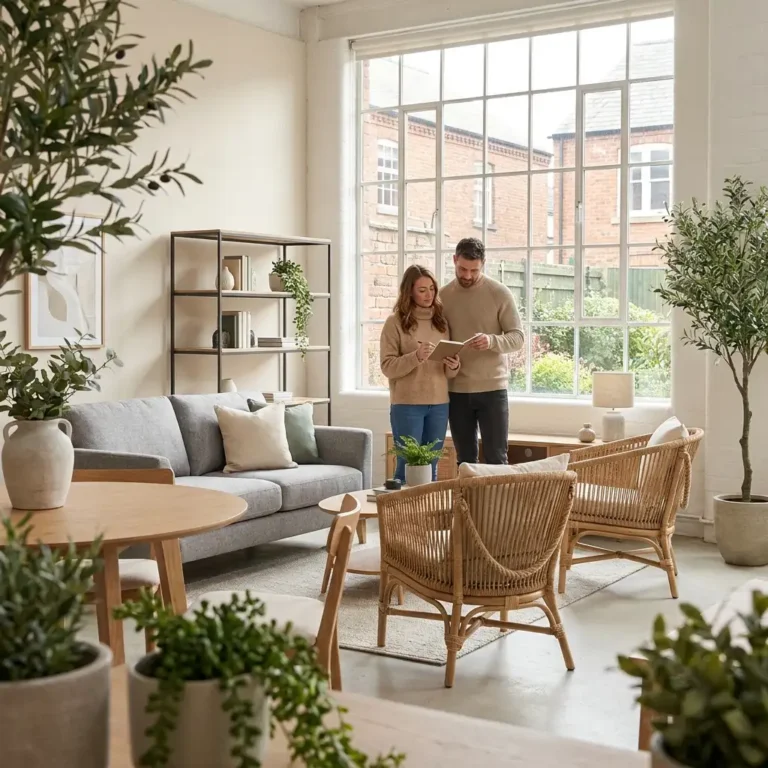
Compact dining is often shaped less by a formal dining room and more by the way shared spaces are used. A table might sit in the kitchen, at the end of the living room, or next to bi-fold doors, which is a fairly common setup. In smaller homes, contemporary dining chairs for apartments usually need to do more than one job, and that tends to become clear quite quickly.
For renters, lighter and smaller chairs are usually easier to move from one home to the next. They also lower the chance of awkward moves in tight stairwells and narrow doorways, especially on landings, around corners, and through flat entrances. It is a practical detail, but often an important one. The need is clear: the ONS recorded average UK private rent for a one-bedroom property at £1,060 per month in December 2024 (ONS). With housing costs at this level, furniture that suits a home now and still works well after a move is likely to be more useful and, in many cases, better value as well.
Multipurpose rooms usually work better with chairs that can be moved easily into other parts of the home. A slim upholstered dining chair may also work at a desk, in a hallway as a spare seat, or in a bedroom when needed. This is useful because, in most homes, furniture isn’t bought for one fixed layout only. That kind of flexibility is especially helpful in apartments and smaller terrace homes, where space often needs to serve more than one purpose.
For couples furnishing a first home or updating a smaller dining area, it’s worth looking for:
- chairs with a modest visual profile
- finishes that can work in more than one room
- durable fabrics that are easy to live with
- frames that stay light enough to move and stable enough for daily use
Frequently Asked Questions
What type of dining chair is best for a small dining room?
Armless chairs with slim frames are the best choice because they take up less space and slide in more easily. Open backs and narrower seats make the room feel less crowded, and lighter materials also help.
How many chairs can fit around a compact dining table?
It depends on the table shape and the full outer width of each chair. In many UK homes, a compact round or rectangular table works best with two, three, or four slim chairs instead of wider padded designs.
Are upholstered chairs a bad idea in small spaces?
Not at all. Upholstered chairs can work very well when the padding stays neat and the frame stays slim. They offer comfort without oversized sides, thick arms, or bulky backs.
What should I look for when buying compact dining chairs in the UK?
Review the full product dimensions, not just the seat size, and make sure the chairs fit properly under your table.
When comparing modern indoor furniture, check finishes, delivery support, and practical sizing details before buying. Retailers such as RENGARD can help. Keep the focus on practical details.
Are lightweight dining chairs less durable?
Not necessarily. A lightweight chair can still be strong if the frame, joints, materials, and overall build quality are made well. The goal is to balance easy movement with solid construction and stable support.
Can I mix chair styles in a small dining room?
Yes, and it can make the room feel more intentional. Using two end chairs with two slimmer side chairs gives a compact space a more tailored look. This creates a smart balance, and brands like RENGARD reflect the wider move toward practical furniture that still feels stylish and modern.
Pulling the room together with confidence
Small-space dining usually works best when chairs aren’t seen as separate pieces, but as part of the whole room layout. The best options often combine slim proportions, clean lines, lighter visual weight, and enough comfort for proper meals instead of only a quick coffee. It is not just about appearance, either. Chairs need to fit the table well, tuck in neatly underneath, and leave enough floor space open so people can move around without needing to squeeze past.
The wider market shows that shift. The UK furniture sector remained substantial, with £20.15 billion spent on furniture and furnishings in 2025 according to FIRA (FIRA). People are still spending money on their homes, but often want smarter pieces that suit real floorplans. In most cases, the priority is practical use and making better use of limited space, which is usually what people are really after.
When comparing dining chairs for small dining rooms, it helps to focus on scale, clearance, and how they hold up day to day. Compact dining chairs UK homes need should still feel comfortable, be easy to move, and suit the softer modern look many British interiors now prefer. Whether the space is a flat in Manchester, a terrace in Staffordshire, or a kitchen-diner in Shropshire, the right chair can make a small room feel calmer, more useful, and more welcoming for everyday meals.
Narrow shapes are worth choosing where they make sense, while comfort should still come first at the table for daily use or when guests come over. If a modern style suits the room, that can work well too. Thoughtful choices like these can turn a compact dining area into one of the hardest-working spaces in the home, and often one of the most overlooked.