How to Style Mirrors and Floor Lamps Together
Mirrors and floor lamps can change the feel of a room without moving a wall or starting a full renovation. In many UK homes, that matters. A narrow hallway in Cheshire, a compact lounge in Manchester, a period terrace in Birmingham or a newer home in Shropshire can all benefit from better light and a stronger sense of space. Used well, these pieces create a gentle glow, improve visual balance and help rooms feel more open. A simple change can have a big effect.
For homeowners who want the soft modern interiors UK buyers look for, mirrors and floor lamps work especially well. The focus is not just brightness. It also includes mood, shape, depth and comfort, so this pairing can do more for a room than many people expect. A mirror catches and spreads lamp light, while a floor lamp softens dark corners and adds height. Together, they create a calm evening ambience and help a room feel more complete, which can shift how the whole space feels later in the day.
Interest in mirror lamp styling UK keeps growing for a clear reason: people want practical ideas for real homes and everyday use. They want looks that feel modern without seeming cold, and they want guidance that makes those choices easier to apply from one room to the next. This guide explains how to pair mirrors and floor lamps by shape, scale, bulb warmth and position. It also covers mirror placement UK tips for living rooms, hallways and bedrooms, along with common mistakes to avoid. Anyone looking for modern lighting UK ideas that support space enhancing decor UK goals will find useful direction here.
Why mirrors and floor lamps work so well together
Good interiors need to do more than look good in daylight. They also need to feel right at night. Mirrors and floor lamps help with that. A floor lamp adds a lower, softer layer of light than a harsh ceiling fitting, while a mirror reflects that light around the room. In many UK homes, that extra ambient lighting makes a real difference, especially through autumn and winter, when natural light fades early.
The wider lighting market helps explain why. Mordor Intelligence estimates the UK LED lighting market will reach USD 2.87 billion in 2025 and USD 3.04 billion in 2026, with indoor environments accounting for 62.75% of the market and the lamps category growing at 8.93% CAGR through 2031 (Mordor Intelligence). Two points stand out. UK buyers care about lighting at home. Lamp-based lighting remains a major design choice, not a minor extra.
Design editors are noticing the same pattern. House Beautiful UK points to layered lighting and softer schemes as key current directions in home design (House Beautiful UK). So when someone styles mirrors and floor lamps UK homeowners actually use, the result does not feel like a passing trend. It becomes a flexible, practical layer of lighting that works in real rooms and fits everyday life.
A simple way to think about it is this:
- The lamp creates the glow
- The mirror spreads that glow
- The room feels brighter and calmer
That idea sits at the centre of light reflection interior UK styling.
Start with the mood you want for mirrors in the room
Before choosing finishes or exact mirror placement UK layouts, decide how the room should feel at night. People skip that step a lot, but it makes styling easier. A reading corner needs focused comfort. A hallway needs welcome and brightness. In a bedroom, softness matters most. A living room, though, may need to do all three at different times.
In soft modern interiors UK homes, layered warmth is the most useful goal in many cases. The floor lamp should not act like a spotlight. It should create a pool of light, or a gentle wash of glow, that the mirror can catch and spread. Warm LEDs matter here. Livingetc recommends warm-toned LED bulbs around 2700K to 3000K for a softer feel rather than cooler, bluer light (Livingetc).
Try picturing the room in layers:
- Background light from the ceiling or wall lights
- Mid-level light from floor lamps
- Reflected light from mirrors and surrounding surfaces
When those layers work together, the room feels full without feeling overlit. That balance is especially helpful in British homes with small windows, north-facing rooms and darker corners.
If the starting point still feels unclear, run through a few practical questions:
- Should the mirror make the room feel bigger?
- Should the lamp stand out as a feature or blend in quietly?
- Will the pairing be used mostly in the day, the evening or both?
- Does the space need warmth, drama or brightness first?
After that, the next choices may become clearer. Modern home decor UK styling works best when every item has a job. Here, one item shapes the light. The other spreads it into the room.
Match mirrors and shapes so the pairing feels intentional
A mirror and lamp can sit near each other and still look disconnected. Shape is often the reason. To style mirrors and floor lamps together well, think of them as a small design conversation. They do not need to match exactly, but they should still feel related.
Many designers are leaning toward softer silhouettes. Scott Richler of Gabriel Scott said, “As we move into 2026, lighting is becoming softer, sculptural, and deeply personal.”
As we move into 2026, lighting is becoming softer, sculptural, and deeply personal.
That idea works especially well for mirror and lamp styling in UK homes. Pair shapes in a way that feels calm and thoughtful.
Here are reliable combinations:
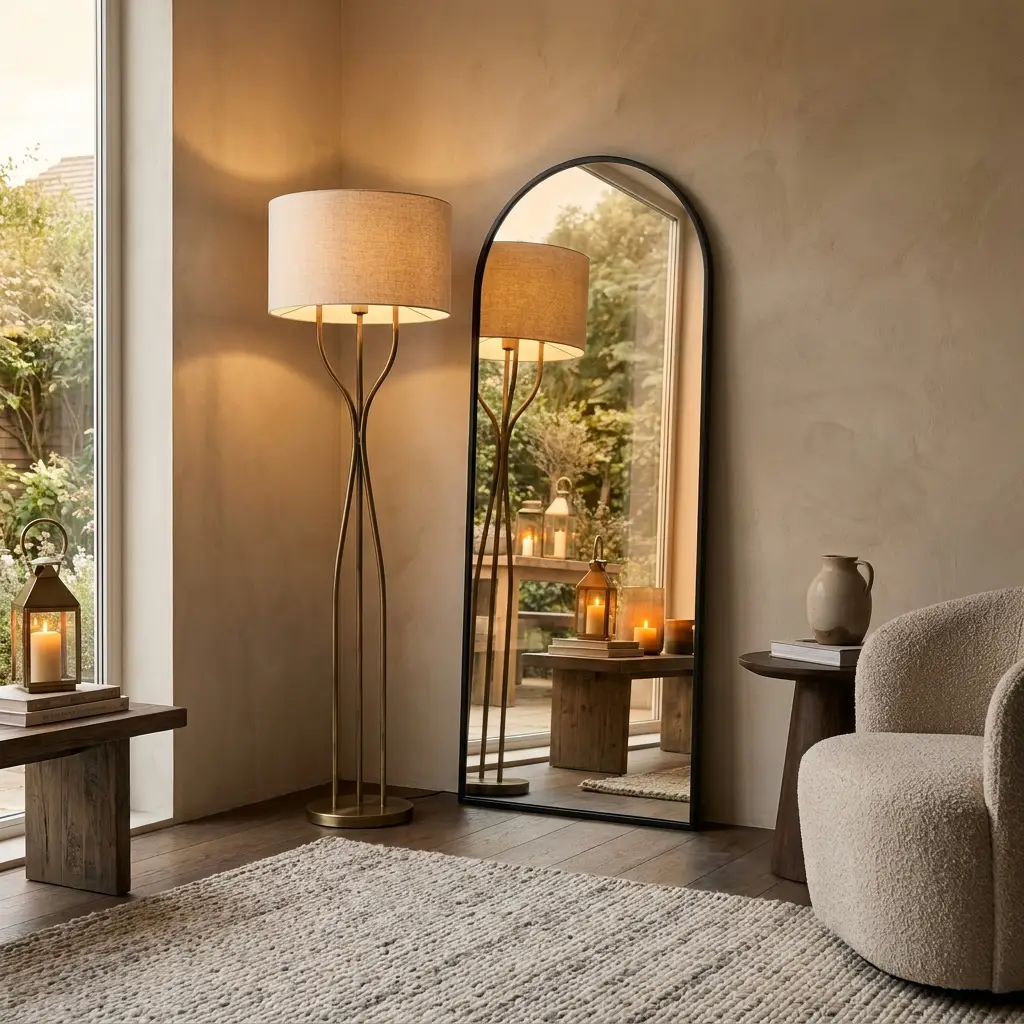
Arched mirrors with curved floor lamps
An arched mirror and a curved floor lamp make one of the easiest pairings for soft modern interiors in UK spaces. They’re also simple to place. The repeated curve feels elegant and relaxed, and suits living rooms and bedrooms especially well.
Round mirror with slim straight lamp
A round mirror softens the lamp’s line and creates nice balance. It works well in hallways, corners and smaller rooms, especially when contrast matters but the space should still feel uncluttered.
Rectangular mirrors with tripod or angled lamps
It adds more structure. In industrial or Scandinavian interiors, where clean lines stand out, this shape fits especially well.
Organic mirrors with linen-shaded lamps
It works best in warmer interiors, especially with natural wood, rope, rattan, or furniture with visible texture.
A helpful rule is to repeat one visual idea across both pieces. Keep it simple.
- curve
- slim shape
- matte finish
- warm metal tone
- natural texture
If both pieces compete for attention, the room can feel restless. If both are too plain, the space can feel flat. Aim for balance. Let one make the stronger statement and let the other be the quieter partner.
Use mirrors placement to bounce light, not glare
Placement can turn good styling into great styling. Done well, the layout can make a dark room feel brighter; done badly, it can create glare or reflect the least attractive part of the space. That difference matters. For the best mirror placement UK results, pay attention to what the mirror reflects after sunset instead of judging it only in daylight.
One strong option is to place the floor lamp so its light falls near the mirror, then let the mirror carry that light deeper into the room. It does not need to sit directly in front of the mirror. That can be too much. A slight side angle works better in many cases.
Think in simple before-and-after terms:
Before
- Beside the sofa, there is a dark corner
- The ceiling light feels too bright
- After 5 pm, the room feels smaller
After mirrors placement changes
- Put a floor lamp to one side of an arched mirror
- Warm light reflects across the wall and into the middle of the room
- The space feels softer and wider
This setup works especially well in compact UK homes. If layout and scale are already part of the plan, How to Furnish a Small UK Home Without Losing Space offers broader ideas that pair naturally with mirror-and-lamp styling.
In hallways, a tall mirror can work best opposite a lamp or near one at the end of the space. In living rooms, place the mirror behind or beside a floor lamp, then angle it so light spreads through the room instead of simply doubling back. A small move can change the result. In bedrooms, placing a lamp near a dressing mirror creates a calmer glow than overhead lighting alone.
Avoid direct bulb reflection at eye level. If a bright bulb bounces straight back when someone sits down, adjust the height, angle or shade.
Choose finishes that suit soft modern mirrors interiors
Material matters just as much as shape. A mirror frame and a floor lamp base can support your room style or make it feel slightly off. In soft modern interiors UK homes, the aim is warmth with restraint. That generally means clean forms with tactile finishes.
House Beautiful UK highlights organic materials and biophilic influences in current lighting trends, including natural textures and softer forms (House Beautiful UK). That fits homeowners drawn to oak, rope, linen, teak tones, brushed brass, black metal or muted stone finishes.
Try these finish pairings:
- Black metal lamp + thin black mirror frame for a cleaner modern look
- Brushed brass lamp + warm cream or oak-framed mirror for a softer feel
- Wood-toned mirror + linen shade for natural, calm rooms
- Textured ceramic lamp base + simple frameless mirror nearby for balance
Furniture style matters too. If a room already includes Scandinavian or industrial pieces, keep the mirror and lamp in that same visual language so everything feels connected rather than loosely put together. RENGARD pieces work well in these schemes because the overall look leans toward modern simplicity, natural texture and practical comfort. For broader inspiration on current interiors, Modern Showroom Trends UK Shaping Interiors is useful if you want to see how materials and silhouettes are being layered now.
Additionally, Modern Rugs to Elevate Your Home Decor can help when choosing softer textures that work naturally with mirrors, lamps and layered lighting.
Don’t match every finish exactly. Exact matching can make a room feel staged. Instead, repeat tones across the room in small ways so the space feels considered without becoming too polished or too obviously coordinated. A brass detail on a lamp can connect with a mirror frame, a side table handle or a picture frame. That kind of repetition creates rhythm, not force.
Room-by-room mirrors ideas for UK homes
Different rooms need different mirror and lamp setups. A pairing that works in a living room won’t always suit a hallway or bedroom. When planning mirrors and floor lamps UK layouts, let the room’s use guide the style.
Living room
A floor lamp softens the edge of a sofa area. Add a mirror nearby to spread light across the seating area, especially helpful in homes across Staffordshire and Shropshire when family rooms shift from daytime use to evening comfort. Choosing the Right Sofa for Modern UK Homes pairs well with these layout ideas if the seating arrangement also needs attention.
Hallway
Hallways can lack daylight and width. A tall mirror can make the space feel more open and reflect light, artwork or a clean line down the hall, not shoes or clutter. A slim floor lamp adds warmth and helps the hall feel welcoming.
Bedroom
A floor lamp by a dressing mirror or in an empty corner can make the room feel calmer than the main light on its own. Choose diffused shades and warm bulbs. In bedrooms, that pairing works best when kept soft. For additional storage and layout ideas, How to Choose Modern Wardrobes for Bedrooms with Limited Space offers useful guidance.
Dining-adjacent spaces
In open-plan rooms, a floor lamp and mirror can soften the shift between living and dining zones. For a fuller, more layered scheme, Lighting Trends for Modern Homes gives added context on how lamps work alongside other kinds of lighting.
Room-by-room choices help space enhancing decor UK styling feel practical rather than just decorative.
Common mistakes that weaken the effect with mirrors
Beautiful mirrors and floor lamps can still miss the mark when a few details are off. Often, it comes down to scale, glare, or too much visual competition. Small details can make a big difference.
Look for these issues:
The mirror is too small
A tiny mirror beside a tall lamp can feel accidental. If the lamp has real presence, the mirror needs enough visual weight to balance it.
The lamp is too bright
When a strong, cool bulb reflects off a mirror, the whole room can feel harsh. In UK homes, ambient lighting works differently. Warmth matters more than brightness.
Both pieces are statement items
In a small room, pairing an oversized gold mirror with a sculptural lamp can make the space feel crowded. It’s better to let one piece stand out.
The mirror reflects clutter
Mirrors double whatever sits right in front of them. If they reflect cables, laundry, bins, or a packed shelf, the whole room feels much busier.
There is no dimmer or light control
House & Garden points to the importance of planning circuits carefully, and interior designer Clare Gaskin notes, “For a lighting scheme that uses a lot of lamps a 5-amp circuit is important,” (House & Garden). If rewiring isn’t an option, a dimmable bulb or smart plug can still give you much more control.
The fix is usually simple. Rotate the mirror slightly. Lower the bulb output. Move the lamp 20 centimetres. In most cases, styling depends on careful adjustment rather than full replacement.
How to create a polished soft-modern look with mirrors on a real budget
You don’t need a designer budget to get this right. In many of the most effective mirror lamp styling UK schemes, one well-chosen lamp, one properly scaled mirror, and a few supporting textures do the work. Not much else.
A practical formula is:
- one floor lamp with warm light
- one mirror with enough height or width for the wall
- one soft texture nearby, such as a rug, curtain, or cushion
- one natural or dark accent to ground the look
Scott Richler also said, “The conversation has shifted away from purely functional fixtures toward pieces that feel crafted, artistic, and atmospheric.”
The conversation has shifted away from purely functional fixtures toward pieces that feel crafted, artistic, and atmospheric.
That doesn’t mean the look has to be expensive. Each choice should feel thoughtful. A simple black arc lamp can feel atmospheric when a warm bulb, the right shade, and the mirror’s reflection work together to shape the glow. A small detail can have a big effect. A basic wood-framed mirror can feel more refined when it reflects light instead of a blank wall.
For homeowners browsing RENGARD, the same idea fits modern furniture made with natural materials and calm silhouettes. The aim is to make a few pieces do more instead of filling every corner. Less clutter gives the room a softer, more polished finish.
Frequently Asked Questions
Where should a floor lamp go in relation to a mirror?
Usually beside the mirror or slightly opposite it works best. The goal is to let the mirror catch and spread the lamp light, not reflect a bare bulb straight into your eyes. A slight angle is often better than a direct face-to-face setup.
Are mirrors and floor lamps good for small UK living rooms?
Yes. This is one of the easiest ways to make a compact room feel brighter and more open without changing the layout. The mirror adds depth, and the floor lamp gives softer side light than a central ceiling fitting alone.
What bulb colour is best for mirror lamp styling UK homes?
Warm white is usually best, around 2700K to 3000K. It creates a calm glow and suits soft modern interiors UK schemes much better than cool blue-white bulbs. Warm bulbs also flatter wall colour, wood tones, and skin tone more naturally.
Can I mix black metal lamps with warm wood mirrors?
Yes, and it often looks better than trying to match everything exactly. Black metal adds structure, while wood adds warmth. This mix works well in modern home decor UK spaces that blend Scandinavian and industrial touches.
How do I choose mirrors and floor lamps that suit a RENGARD-style interior?
Look for clean silhouettes, natural textures, and finishes that feel calm rather than flashy. A slim floor lamp with a linen or simple metal shade can sit well with a mirror in oak, black, or soft neutral tones. If you are using furniture from RENGARD or a similar modern collection, keep the mirror and lamp understated enough to support the room rather than dominate it.
Should the mirror and floor lamp match exactly?
No. They should relate, not clone each other. Matching one detail such as shape, finish, or visual weight is usually enough. If you want a balanced look, a modern furniture and decor retailer like this UK home and garden furniture specialist can help you compare styles that share the same mood.
Final styling moves that make mirrors and the whole room feel better
The best mirror and lamp pairings feel easy. That sense of ease comes from a series of deliberate choices: selecting a warm bulb, placing the lamp where it gives off a soft glow, and setting the mirror to reflect light instead of visual clutter. Shapes can relate without matching exactly. Finishes may repeat in a quiet way, and one piece can lead while the other stays in a supporting role.
For UK homeowners, that matters. Many rooms need help with evening comfort as much as they need to look good in daylight, so mirrors and floor lamps UK styling works especially well in narrow halls, smaller reception rooms, and dim corners that never quite feel finished. It supports modern lighting UK goals while improving space enhancing decor UK results at the same time.
The key takeaways are clear:
- use mirrors to reflect lamp light rather than direct glare
- choose warm bulbs for softer ambient lighting UK schemes
- match shapes and finishes so the pairing feels planned
- scale both pieces to the room
- style for evening mood rather than daylight alone
When those ideas are put into practice, a room looks brighter and feels calmer, more open, and more complete. That’s the effect good light reflection interior UK styling should create, especially after the space begins to rely more heavily on lamp light in the evening.