Best armchairs for small living rooms UK Guide
In a small living room, every piece of furniture has to earn its place. An armchair has to do more than just look good. It needs to fit the space, be comfortable enough for everyday use, and still leave room to get between the sofa and the doorway, which is often where things start to feel awkward. So choosing the best armchairs for small living rooms UK shoppers are genuinely happy with isn’t just a case of going for the smallest one. It’s usually more about getting the proportions right for the room.
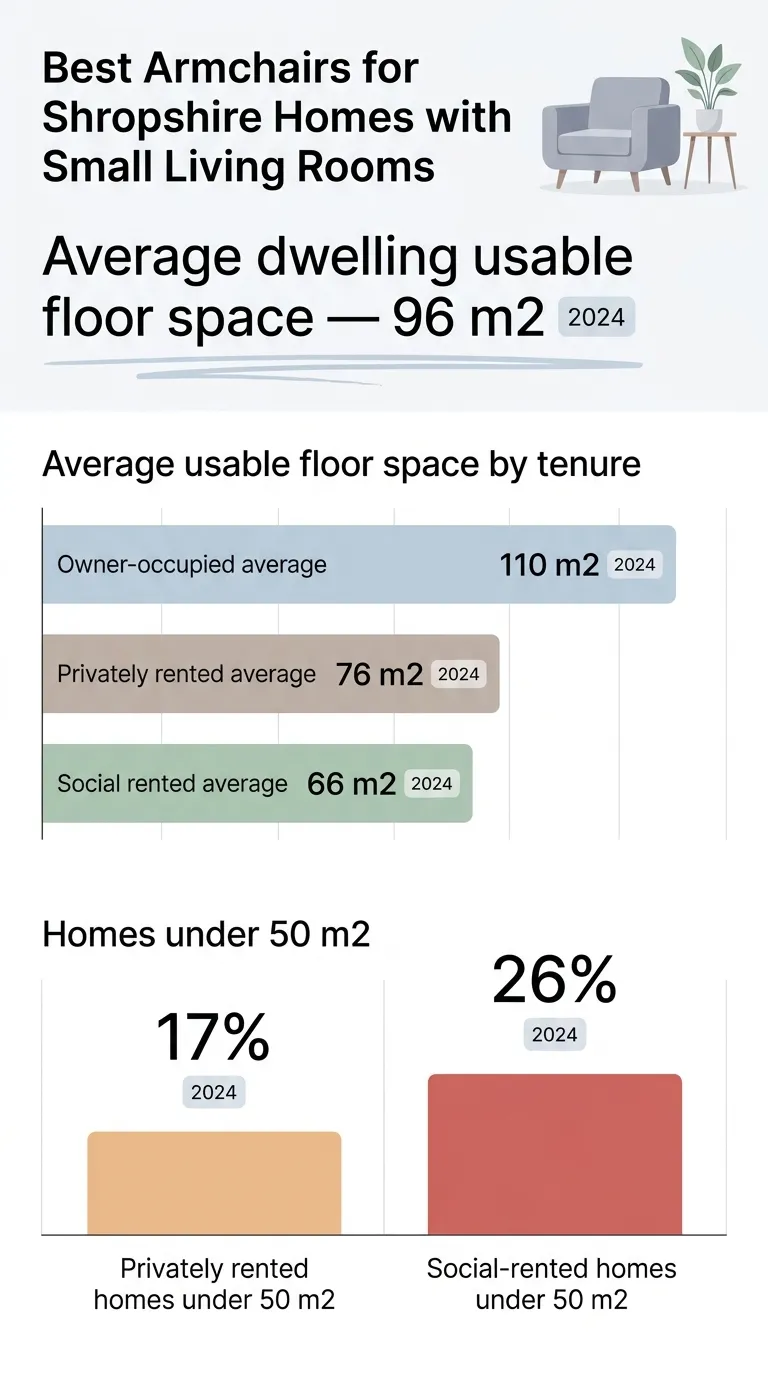
That matters even more in Shropshire and nearby areas such as Staffordshire, Cheshire, Manchester, North Wales, and Birmingham, where many homes have compact lounges, cottage layouts, bay windows, narrow terraces, or new-build living rooms that need careful planning. Those are practical constraints, not design ideas, and they’ll feel familiar to anyone who’s tried shifting furniture around in a tight room. In England, the average usable floor space of dwellings was 96 m2 in 2024. Privately rented homes averaged 76 m2, and social rented homes averaged 66 m2 (English Housing Survey).
That broader context helps explain why compact armchairs UK buyers keep searching for have become such an important part of practical living room design. In this guide, we’ll look at what really makes an armchair space-saving, which shapes often work best, how to pair a chair with your sofa, which measurements matter most, and ways to create small lounge seating ideas UK homeowners can use in real everyday layouts. The focus is mostly practical. It will also cover style choices for contemporary interiors and softer modern spaces, along with common mistakes to avoid and practical buying advice for premium compact armchairs UK shoppers can enjoy for years, which is arguably what makes the decision worth getting right.
Why compact armchairs matter in British homes and the best armchairs for small living rooms UK buyers choose
Small lounges aren’t unusual. For lots of households, they’re just everyday living. England had 25.6 million residential dwellings in 2024, and quite a few homes were very short on space, including 17% of privately rented homes and 26% of social-rented homes with less than 50 m2 of usable floor space (English Housing Survey).
| Housing metric | Figure | Period |
|---|---|---|
| Average dwelling usable floor space | 96 m2 | 2024 |
| Owner-occupied average | 110 m2 | 2024 |
| Privately rented average | 76 m2 | 2024 |
| Social rented average | 66 m2 | 2024 |
| Privately rented homes under 50 m2 | 17% | 2024 |
| Social-rented homes under 50 m2 | 26% | 2024 |
That isn’t only true in Shropshire. It points to a broader pattern across the UK: many people need armchairs for British homes that do more without taking up much room. You see it most in older cottages with alcoves, terraces with narrow front rooms that are trickier to furnish, compact family homes, and homes where one chair often has to do several jobs.
The right chair can create a reading corner by a lamp or window, balance a sofa across the room, or work as flexible guest seating without making the space feel crowded. If a full room refresh is on the plan, it often helps to think beyond seating too. Details like throws, lighting, and smaller decorative pieces can help a compact chair feel more at home in the room and more connected to the rest of the space, which often makes a small lounge easier to use. We covered that here: Luxury home accessories UK for Every Room and Neutral Home Accessories UK for Modern Homes.
What actually makes an armchair good for a small living room
The small living room armchairs Shropshire homeowners usually go for tend to have a few things in common. They’re compact but not flimsy, supportive without looking oversized, and they help the room feel open instead of cramped. In a small space, that’s usually the balance that counts most.
A good starting point is width. In a compact lounge, chairs with slimmer arms often work better than ones with thick padded sides. It sounds like a minor detail, but it often isn’t. You lose a little arm width, but you gain useful space beside a sofa, next to a side table, or along a wall. Depth matters just as much. Very deep lounge chairs can look appealing in a showroom, but in a smaller room they often become awkward because they pull the whole seating arrangement too far forward. That can make the chair seem bigger than the room can comfortably take.
Why raised legs help compact rooms
Raised legs are another real advantage. They leave more floor visible, which usually helps the room feel lighter. That is one reason space saving armchairs UK buyers often prefer modern styles with timber or metal legs instead of heavy skirted bases. House Beautiful UK also recommends visually lighter furniture for small living spaces, including pieces that let more of the floor remain visible (House Beautiful UK). That little gap under a chair often does more than people expect in a tighter layout.
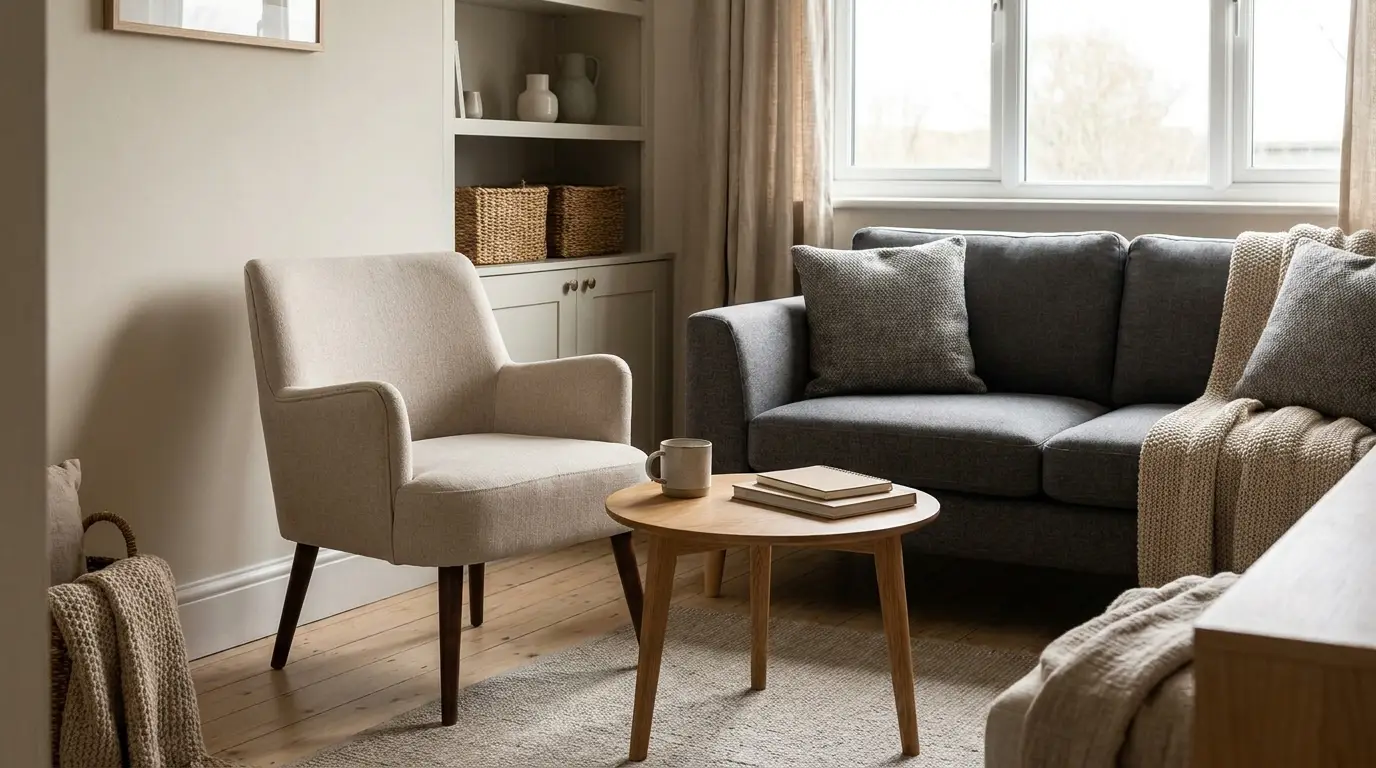
Shape matters too. Rounded backs can soften a compact room, while square arms give a cleaner, more structured look. Swivel chairs can also work well in smaller spaces, especially if the base is compact and the chair doesn’t need much clearance, which is usually what makes them practical. The main test is still simple: does the chair offer comfort without blocking walkways, windows, or sightlines? If it does, it’s probably a good candidate.
The smartest armchair styles for compact spaces
Not every armchair style fits every room. A few tend to work especially well in compact spaces. Others don’t, and that’s often pretty obvious. Some are simply better as occasional seating or statement accents.
Slim-arm accent chairs for the best armchairs for small living rooms UK shoppers compare
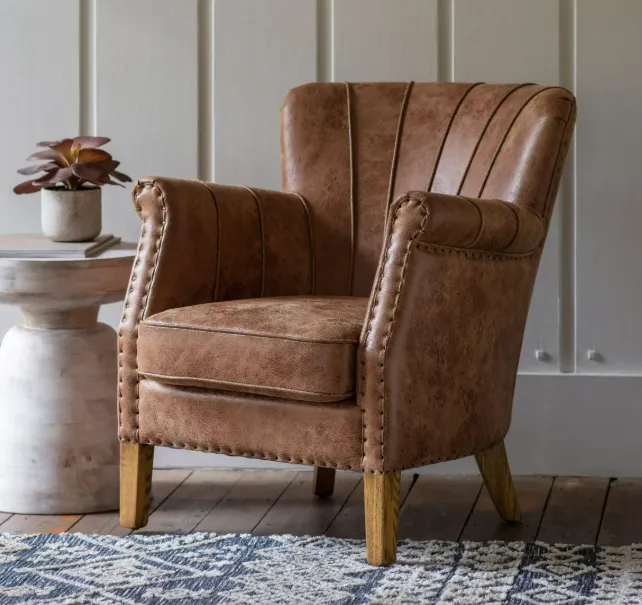
For small rooms, these are usually the safest pick. You still get a clearly defined seat area, but without the extra width of oversized arms, so they tend to fit better in tighter spaces. It keeps things simple. They work in a wide range of interiors too, from soft-modern spaces to classic contemporary ones. If you’re looking at accent armchairs for small rooms, this is usually the style to start with.
Exposed-leg lounge chairs
Chairs with visible legs tend to look lighter than ones that rest flat on the floor, even if that sounds like a small thing at first. In narrow Shropshire lounges, though, it often helps, because how heavy a chair looks can matter almost as much as its actual size.
Compact tub chairs
A tub chair can sit neatly in a corner or a bay window, and its rounded shape often helps soften harder lines. It’s an easy pick. In most cases, though, it’s best to avoid styles that are too deep or too low.
Petite wingback chairs
A smaller wingback gives the room some character without taking over, which can matter a lot in tighter spaces. It often works especially well in cottages or period homes that need shape and warmth. Still, keeping the dimensions in check helps the space not feel crowded.
Swivel chairs with a neat footprint for the best armchairs for small living rooms UK layouts
In open-plan rooms or more awkward layouts, compact swivel chairs can be a really practical fit because they rotate to suit the space. They can point toward the television or fireplace, then swing round to face a conversation area without moving the base.
Ideal Home has pointed out that, in small lounges, armchairs can sometimes make more sense than trying to squeeze in one oversized sofa (Ideal Home). That’s a useful point here. For UK buyers who tend to overlook them, occasional chairs can be a smart option, especially when flexibility matters more than simply having the widest sofa possible.
Why the smallest chair is not always the best choice
It’s an easy detail to overlook. In a small room, it’s natural to assume the smallest chair you can find is the right pick, and on the surface that does make sense. However, if the furniture is too small, the room usually ends up feeling awkward rather than polished.
We always advise our clients to avoid small, fiddly furniture in compact spaces.
That advice matters because proportion usually affects how the whole room looks. A chair should seem balanced next to the sofa and coffee table, and it also needs to sit comfortably within the wall space around it, not just fit by measurement alone. When a chair is too delicate, it can disappear beside the sofa or look lost against a long wall. Too slight. If it is too bulky, it starts to take over the room. The better choice is often something compact, but with enough visual weight to hold its place.
According to Sarah Hellmers and Liz Hellmers in the same Ideal Home feature, very tiny pieces can make a room feel worse rather than better, because visual coherence often matters more than choosing the absolute smallest item (Ideal Home).
Balancing comfort and scale
A better approach is to focus on controlled dimensions and real seat comfort. Narrow arms, a medium seat depth, and a back height that supports proper sitting all tend to matter more than a chair that only works for occasional perching. That is often why premium compact armchairs UK buyers choose can feel worth the cost: they save space while still feeling like proper furniture in most cases.
For anyone who wants the chair to stand out a little more, there is a fine line between a compact armchair and a statement piece. Usually, what works best is a bolder shape with a disciplined footprint. Not oversized. That is often what makes it feel intentional instead of crowded. The Best Statement Furniture Ideas for Contemporary Homes offers helpful context.
How to measure the best armchairs for small living rooms UK homes need
Getting the size right usually saves you from costly mistakes. Before you get caught up in fabrics or colours, measure the room and the path the chair will need to travel to get inside. It’s not the exciting part, but it often ends up being the thing that matters.
Begin with the spot where the chair will go. Write down the maximum width, depth, and height the space can take, then leave enough room around it for people to move through the area comfortably. A compact armchair should make movement easier, not block a walkway or make the seating area feel cramped. It seems obvious, but it’s easy to overlook.
Then measure your sofa too, because that often matters more than people realise. The chair needs to work in the room for both size and position, but it also needs to match the sofa in scale and seat height. That part often gets overlooked.
The 4-inch seating rule is all about keeping balance in a room by making sure that your seating heights have no more than a 4-inch difference.
This is especially helpful when you’re pairing a new armchair with a sofa that’s already in the room. If the armchair sits noticeably lower or higher, the arrangement can feel off-balance. According to Kelly Collins in Ideal Home, keeping seat heights within that range helps a room feel more visually balanced and carefully planned (Ideal Home).
How will it get into the room? Measure doorways, stair turns, and hallways as well. A lot of stylish armchairs fail for one practical reason: they’re difficult to get indoors. It’s a common problem, and a few quick checks can usually prevent it.
Planning layouts before ordering
Additionally, using a digital room planner can help you test spacing before you commit to a chair size or shape. Guides such as How to Use a Room Planner Before You Buy Furniture can make those measurements easier to visualise in compact lounges.
So a simple checklist helps:
Key armchair measurements to compare
- Overall width
- Overall depth
- Overall height
- Seat height
- Seat depth
- Arm height
- Leg clearance
- Diagonal access measurement for delivery
This same method can also help when you’re furnishing other small spots at home. It sounds basic, but it still matters when you’re actually doing it. That’s why guides such as Guide to Choosing the Best Wooden Bed Frames and Choosing the Best Single Beds for Small Rooms are useful reminders that measurements usually matter every bit as much as style, and sometimes more.
Layout ideas that make one armchair work harder
In a small lounge, the spot you choose for the chair matters nearly as much as the chair itself. The idea is to fit in another seat without leaving awkward dead corners or getting in the way of the room’s natural path, and that can happen more easily than you’d expect. People should still be able to walk from the doorway to the sofa, shelves, or fireplace without squeezing past it.
Often, placing it on a slight diagonal works best. Angling the chair a little toward the sofa, rather than setting it flat against the wall, can make the room feel softer and more naturally set up for conversation. In a bay window, a compact chair usually works better set to one side rather than right in the centre, so the shape of the window still shows instead of being hidden. It may seem like a small change, but it can make a noticeable difference here.
Making narrow rooms feel more open
Choosing one armchair instead of bringing in a second sofa is often the more practical move. This often makes the room feel less crowded and opens up more space. In Shropshire cottages or terraces, it can also make it easier to move around shelving, fireplaces, and doors that open out to the garden. In many cases, that means the room is easier to use day to day, not just nicer to look at.
In long, narrow rooms, putting the chair near the shorter end often keeps the space from feeling even more stretched. In square rooms, one accent chair can help break up a boxy layout. It’s a simple change, but usually an effective one, especially if the goal is to shift the feel of the room without moving everything else around.
According to Ideal Home, lighter-profile seating with slimmer shapes tends to suit compact lounges better than bulky pieces that dominate the space (Ideal Home). That’s especially helpful when planning small lounge seating ideas UK homeowners can live with comfortably every day.
For a softer finish, pair the chair with a compact side table or even a floor lamp rather than a large nesting table set. You’ll usually find the area works best when kept simple, since it rarely needs much around it. That way, the chair looks deliberate rather than as if it was squeezed in.
Choosing fabrics, colours, and finishes for a lighter look
The chair’s shape comes first, but the finish isn’t far behind. A dark colour or chunky fabric can make even quite a small chair seem bigger than it really is. By contrast, a simpler finish can make the same size chair feel much lighter in the room, and that usually matters more than people expect.
Linen-look weaves, smooth flat fabrics, soft boucles, and other understated textures often work well in contemporary British interiors, though visual weight still matters. In compact rooms, pale neutrals, warm greys, taupes, muted greens, and earthy clay tones usually fade into the background. They’re usually easy on the eye and often don’t fight with the rest of the room. They also suit soft-modern homes quite well, and that’s a look many UK buyers already prefer.
In a 2025 UK survey of 2,000 adults, 61% said they decorate around a specific interior style, while 80% said value for money mattered most to them (Furniture And Choice). That points to something fairly simple: people want style, often within a look they’ve already picked, but they still care about cost and practicality.
When looking at compact armchairs UK options, it helps to pick a fabric and tone that would still work if the chair later ends up in a bedroom, hallway, or another living room. Finishes that feel timeless usually hold up better than very trend-led colours, especially if you want that flexibility.
If the room already has lots of visual detail, a plain fabric with slim black or wood legs can help keep it calm. If that starts to feel a bit plain, a subtle texture can add interest without making the space look cluttered. Sometimes, it only takes a small change to alter the overall feel.
Mixing textures without adding bulk
Similarly, soft accessories can help a compact chair feel warmer without making the room seem overfilled. Textiles such as Best Cotton Throws for Cozy Living Spaces often work well because they add texture without taking up additional floor space.
When a premium compact armchair is worth the spend
Furniture spending has been picking up again, but people are still careful about what they buy. UK household spending on furniture and furnishings reached £20.15 billion in 2025, up 3.2% year on year according to FIRA, while retail furniture and lighting sales growth went from -11.0% in 2024 to +2.3% in 2025 according to the ONS (FIRA, ONS).
That points to a fairly practical approach: people are buying fewer pieces and taking more care over the ones they do choose. A premium compact chair is usually worth paying for if the frame feels sturdy, the cushioning holds its shape, the fabric can handle daily use, and the design works in more than one room layout, which matters more often than people realise.
| Market indicator | Figure | Period |
|---|---|---|
| Household spending on furniture and furnishings | £20.15bn | 2025 |
| Year-on-year change in household furniture spending | +3.2% | 2025 vs 2024 |
| Retail furniture and lighting sales growth | -11.0% | 2024 |
| Retail furniture and lighting sales growth | +2.3% | 2025 |
The same figures suggest plenty of households are still picking carefully. So premium doesn’t need to mean extravagant. Here, it should mean better build quality, lasting comfort, and a design that still earns its place in a compact room, whether that’s a living room corner, a bedroom reading spot, or a small home office. That’s usually the most practical way to judge it.
If you’re comparing styles and support levels, a curated retailer like RENGARD can make things easier by narrowing the choice to pieces with strong design and everyday practicality, without veering into oversized furniture that often suits showrooms better than real homes. Some buyers also compare proportions in guides such as High Back Armchairs UK vs Low Profile Designs before deciding which silhouette suits a smaller lounge best.
Common mistakes when buying the best armchairs for small living rooms UK shoppers compare
Some mistakes stand out straight away. Others don’t usually show up until the chair has actually been delivered, which is often the most frustrating part.
One common mistake is picking a chair for looks alone. A chair can look great and still be too deep, too low, or too wide for daily use, and that can get annoying very quickly. Another detail people often overlook is the leg or base design. In a small room, visual weight can matter more than people expect. Even when the footprint is technically compact, a chunky base can still make the chair feel bulky and take up the room visually, even if the measurements looked fine on paper.
It’s also easy to look at the chair by itself and forget about the rest of the room. An armchair has to sit alongside a sofa, coffee table, lamp, rug, and often a TV unit. Once all those pieces are competing for space, the chair can start to seem like the problem, even when it isn’t. That’s the kind of detail people often miss when shopping for one piece at a time.
Another mistake is choosing a chair that’s too close a match to the sofa. In compact interiors, a bit of contrast often works better. The chair should work with the sofa without looking like a copy in shape, fabric, and visual weight.
Maintenance is another thing people often underestimate. A pale textured chair in a family room may still work beautifully, but only if the fabric suits the household. In most cases, premium furniture should fit real life, not just an ideal mood board.
Frequently Asked Questions
What size armchair is best for a small living room?
There isn’t one size that’s always right. If the room is compact, go for a chair with controlled width, moderate depth, and slimmer arms. Pay attention to how the chair works with your layout and walkways, rather than just picking the smallest model you can find.
Are armchairs better than a second sofa in a small lounge?
Often, yes. A suitably sized armchair gives you another place to sit without making the room feel cramped. That tends to suit narrow terraces, bay-window lounges, and compact Shropshire cottages especially well, where it’s important to keep room to move.
Should armchairs in small rooms have legs?
Usually, yes. With raised legs, you can see more of the floor, so the room tends to feel lighter and less cramped. That’s part of it. Chairs with exposed legs also come up a lot in space-saving armchairs UK searches.
How do I match an armchair to my existing sofa?
First, look at seat height, scale, and the overall shape. It’s safest if the seat heights are close. Try to keep the tones or textures similar too. Don’t pick a chair that’s much chunkier than the sofa or much more delicate.
Where can I compare premium compact armchairs for British homes?
With a retailer like RENGARD, you can look at modern shapes, practical finishes, and proportions that suit the room all in one place. That makes it simpler to judge whether a chair will work in contemporary interiors or compact UK layouts before you commit.
What else should I style around a compact armchair?
Keep it simple, but make sure the area still works. A small side table and a floor lamp will do, with one soft accessory if needed. That’s all. If you want the chair corner to look a bit more polished, RENGARD and similar style-led retailers can help you coordinate the lighting and accessories without crowding the room.
The best way to choose with confidence and find the best armchairs for small living rooms UK homeowners prefer
The best armchairs for small living rooms UK buyers should look at aren’t only narrow. They need to sit well in the room, too. In most cases, they should save space through smart design instead of feeling like a compromise. That usually comes down to slim shapes, raised legs, sensible depth, supportive comfort, and a form that works with the rest of the space rather than fighting it.
In Shropshire homes, that often means chairs that work well in awkward corners, with cottage proportions, in bay windows, and in modern compact layouts. A good place to begin is with measurements. Compare the seat height with the sofa, then think about exactly where the chair will go. You’ll usually find that visual lightness matters here, along with a finish that suits everyday life, especially if the chair will be used often. In a small room, one well-chosen chair can often do more than squeezing in extra seating.
With those points in mind, compact armchairs UK options are much easier to assess. The right piece should fit the room naturally, whether beside a sofa, in a bay window, or in an unused corner. It can make the space work better, feel calmer, and look more put together. The real aim with armchairs for British homes is usually a small space that feels comfortable, easy to move through, and stylish.