
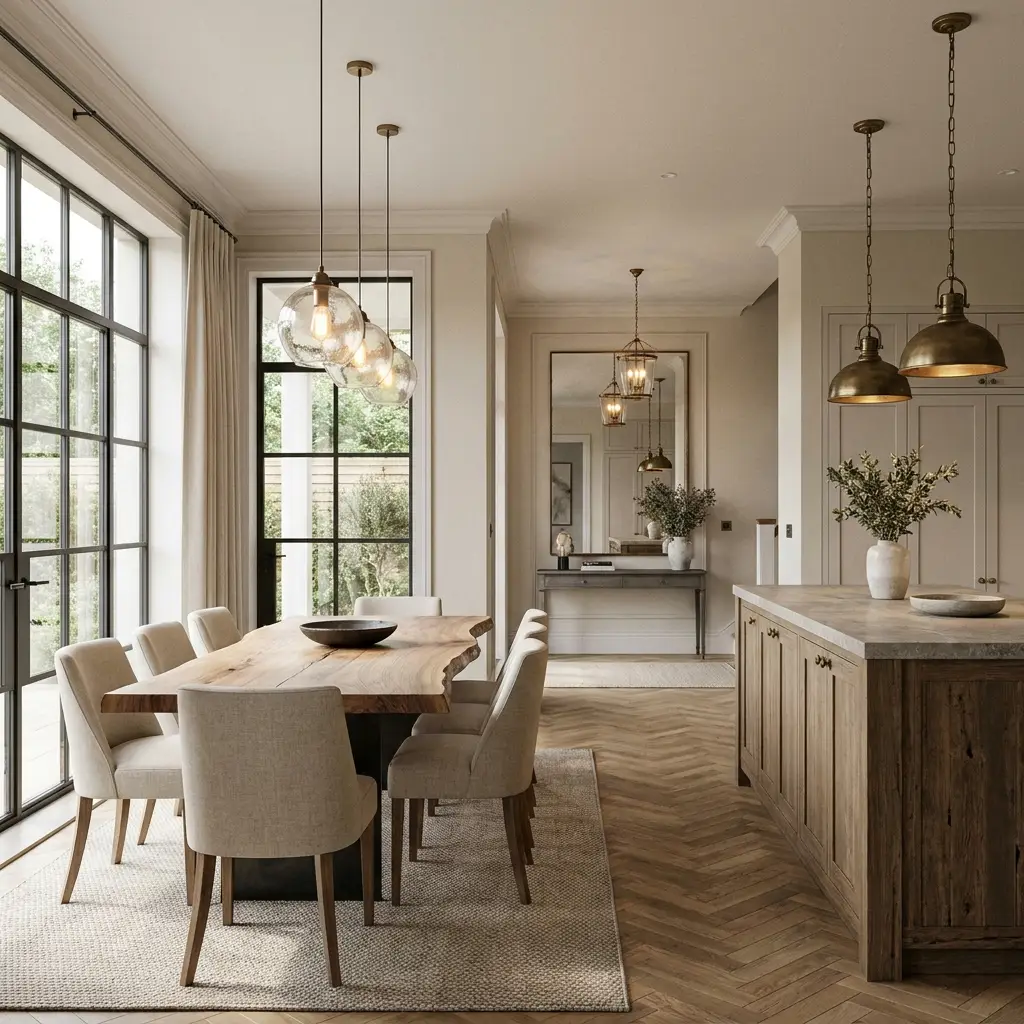
Pendant Lights for Dining Rooms, Kitchens and Hallways: A Room-by-Room Buying Guide
Pendant lights do a lot in a home. They can brighten a dark table, set the mood in a kitchen, and turn a plain hallway into a strong first impression. But choosing the right one takes more than finding a shade that looks good. Size matters, along with drop height, spacing, bulb warmth, and finish. A pendant that seems perfect in a showroom can end up hanging too low over a table, looking too small above an island, or feeling too bold in a narrow hall.
Choosing by room makes the decision easier. Many homeowners shop for lamps & lighting based on style alone, then realise the fixture does not really suit the space. In everyday homes, pendant lights need to balance looks and function. They should work with your furniture, suit your ceiling height, and support how the room is used each day. That is especially true when better finishes and luxury home accessories are already part of the scheme, and the lighting needs to feel properly thought through.
Clear rules make the process simpler. This guide explains how to choose pendant lights for dining rooms, kitchens, and hallways. It covers sizing, spacing, hanging height, colour temperature, common mistakes, and current design trends. It also shows how pendant lighting fits into a wider home scheme, from dining furniture to hallway styling. Anyone building a coordinated look can also use articles like Introducing RENGARD Home: Modern Indoor Furniture for Contemporary British Living to connect lighting choices with the rest of the interior. For further inspiration on combining lighting and decor, see Stylish Home Furniture Showroom in Shropshire, which explores coordinated home styling ideas.
Why pendant lights remain a smart home upgrade
Pendant lights are not a passing trend. They’re part of a growing lighting market, driven by homeowners who want style and efficiency in the same purchase, not one or the other. Intel Market Research values the global pendant lamps market at USD 3.45 billion in 2025, with forecasts rising to USD 5.92 billion by 2034 (Intel Market Research). The decorative lighting market is also expected to grow from $41.86 billion in 2025 to $43.55 billion in 2026 (Research and Markets). These figures show that people now see lighting as both a practical need and a design choice.
Residential demand stays strong too. Mordor Intelligence reports that residential lighting holds 31.10% of the global lighting market in 2025 (Mordor Intelligence). For homeowners, that means more choice in finishes, shapes and smart features than they had before.
The appeal is clear. Pendant lights open up visual space, draw the eye upward and suit rooms where focused light works better than a floor lamp or table lamp. They also pair naturally with dining tables, kitchen islands, console tables and entrance furniture, which helps explain why they keep showing up in everyday home layouts.
The overarching advice is to install dimmers and switches intentionally as they play an important role in an effective lighting scheme.
Pendant light advice matters in every room. With a dimmer, pendant lights can shift from bright and practical to soft and welcoming in seconds. That flexibility makes them one of the most useful options in modern lamps & lighting.
Start with function before style
Decide what the pendant needs to do before comparing finishes. That one choice helps avoid most buying mistakes. Start with three simple questions: is the light for task use, mood or both? How tall is the ceiling? And what sits below it: a table, an island or an open walkway?
In kitchens, designers are clear on one point: decorative lighting shouldn’t replace work lighting because the sink, prep zones and counters need proper illumination first. Pendants come after that. They add a second layer for atmosphere and visual order.
Make sure to address the lighting in each activity area. Usually this includes the sink and prep areas and possibly the dining area. Those areas need to be illuminated through recessed and/or under-cabinet lights. After you’ve addressed the functional lighting needs, a second layer of decorative lighting such as pendants can be considered, but decorative lights are not always necessary. Always consider your tasks first and then address the aesthetics. In kitchens, decorative lighting should not be an answer to a task lighting need.
The same layered approach also works well in other parts of the home. In dining rooms, pendant lights shape the mood and create focus over the table. In hallways, they can play a more decorative role, so ceiling clearance matters most. Hunter Fan says pendant lights work best in kitchens, dining rooms, living rooms and hallways. Not everywhere, though. They’re less suitable in spaces with low ceilings or heavy foot traffic (Hunter Fan).
A simple buying framework helps:
- Purpose: task, ambient or decorative
- Placement: over furniture or in open circulation space
- Scale: fixture size versus room and furniture size
- Maintenance: easy to clean or more delicate
- Control: dimmer-compatible or fixed output
Get these five points right first, and the style choices get much easier.
Choosing pendant lights for dining rooms
Pendant lights work especially well in dining rooms. They create a visual centre, frame the table and make meals feel warmer, softer and more relaxed. In most homes, a good starting point is to hang the pendant 30 to 36 inches above the dining table, a guideline supported by Hunter Fan (Hunter Fan). Lightology also recommends leaving about 6 inches of breathing room on each side, so the fixture doesn’t feel cramped against the table edges (Lightology).
Warm light suits a dining room best. A colour temperature of 2,700K to 3,000K gives the space a welcoming look, while dining surfaces need around 200 to 500 lux for comfortable everyday use (eGelea Light).
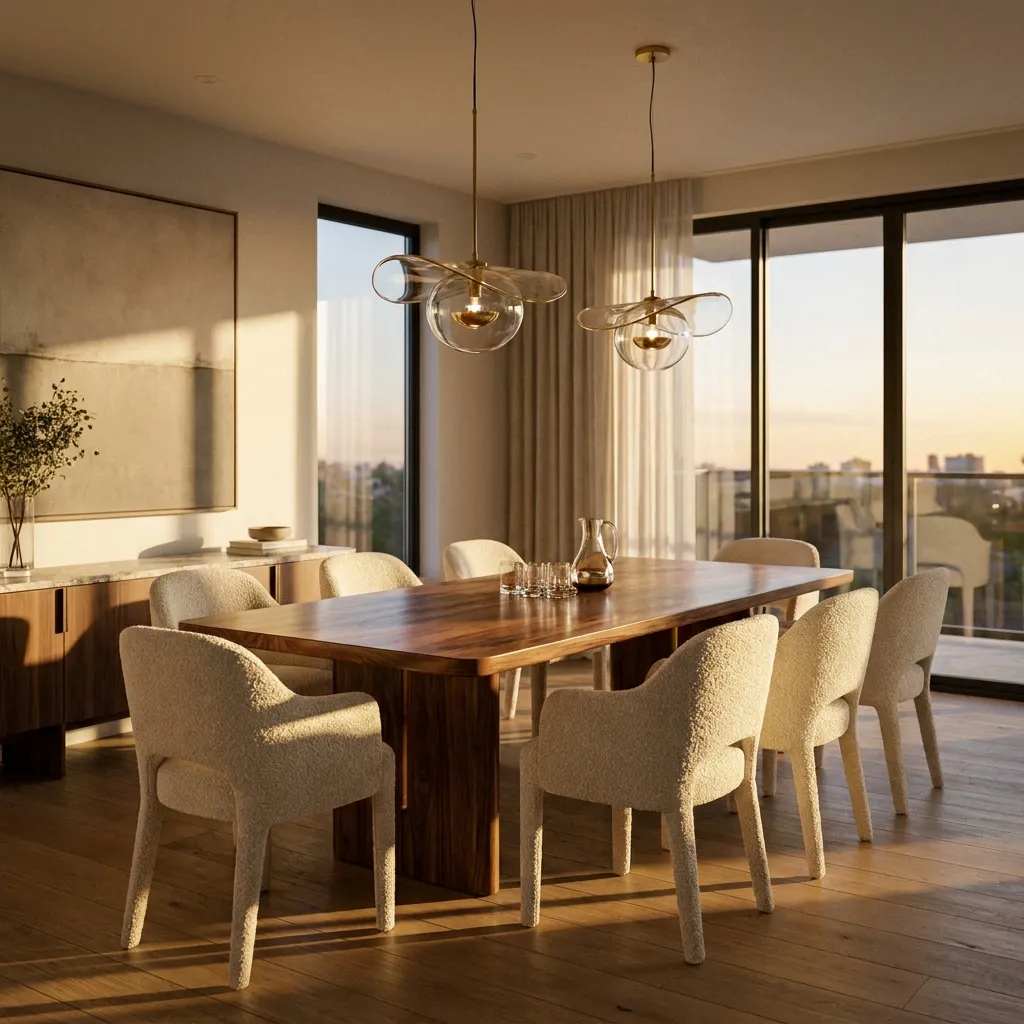
The table shape, along with the overall mood of the room, should guide the style choice. For a round table, one central globe, dome or lantern pendant can work well. For a long rectangular table, a linear pendant or two smaller pendants makes more sense. Some dining rooms already feature statement furniture, rugs, mirrors and other luxury home accessories. In that kind of space, the lighting should support the look rather than compete with it.
A few simple rules help:
- Use one pendant for a small round or square table.
- Use two pendants or one linear fixture for longer tables.
- Choose a wide shade for a stronger visual presence.
- Add a dimmer so the room can handle dinner, homework or hosting.
Coordinated finishes matter even more when the dining room opens into a lounge or kitchen. A black metal pendant can connect with chair frames or console legs. Warm brass can echo mirrors and decorative accents. For broader room styling ideas, Sofas and Armchairs UK: How to Furnish Your Home with Style offers useful ideas on creating a balanced interior look across connected spaces. Additionally, Bathroom Remodel UK: How to Update Your Kitchen and Modern Decor explores how lighting and fixtures can blend naturally with updated kitchen designs.
How to buy pendant lights for kitchens without getting it wrong
Kitchen pendant lights need more discipline than dining room pendants. They can look beautiful, but they also have to handle real work, steam, grease and constant movement around the room. Over an island, they should support the space without blocking sight lines or causing glare. For height, practical guidance from LightsOnline suggests hanging pendants 28 to 34 inches above the surface, while Hunter Fan gives a slightly wider range of 30 to 36 inches (LightsOnline, Hunter Fan).
Spacing matters just as much. According to Hunter Fan, 24 to 30 inches between pendants works well, while Rejuvenation gives a very similar range of 26 to 30 inches (Rejuvenation). In most medium kitchens, two pendants are enough. Three can work over a very long island, but they can also make the space feel more crowded than it needs to.
We like to use fixtures that are easy to clean in a kitchen because of the nature of cooking and messy cooks! We prefer two large pendants over an island to three smaller ones, or even one single large fixture over an island to keep the space visually clean.
That advice holds up in everyday use. In the kitchen, clear glass can look light and airy, but it shows fingerprints and grease quickly. Ribbed glass hides marks better, and painted metal shades are easier to wipe clean with regular use. Open-bottom pendants usually give better task light than deep opaque shades, which can leave the work surface looking dim.
Style should still connect with the rest of the room. If the kitchen includes wood stools, marble worktops or modern bar seating, the pendant should relate to those materials in a way that feels consistent. Warm metals are popular. Sculptural forms and oversized shapes are also popular (Mahlander’s). Before choosing on looks alone, check the design against the kitchen’s function, or the fixture can end up working against the space instead of helping it.
Hallway and entry pendant lights: stylish, but only when the space allows
Hallways can get overlooked when people plan lamps and lighting, even though these spaces shape how a home feels. The right pendant can make an entrance feel taller, warmer and more carefully put together. One rule matters most here: safety. In walk-through areas, Hunter Fan recommends keeping at least 7 feet of clearance from the floor (Hunter Fan). If the ceiling is low, a flush or semi-flush light is generally the safer option.
In a tall entry, pendant lights can work almost like sculpture. Oversized globes, lanterns and shades in natural materials can suit that kind of space well. In a narrow hall, something slimmer makes more sense. Cylinders, small domes or open metal frames can add style without taking over.
Hallway lighting also needs to relate to the pieces around it. If the area includes a mirror, console table, wall art or a decorative bowl, the pendant becomes part of that full first impression. It should feel in scale with those items, not separate from them. Coordinated hallway furniture can help, especially in homes aiming for a polished, simple look. To explore more hallway styling ideas, see Indoor Outdoor Living UK: How to Style Your Home with Furniture.
A before-and-after example shows the difference clearly. A plain hallway with a bright, cool bulb and a standard flush fixture can feel flat and harsh. Swap that for a small warm-metal pendant, a warm white bulb and a dimmer, and the same hallway feels softer and more welcoming. Add a mirror below, and the light carries further while the space feels larger too.
Homeowners refining the full entrance area can also look at Staffordshire Home Furniture: Modern, Stylish, British for ideas on matching furniture and accessories to a clean, modern British home style.
Picking the right size, shape, and finish
Many pendant light issues come down to proportion. A fixture can look beautiful on its own and still feel off once it’s in the room. The goal is simple: match the shape to the space and the furniture underneath.
For dining rooms, globe pendants can soften the harder lines of angular tables and chairs. Domes direct light downward in a more focused way. Linear pendants work well over long tables and can suit more modern spaces. In kitchens, two medium-to-large pendants can feel calmer than a row of smaller ones. In hallways, vertical shapes draw the eye upward. It’s a subtle effect.
Finish matters too. Some straightforward pairings work especially well:
- Brass or warm gold: ideal for warm wood, stone and classic modern interiors
- Black metal: creates strong contrast in light kitchens and minimalist rooms
- Glass: airy and elegant, best where easy cleaning is possible
- Natural fibre or paper-look shades: add soft texture and relaxed warmth
- Mixed materials: help tie together metal, wood and upholstery
Architectural Digest points to soft-glow paper, glass and pendants made from natural materials as popular choices, largely because they bring warmth without adding visual heaviness (Architectural Digest). Hunter Fan also highlights sculptural forms. Elongated cones, rounded globes and ribbed glass cylinders stand out as current trends with a strong presence (Hunter Fan).
One rule stays consistent: choose a shape that supports the lines already in the room. If the furniture is bold, keep the pendant cleaner. In a simpler space, it can show more personality.
Bulbs, brightness, and dimmers make the biggest difference
A well-chosen shade can still disappoint if the bulb is wrong. By the time people are buying pendant lights, bulb choice may not feel exciting, but it shapes the result every day. In dining rooms and many kitchens, warm white light in the 2,700K to 3,000K range works best in most cases. It is kinder to food, wood and skin tones than cooler light.
Brightness needs to fit the space. Above a dining table, softer layered light can feel better than one harsh source. Over a kitchen island, homeowners need stronger practical light, but not so much that it throws glare across polished worktops. In hallways, an even spread matters more than high intensity. Bright patches can feel awkward.
Running costs matter more now, and bulb life does too. Modern LED pendant lights are expected to grow at a 10.6% CAGR from 2026 to 2033, which shows how strongly buyers value lower energy use and longer bulb life (LinkedIn Pulse). For most homeowners, integrated LED fittings or LED-compatible designs make sense, as long as the light stays warm and the fitting works with dimming.
Look for these practical features:
- LED compatibility or integrated high-quality LED
- A dimmable driver or a dimmer-friendly bulb
- Easy bulb access if the fitting is not integrated
- A shade design that reduces glare at eye level
- A finish and material that suit the room’s maintenance needs
If one point stands out, make it the dimmer. It is not an extra. It should be part of the lighting plan from the start.
Common mistakes homeowners make with pendant lighting
Most pendant lighting mistakes are easy to avoid when homeowners know what to look for. One common problem is hanging a fixture too high or too low. If it sits too high, it can feel disconnected from the room. If it hangs too low, it blocks sightlines and makes the space feel awkward. Another common mistake is choosing a pendant that is too small for a large table or island, which can make even an expensive room look unfinished.
Many homeowners focus on the pendant by itself instead of thinking about the wider lighting plan. In kitchens especially, layered lighting matters. A pendant does not replace under-cabinet lighting or task lighting. Some people also forget about upkeep. Attractive finishes lose their appeal quickly when they are hard to clean in a busy kitchen, and daily use makes that clear fast.
Mixing too many finishes in one open-plan space is another common issue. A room can start to feel unsettled when it already has brass handles, black stool legs, chrome taps and timber furniture, and then a fifth finish appears in the pendant. It is too much. In most homes, repeating one or two finishes with purpose creates a more settled result.
Some buyers also follow trends too closely. Oversized pendants and sculptural shapes can look striking, but the room needs to support them. Trend-led lighting works best when the practical rules are already in place.
Frequently Asked Questions
How low should pendant lights hang over a dining table?
A good rule is 30 to 36 inches above the table surface. That usually gives enough visual presence without blocking sight lines. If the ceiling is very high, you can adjust slightly, but keep the fixture connected to the table below.
How many pendant lights should I use over a kitchen island?
In many kitchens, two pendants are enough. They often look cleaner than three smaller fixtures and provide balanced light when spaced properly. The right number depends on island length, pendant width, and ceiling height.
Are pendant lights suitable for hallways?
Yes, but only when the ceiling height allows safe clearance. In walk-through areas, you should keep at least 7 feet from the floor to the bottom of the fixture. If that is not possible, choose a flush or semi-flush light instead.
What bulb colour is best for pendant lights in dining rooms and kitchens?
Warm white light, usually 2,700K to 3,000K, works well in both spaces. It makes dining areas feel more welcoming and helps kitchens avoid a cold, overly clinical look. If possible, pair it with a dimmer for more control through the day.
How do I match pendant lights with furniture and home accessories?
Start by repeating shapes, materials, or finishes already in the room. A pendant should connect with nearby tables, chairs, mirrors, or luxury home accessories rather than feel like a separate statement. Browsing coordinated interiors from brands such as RENGARD can help you see how lighting fits with furniture, rugs, and decorative accents in a more complete room scheme.
Where can I find pendant lights that suit a modern British home style?
Look for collections that balance clean lines, useful sizing, and finishes that work with contemporary furniture. If you are also updating dining, living, or hallway pieces, RENGARD is a useful example of a retailer focused on modern furniture and home accessories, which can make it easier to build a more cohesive interior rather than buying each element in isolation.
Final tips for choosing with confidence
The best pendant lights do more than decorate a room. They meet a need, support daily routines and help a space feel complete. In dining rooms, that means warmth, balance and the right drop over the table. In kitchens, task lighting comes first, with pendants acting as a second layer. In hallways, check clearance before thinking too much about style. Simple but important.
The wider market helps explain the growing interest in pendant lights. Homeowners are spending more on decorative lighting, efficient LED options and rooms that feel planned instead of thrown together in a rush. Because of that, pendant lights have become one of the smartest upgrades in lamps & lighting today. A practical one too.
As you shop, keep this checklist in mind:
- measure the room and the surface below the light
- decide if the fixture is for task use, mood or both
- choose warm dimmable light where comfort matters
- match the finish to nearby furniture and accessories
- think about cleaning and long-term use
A clear checklist removes the guesswork. It helps homeowners choose fixtures that fit the home, the layout and the overall style. Good lighting then becomes more than a simple purchase. It becomes one of the most effective luxury home accessories in the house.
One Comment